
Henry J 513 327 cubic inch V8 1951
Allmän beskrivning :
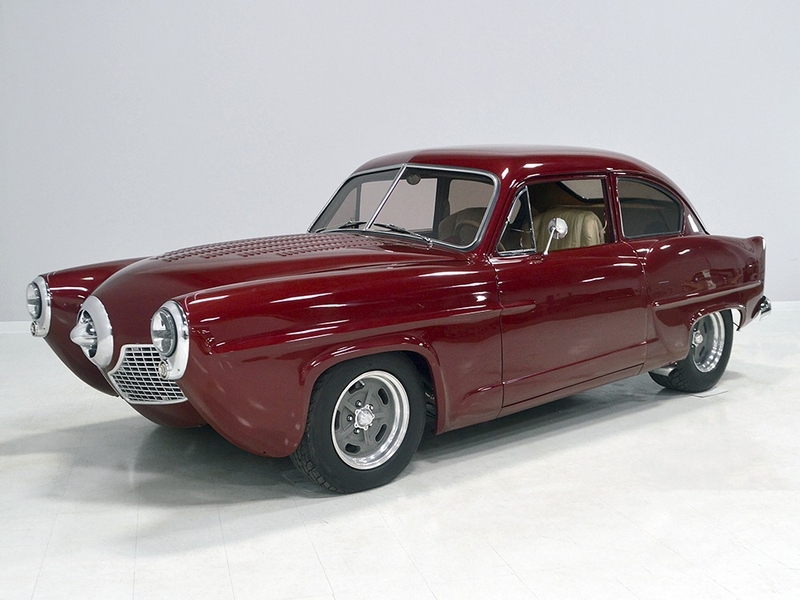
You would be forgiven if you did a double-take on this nasty little beast of a car—is it a Studebaker or a Henry J? It is indeed a 1951 Henry J, albeit with a 1950 Studebaker Starlite nose expertly grafted on. Of course, that’s just one of the many, many modifications that make this car one of the most spectacular rods we’ve seen in a very long time. The craftsmanship, the detailing, and the pure functionality of its Corvette powertrain are extremely impressive. It’s a little out-of-the-ordinary, yes, but we can guarantee you’ll never see anything like it and once you get a chance to examine it up close, you, too, will be blown away by the vast amounts of work that went into this build. It is exceptional in every way.
On a car as modified as this one, it’s hard to know where to start. It began life as a humble 1951 Kaiser Henry J, a low-priced car that had big car style and a ton of personality. You see them now and then, but they remain quite rare at shows and you’ll come to enjoy telling people this car’s story. From the windshield back, it’s Henry J—mostly. There are, of course, a number of modifications but they’re so seamlessly done that you’d need a stock one to see the differences. The character lines on the fenders were added, giving the car a totally unique look that seems very OEM. Obviously a lot of the brightwork was shaved, including the door and trunk handles, and those are 1950 Pontiac taillights out back, now filled with LED bulbs. The power antenna was frenched into the rear deck, but things like the cool tail fins, bulging quarter panels, and that delightful heart-shaped rear window are pure Henry J. Up front, the fenders were lengthened ten inches to give the Studebaker nose the right proportions, and now that the bumpers have been shaved, the “bullet nose” Stude looks quite radical. The hood was likewise lengthened ten inches and narrowed three inches to fit, and the whole assembly tilts forward for engine access. Talk about a show-stopper! You should also check out the excellent gaps, even on that massive nose, and the dozens of louvers punched into the hood that give it an old-school performance vibe. Then there’s the beautiful Claret red paint, which comes from a late-model color chart, and it offers a deep shine but not a lot of distraction from the spectacular bodywork. Same goes for the pinstripes, which highlight the car’s most interesting features but they were careful not to go crazy and just let it all work together. But we have to admit, we do love the “StudaJ” script on the trunk, since it explains the car perfectly.
The doors open with the touch of a button on the key fob and inside you’ll find a beautifully stitched tan ultraleather interior. The seats are from a 2006 GTO, and they offer 6-way power assist and OEM levels of comfort. The head rests were removed for the compact interior and they look right. There’s also a custom center console and door panels that match the vertical pleat theme and beautiful chocolate brown carpets that add an extremely upscale look. The entire dash was reworked to accommodate gauges from a 1959 Impala in the center and an accessory GM tachometer above the steering column, but it works so well, you’d think it was designed that way. The gauges are new, of course, and they all work properly to monitor all the engine’s functions. This car includes a full list of comfort and convenience features, including ice cold A/C, power windows and locks, the aforementioned power leather seats, a tilt steering column, and a trick Alpine AM/FM/iPod stereo system with a custom head unit in the center of the console and the hardware in the trunk. You’ll also find a handy 12-volt charging port and a USB port—who says old school cars can’t carry modern tech? There are three pedals on the floor, which means you’ll have to shift it yourself, but I don’t think you’ll complain about the Camaro-spec Tremec 6-speed manual gear box underneath. The back seat area is for storage now, but it’s beautifully finished with more tan ultraleather and bound carpets, plus a pair of speakers that sound great. Overhead there’s a console with map lights and remote garage door opener buttons, as well as a beautifully tailored headliner that fits quite well. There’s also a modest trunk that includes the Optima battery, entertainment system head unit, and the fuel filler.
Power comes from a vintage 1964 Chevrolet 327 that’s been bored .030 oversize and stuffed full of 10.5:1 flat-top pistons and a balanced rotating assembly. Up top, there are a set of fuelie heads wearing Harlan-Sharp roller rockers, an Edelbrock intake manifold, and a big Holley 4-barrel carburetor. Ignition duties come from a very trick Joe Hunt distributor that looks like an old-school magneto but has electronic internals for modern reliability. A giant BeCool aluminum radiator with electric fan has no problem keeping it cool, even with the A/C blasting and a set of vintage finned Corvette valve covers and Chevy Orange engine paint continue the old school feel. This cool little beast also includes power steering so its very easy to handle. Turn the key and it fires up easily, idles well even when it’s cold, and it does indeed pull with a ferocity that’s almost unexpected. It’s well-tuned, docile, and extremely potent.
The chassis is based on a highly modified and reinforced Henry J frame, which remarkably enough, came from the factory fully boxed so it was stout already. The aforementioned T56 6-speed manual transmission uses a hydraulic clutch and there’s a custom heavy-duty driveshaft feeding a modified 9-inch Ford rear end with 3.89 gears and a limited slip inside. The entire front suspension is new and uses GM hardware for easy service, including Impala SS spindles and 12.5-inch disc brakes. The frame has been heavily reinforced with custom crossmembers and the rear suspension is a Cal-Trac setup with traction bars and inboard shocks. Ceramic-coated long-tube headers dump into a custom side exhaust system with mufflers that resemble a GM chambered exhaust system, so this sucker sounds wicked without being annoying at cruising speeds. There’s a custom fuel cell out back, stainless plumbing throughout, and upgraded hardware used to hold it all together. A 2-inch drop up front gives it that nasty stance and it sits on staggered American Racing Salt Flats wheels with 26x8.00R15 front and 28x12.00R15 rear Mickey Thompson radials.
There’s a lot more going on here than we have space to tell you about, but just look at the photos and you can see the astronomical amount of work that went into this car. We know this is unusual and that you might feel more comfortable in a generic Ford or Chevy, but we promise that when you show up in this show-winning little Henry J, nobody will be asking why you didn’t buy a Ford. It’s a definite winner. Call today!
http://www.harwoodmotors.com/vehicles/inventory_details.php?id=855
1951 Henry J 513 327 cubic inch V8 is listed såld on ClassicDigest in Macedonia by for $54900.
Fakta i bilen
Karosstyp : Personbil Märke : Henry J Modell : 513 Modellversion : 327 cubic inch V8 Motorvolym : 0.0 Årsmodell : 1951 Läge : Ohio
Såld
Information om säljaren
Såld
Other cars listed for sale by this dealer
Ford Fairlane
29900$
Ohio
Chevrolet Corvette
89900$
Ohio
Other Other
7900$
Ohio
Ford Galaxie
59900$
Ohio
Chevrolet Corvette
84900$
Ohio
om Henry J
Henry J var en kompaktbil som tillverkades av Kaiser-Frazer Corporation under början av 1950-talet. Den bar namnet efter Henry J. Kaiser, en av företagets grundare. Henry J var ett svar på behovet av en prisvärd kompaktbil i det amerikanska samhället efter andra världskriget.Designad som en enkel och prisvärd bil, lanserades Henry J på marknaden för att konkurrera med andra små bilar från den tiden, som Willys Aero och Nash Rambler. Dess design var enkel, med minimal kromdekoration och en okomplicerad framtoning, vanligtvis tillgänglig som tvådörrars sedan och tvådörrars företagscoupé.
Olika utrustningsnivåer, inklusive Henry J Corsair och Henry J Vagabond, gav köparna möjlighet att välja önskad nivå av utrustning och bekvämligheter. Under huven hittade man en liten och bränsleeffektiv fyracylindrig motor som passade den kompakta storleken.
Även om Henry J var avsedd att vara prisvärd stötte den på utmaningar på marknaden. Den hade svårt att konkurrera med mer etablerade varumärken inom kompakta bilar, och försäljningen nådde inte de förväntade nivåerna.
Tillverkningen av Henry J pågick från 1950 till 1954, med en betydande ansiktslyftning år 1951 som introducerade en ny grill och andra designförändringar. Trots att den inte nådde kommersiell framgång har Henry J sin plats i historien som ett pionjärarbete för att introducera en prisvärd kompaktbil på den amerikanska marknaden. Den spelade en roll i utvecklingen av kompakta bilar i USA och lade grunden för senare småbilserbjudanden. Idag betraktas den som en del av den amerikanska bilhistorien från efterkrigstiden.