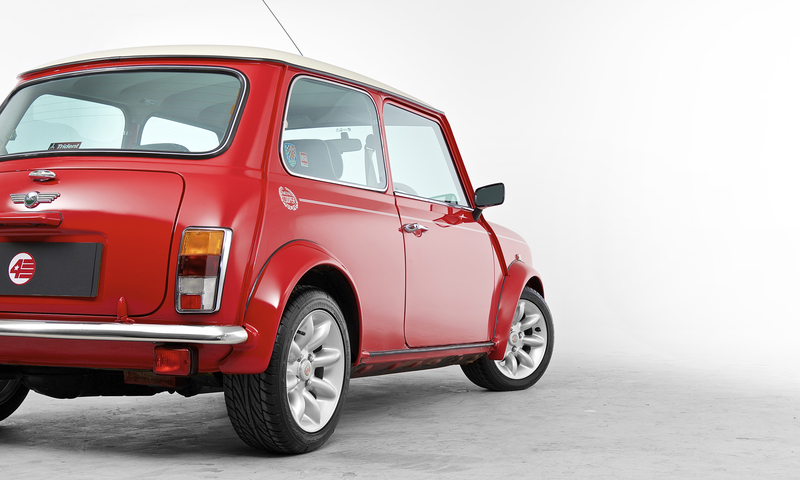

Mini Cooper Sport 2000
Allmän beskrivning :
A perfect Mini Cooper Sport, with less than 3k miles from new.
MODEL HISTORY
The Mini, a British icon of the 1960s, was a legend in its own right that influenced a generation of car manufacturers. The Mini was considered the British equivalent to its German contemporary the Volkswagen Beetle. It has earned its place in the history books and in 1999 was credited the second most influential car of the 20th Century behind the Ford Model T, not bad going for the little front wheel drive pocket rocket.
It was the compact design and space saving front wheel drive layout that allowed 80% of the cars floor plan to be used for passengers and luggage, they even put the door hinges on the outside to aid the simple compact design. This layout was a first for car manufacturers and introduced at a time when sales of large cars was on a rapid decline and small German bubble cars were booming. Production ranged from its introduction in 1959 until the final car rolled off the production line in 2000. An incredible 41 years of production that spawned many models of Mini targeting various different markets.
It was John Cooper, owner of the Cooper car company and designer and builder of Formula one and rally cars, that saw potential for the Mini in competition. After a whole host of upgrades the Mini Cooper debuted in 1961 followed shortly after in 1963 by the Mini Cooper S, which enjoyed victory in the Monte Carlo Rally in 1964, 65 and 67.
The final Classic Minis rolled off the production line in 2000 before the Mini name reverted to BMWs ownership. By which time the range consisted of the Mini Classic Seven, The Mini Classic Cooper and the Mini Classic Cooper Sport. The final Mini was built on the 4th October 2000 by which time a total of 5,387,862 had been manufactured.
Equipment
Front fog lamps, 13-inch sports alloys, Bonnet stripes, Leather interior, Leather steering wheel and gear knob, Wood fascia, Sports Pack, Rover CD player, Driver's airbag, Alarm, Immobiliser, Heated rear window, Spare wheel, Toolkit.
EXTERIOR
This Cooper Sport really looks the part with its Solar Red paint, Old English White roof, bonnet stripes, and four spotlights positioned across the front. The coachwork presents with a deep luster and shows no imperfections, which is unsurprising given that the car has covered less than 3k miles from new.
The Mini has been kept in dry storage out of the sun and so the body is free from any fading, or corrosion for that matter. The chrome-work remains bright with all rubber and plastic trim in excellent fettle too. What's more all lenses are clear and free from any chips or moisture.
INTERIOR
With a driving position that is unique to the Mini the interior is a fun place to be. Having seen little use since the car rolled off the production line, it remains in pristine condition. This example is also equipped with the original Rover CD player.
The seats are in excellent shape and are upholstered in black leather with cream piping to match the steering wheel and gearshift. The dash and switchgear are all immaculate and the carpets are unspoiled, protected by a set of original mats. The boot area looks unused with the original spare wheel and tool kit still neatly stored under the boot carpet.
ENGINE & TRANSMISSION
The Mini is equipped with a 1275cc twin-point fuel-injected engine. Boasting 62hp the car can reach speeds of around 90mph. Opening the tiny bonnet reveals a very clean and orderly engine compartment. Mechanically the Mini is in excellent order having been maintained regardless of mileage. What's more the four-speed manual gearbox remains feeling tight and precise.
WHEELS, TYRES & BRAKES
Over and above the standard Mini Cooper, the Cooper Sport was equipped with 13-inch alloys from the factory. All of the wheels on this example are in pristine condition having never seen a curb. They are shod in a top quality set of Dunlop tyres, with the brakes showing minimal wear also.
HISTORY FILE
This impeccable Mini was delivered to the supplying dealer, Trident Garages of Weybridge, on 22nd February 2000. Despite being ordered for demonstration purposes the car was not actually registered until September 29th. One year later, a Mr Roberts purchased it for his wife. The Mini then received its second service in November 2001 at just 1,489 miles. Since that time the car has been driven sparingly, remaining carefully stored when not in use.
Present in the history file is all the original paperwork from Trident Garages, to include the vehicle allocation form, delivery note, and first registration documents. Present also are invoices for the first two services that were carried out at the dealership. Mr Roberts' invoice for the purchase of the car is included too, as is a sales brochure, and the complete Mini book pack. A handful of SORN acknowledgement letters show that the car was not in use between 2005 and 2014, with vehicle test certificates confirming the car's mileage during that period also present. It was most recently serviced in March 2015.
http://www.4starclassics.com/mini-cooper-sport-for-sale/
2000 Mini Cooper Sport is listed såld on ClassicDigest in Kingsley by 4 Star Classics for £20495.
Fakta i bilen
Karosstyp : Personbil Märke : Mini Modell : Cooper Modellversion : Sport Motorvolym : 1.3 Årsmodell : 2000 Karosstyp : Pick up Läge : Hampshire Fordon Registrering : Normal
Såld
Information om säljaren
Såld
People who viewed this Mini Cooper also viewed similar Mini listed at ClassicDigest

Mini Cooper
36000 $
Ft. Lauderdale
Mini Cooper
25500 $
Arlington
Mini Cooper
21900 €
Netherlands
Mini Cooper
17900 €
Netherlands
Mini Cooper
14900 €
Netherlands
Other cars listed for sale by this dealer
Datsun 240Z
39995£
Hampshire
Volkswagen Karmann-Ghia
36995£
Hampshire
Peugeot 205
10995£
Hampshire
Mercedes-Benz 500SL r129
19995£
Hampshire
BMW 735
29995£
Hampshire
om Mini
He Mini is indeed an iconic car that revolutionized the automotive industry and set the standard for compact cars. Here's a brief history of the Mini, its development, and some of the key versions of the classic Mini:1. Origins and Development:
Founder and Designer: The Mini was designed by Sir Alec Issigonis, a British-Greek automotive engineer.
Introduction: The Mini was officially introduced by the British Motor Corporation (BMC) in 1959.
Innovative Design: Issigonis' design featured a transverse engine, front-wheel drive, and a compact layout, maximizing interior space.
2. Classic Mini Models:
Mark I (1959–1967):
Mini Cooper (1961): The performance-oriented Cooper version, developed in collaboration with racing legend John Cooper, was introduced.
Mark II (1967–1970):
Minor design changes, including a redesigned grille.
Mark III (1969–2000):
Introduction of the Clubman and Clubman Estate variants.
Further design updates, including a more rounded front grille.
3. Mini Cooper S:
Performance Variant: The Mini Cooper S, particularly the Mk I version, became famous for its success in rally racing, winning the Monte Carlo Rally multiple times.
4. Mini Moke:
Utility Vehicle: The Mini Moke was a utility vehicle based on the Mini platform, featuring an open-top design. It gained popularity in various warm-weather locations.
5. Mini Countryman:
Extended Version: The Mini Countryman was introduced as a longer and more practical version of the classic Mini. It featured a rear-hinged door for easier access to the rear seats.
6. End of Production:
Later Years: Production of the classic Mini continued until the year 2000.
Final Editions: The last classic Mini rolled off the production line on October 4, 2000, marking the end of an era.
7. BMW Era and New MINI:
BMW Acquisition: BMW acquired the rights to the Mini brand and introduced the new MINI in 2001.
Modern Interpretation: The new MINI retained some design cues from the classic but featured modern technology and safety standards.
8. Legacy and Influence:
Cultural Icon: The classic Mini became a cultural icon, symbolizing British design and efficiency.
Influence on Compact Cars: The Mini's layout and design principles influenced the development of compact cars for decades to come.
The Mini's impact on the automotive industry goes beyond its compact size; it represents a design philosophy that prioritizes efficiency, space utilization, and a fun driving experience. The classic Mini's enduring popularity is a testament to its timeless design and innovative engineering.
User
great..German please
ChatGPT
Der Mini ist zweifellos ein ikonisches Auto, das die Automobilindustrie revolutioniert hat und den Standard für Kompaktwagen gesetzt hat. Hier ist eine kurze Geschichte des Mini, seiner Entwicklung und einiger wichtiger Versionen des klassischen Mini:
1. Ursprünge und Entwicklung:
Gründer und Designer: Der Mini wurde von Sir Alec Issigonis, einem britisch-griechischen Automobilingenieur, entworfen.
Einführung: Der Mini wurde 1959 offiziell von der British Motor Corporation (BMC) vorgestellt.
Innovatives Design: Issigonis' Design umfasste einen Quermotor, Frontantrieb und ein kompaktes Layout, das den Innenraum maximieren sollte.
2. Klassische Mini-Modelle:
Mark I (1959–1967):
Mini Cooper (1961): Die leistungsorientierte Cooper-Version, in Zusammenarbeit mit dem Rennlegenden John Cooper entwickelt, wurde eingeführt.
Mark II (1967–1970):
Geringfügige Designänderungen, einschließlich eines neu gestalteten Kühlergrills.
Mark III (1969–2000):
Einführung der Varianten Clubman und Clubman Estate.
Weitere Designaktualisierungen, einschließlich eines abgerundeteren vorderen Kühlergrills.
3. Mini Cooper S:
Leistungsvariante: Der Mini Cooper S, insbesondere die Version Mk I, wurde durch seinen Erfolg bei Rallye-Rennen bekannt und gewann mehrmals die Rallye Monte Carlo.
4. Mini Moke:
Nutzfahrzeug: Der Mini Moke war ein Nutzfahrzeug auf Basis des Mini-Plattformkonzepts mit offenem Verdeck. Er wurde in verschiedenen warmen Regionen populär.
5. Mini Countryman:
Verlängerte Version: Der Mini Countryman wurde als längere und praktischere Version des klassischen Mini eingeführt. Er verfügte über eine rückwärts öffnende Tür für einen leichteren Zugang zu den Rücksitzen.
6. Ende der Produktion:
Spätere Jahre: Die Produktion des klassischen Mini lief bis zum Jahr 2000 weiter.
Abschlusseditionen: Der letzte klassische Mini verließ die Produktionslinie am 4. Oktober 2000 und markierte das Ende einer Ära.
7. BMW-Ära und neuer MINI:
BMW-Übernahme: BMW erwarb die Rechte an der Marke Mini und führte 2001 den neuen MINI ein.
Moderne Interpretation: Der neue MINI behielt einige Designelemente des klassischen Mini bei, verfügte jedoch über moderne Technologie und Sicherheitsstandards.
8. Erbe und Einfluss:
Kulturelles Symbol: Der klassische Mini wurde zu einem kulturellen Symbol, das britisches Design und Effizienz verkörpert.
Einfluss auf Kompaktwagen: Das Layout und die Designprinzipien des Mini beeinflussten die Entwicklung von Kompaktwagen für Jahrzehnte.
Die Auswirkungen des Mini auf die Automobilindustrie gehen über seine kompakte Größe hinaus. Er repräsentiert eine Designphilosophie, die auf Effizienz, Raumnutzung und Fahrspaß setzt. Die anhaltende Beliebtheit des klassischen Mini ist ein Beweis für sein zeitloses Design und innovative Ingenieurskunst.
User
and swedish
ChatGPT
Mini är verkligen en ikonisk bil som har revolutionerat bilindustrin och satt standarden för kompakta bilar. Här är en kort historia om Mini, dess utveckling och några av de viktigaste versionerna av klassiska Mini:
1. Ursprung och Utveckling:
Grundare och Designer: Mini designades av Sir Alec Issigonis, en brittisk-grekisk bilingenjör.
Introduktion: Mini introducerades officiellt av British Motor Corporation (BMC) år 1959.
Innovativ Design: Issigonis design inkluderade en tvärställd motor, framhjulsdrift och en kompakt layout för att maximera interiören.
2. Klassiska Mini-Modeller:
Mark I (1959–1967):
Mini Cooper (1961): Den prestandaorienterade Cooper-versionen, utvecklad i samarbete med rallylegenden John Cooper, introducerades.
Mark II (1967–1970):
Mindre designförändringar, inklusive en omformulerad grill.
Mark III (1969–2000):
Införande av varianter som Clubman och Clubman Estate.
Ytterligare designuppdateringar, inklusive en rundare främre grill.
3. Mini Cooper S:
Prestandavariant: Mini Cooper S, särskilt versionen Mk I, blev känt för sin framgång i rallysporten och vann Monte Carlo Rally flera gånger.
4. Mini Moke:
Nyttofordon: Mini Moke var en nyttobil baserad på Mini-plattformen med öppet tak. Den blev populär på platser med varmt klimat.
5. Mini Countryman:
Förstorad Version: Mini Countryman introducerades som en längre och mer praktisk version av den klassiska Mini. Den hade en bakre dörr som öppnades bakåt för enklare tillgång till baksätena.
6. Produktionens Slut:
Senare År: Produktionen av klassiska Mini fortsatte till år 2000.
Slutversioner: Den sista klassiska Mini rullade av produktionslinjen den 4 oktober 2000 och markerade slutet på en era.
7. BMW-eran och Nya MINI:
BMW-förvärv: BMW förvärvade rättigheterna till Mini-varumärket och introducerade den nya MINI år 2001.
Modern tolkning: Den nya MINI behöll vissa designelement från den klassiska Mini men hade modern teknik och säkerhetsstandarder.
8. Arv och Påverkan:
Kulturell Ikon: Den klassiska Mini blev en kulturell ikon och symboliserade brittisk design och effektivitet.
Påverkan på Kompaktbilar: Minis layout och designprinciper påverkade utvecklingen av kompakta bilar i årtionden.
Minis påverkan på bilindustrin sträcker sig bortom dess kompakta storlek; den representerar en designfilosofi som prioriterar effektivitet, användning av utrymme och en rolig körupplevelse. Den klassiska Minins fortsatta popularitet är ett bevis på dess tidlösa design och innovativa ingenjörskonst.
Mini är verkligen en ikonisk bil som har revolutionerat bilindustrin och satt standarden för kompakta bilar. Här är en kort historia om Mini, dess utveckling och några av de viktigaste versionerna av klassiska Mini:
1. Ursprung och Utveckling:
Grundare och Designer: Mini designades av Sir Alec Issigonis, en brittisk-grekisk bilingenjör.
Introduktion: Mini introducerades officiellt av British Motor Corporation (BMC) år 1959.
Innovativ Design: Issigonis design inkluderade en tvärställd motor, framhjulsdrift och en kompakt layout för att maximera interiören.
2. Klassiska Mini-Modeller:
Mark I (1959–1967):
Mini Cooper (1961): Den prestandaorienterade Cooper-versionen, utvecklad i samarbete med rallylegenden John Cooper, introducerades.
Mark II (1967–1970):
Mindre designförändringar, inklusive en omformulerad grill.
Mark III (1969–2000):
Införande av varianter som Clubman och Clubman Estate.
Ytterligare designuppdateringar, inklusive en rundare främre grill.
3. Mini Cooper S:
Prestandavariant: Mini Cooper S, särskilt versionen Mk I, blev känt för sin framgång i rallysporten och vann Monte Carlo Rally flera gånger.
4. Mini Moke:
Nyttofordon: Mini Moke var en nyttobil baserad på Mini-plattformen med öppet tak. Den blev populär på platser med varmt klimat.
5. Mini Countryman:
Förstorad Version: Mini Countryman introducerades som en längre och mer praktisk version av den klassiska Mini. Den hade en bakre dörr som öppnades bakåt för enklare tillgång till baksätena.
6. Produktionens Slut:
Senare År: Produktionen av klassiska Mini fortsatte till år 2000.
Slutversioner: Den sista klassiska Mini rullade av produktionslinjen den 4 oktober 2000 och markerade slutet på en era.
7. BMW-eran och Nya MINI:
BMW-förvärv: BMW förvärvade rättigheterna till Mini-varumärket och introducerade den nya MINI år 2001.
Modern tolkning: Den nya MINI behöll vissa designelement från den klassiska Mini men hade modern teknik och säkerhetsstandarder.
8. Arv och Påverkan:
Kulturell Ikon: Den klassiska Mini blev en kulturell ikon och symboliserade brittisk design och effektivitet.
Påverkan på Kompaktbilar: Minis layout och designprinciper påverkade utvecklingen av kompakta bilar i årtionden.
Minis påverkan på bilindustrin sträcker sig bortom dess kompakta storlek; den representerar en designfilosofi som prioriterar effektivitet, användning av utrymme och en rolig körupplevelse. Den klassiska Minins fortsatta popularitet är ett bevis på dess tidlösa design och innovativa ingenjörskonst.