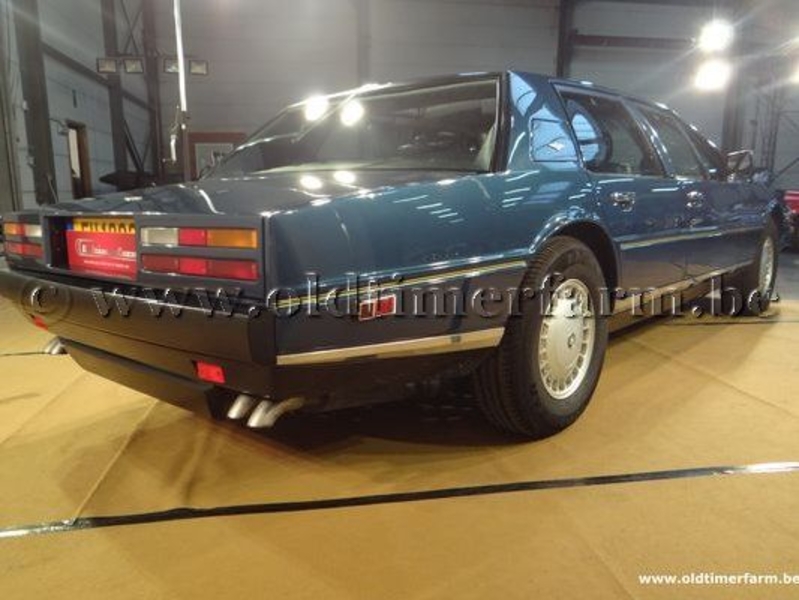

Aston Martin Lagonda '82 1982
General description :
Lowered price!!!(from Wikipedia, the free encyclopedia) Lagonda is a British car manufacturer, founded as a company in 1906 in Staines, Middlesex by the American Wilbur Gunn (1859–1920). He named the company after a river near the town of his birth Springfield, Ohio. The company was purchased and integrated into Aston Martin in 1947. Wilbur Gunn had originally built motorcycles on a small scale in the garden of his house in Staines with reasonable success including a win on the 1905 London—Edinburgh trial. In 1907 he launched his first car, the 20-hp, 6-cylinder Torpedo, which he used to win the Moscow—St. Petersburg trial of 1910. This success produced a healthy order for exports to Russia which continued until 1914. In the pre-war period Lagonda also made an advanced small car, the 11.1 with a four-cylinder 1000 cc engine, which featured an anti-roll bar and a rivetted monocoque body and the first ever fly-off handbrake. During World War I Lagonda made artillery shells. After the end of the war the 11.1 continued with a larger 1400-cc engine and standard electric lighting as the 11.9 until 1923 and the updated 12 until 1926. Following Wilbur Gunn's death in 1920, three existing directors headed by Colin Parbury took charge. The first of the company's sports models was launched in 1925 as the 14/60 with a twin-cam 1954-cc 4-cylinder engine and hemispherical combustion chambers. The car was designed by Arthur Davidson who had come from Lea-Francis. A higher output engine came in 1927 with the 2-litre Speed Model which could be had supercharged in 1930. A lengthened chassis version, the 16/65, with 6-cylinder 2.4-litre engine, was available from 1926 to 1930. The final car of the 1920s was the 3-litre using a 2931-cc 6-cylinder engine. This continued until 1933 when the engine grew to 3181 cc and was also available with a complex 8-speed Maybach transmission as the Selector Special. A new model for 1933 was the 16-80 using a 2-litre Crossley engine with pre-selector gearbox from 1934. A new small car, the Rapier came along in 1934 with 1104-cc engine and pre-selector gearbox. This lasted until 1935 but more were made until 1938 by a separate company, Rapier Cars of Hammersmith, London. At the other extreme was the near 100-mph, 4.5-litre M45 with Meadows 6-cylinder 4467-cc engine. An out and out sporting version the M45R Rapide, with tuned M45 engine and a shorter chassis led to a Le Mans victory in 1935. Also in 1935 the 3-litre grew to a 3.5-litre. All was not well financially and the receiver was called in 1935 but the company was bought by Alan Good, who just outbid Rolls-Royce. He also persuaded W. O. Bentley to leave Rolls-Royce and join Lagonda as designer along with many of his racing dept staff. The 4.5-litre range now became the LG45 with lower but heavier bodies and also available in LG45R Rapide form. The LG45 came in 3 versions known as Sanction 1,2 and 3 each with more Bentley touches to the engine. In 1938 the LG6 with independent front suspension by torsion bar and hydraulic brakes came in. Bentley's masterpiece the V12 was launched in 1937. The 4480-cc engine delivered 180 bhp and was said to be capable of going from 7 to 105 mph in top gear and to rev to 5000 rpm. In 1947 the company was taken over by David Brown and moved in with Aston Martin, which he had also bought, in Feltham, Middlesex. Production restarted with the last model from W. O. Bentley, the 1948 2.6-Litre with new chassis featuring fully independent supension. Its new 2580 cc twin overhead cam straight 6 became the basis for the Aston Martin engines of the 1950s. The engine grew to 3 litres in 1953 and continued to be available until 1958. Many thought that the marque had disappeared but in 1961 the Rapide name was resurrected with aluminium body by Carrozzeria Touring of Milan and 3995 cc engine capable of taking the car to 125 mph. By this time, Aston Martin-Lagonda as it now was, had moved to Newport Pagnell in Buckinghamshire. The Rapide lasted until 1965. Between 1974 and 1976, seven Lagonda saloons were produced on the basis of the Aston Martin V8. One more car was to appear with the large and futuristic Aston Martin Lagonda of 1976 designed by William Towns. This low, rather square, wedge shaped car was built on Aston Martin V8 components and was available, at least in theory, until 1989. Aston Martin produced a concept car called the Lagonda Vignale at the 1993 Geneva motor show. In 1994, a handful of Lagonda 4-door saloons and shooting brakes were built on the basis of the Aston Martin Virage. The Rapide name was revived in 2010 as the Aston Martin Rapide saloon. Aston Martin said on 1 September 2008, as reported by Automotive News Europe that it will relaunch its Lagonda brand to help it expand into new markets such as luxury sedans and celebrate Lagonda's centennial anniversary in 2009. "The Lagonda brand would allow us to develop cars which can have a different character than a sports car," said CEO Ulrich Bez in a statement. "Lagonda will have its own niche with luxurious and truly versatile products suitable for both existing and emerging markets". "Lagonda models would be vehicles that could be used all year round in markets such as Russia where specialized sports cars such as Aston Martins could only be used for three or four months each year", said Aston Martin spokeswoman Janette Green. SpecificationsBodyworkLength : cm (in): 528 (207.9) Width : cm (in): 181 (71.3) Height : cm (in): 130 (51.2) Wheelbase : cm (in) : 291 (114.6) Weight: kg (lb) : 2100 (4635) Mechanics. Displacement : V8 5340 cc (3215 cu in) Aston Martin, forward Valve gear : 16 Fuel system : 4 We 42 DCVF carburettors Gearbox : 3-speed, automatic Driven wheels : rear wheel drive Maximum power : 313 bhp @ 5500 rpm Maximum torque : 434 Nm at 4500 rpm Maximum speed : 230 km/h (143 mph) For more pictures sroll down.This car is just in at Oldtimerfarm, Aalter Belgium. Steenweg op Deinze 51C. Teusday-Saterday 10-17h (no appointment needed) Sunday: closed. Monday strictly on appointment. We specialize in consignment sales of collection cars. We are proud we can offer this car for sale. A more detailed description will soon follow. In the meantime you can have a look at the very ample photo coverage on the website. Of course Xavier or Olivier will be very happy to give you all possible explanations by phone on +32472401338.Meet us at:You can meet us at these events where we will show a sample of our stock.04-06/03/2016 Antwerp Classic Salon06-10/04/2016 28th Techno-Classica Essen - Germany29-01/05/2016 Open Door Event @OLDTIMERFARM
http://www.oldtimerfarm.be/en/collection-cars-for-sale/2662/aston-martin-lagonda-82.php
1982 Aston Martin Lagonda '82 is listed sold on ClassicDigest in Aalter by Oldtimerfarm Dealer for €49500.
Car Facts
Car type : Car Make : Aston Martin Model : Lagonda Model Version : '82 Engine size : 0.0 Model Year : 1982 Sub type : Coupé Location : Aalter Vehicle Registration : Normal
Sold
Seller Information
Sold
People who viewed this Aston Martin Lagonda also viewed similar Aston Martin listed at ClassicDigest
Aston Martin Lagonda
Milton Keynes
Aston Martin Lagonda
115000 £
Surrey
Aston Martin Lagonda
109000 €
Brummen
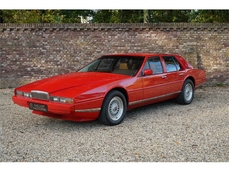
Aston Martin Lagonda
115500 €
Brummen
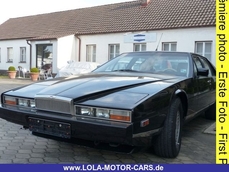
Aston Martin Lagonda
74900 €
Adalbert-Stifter-Straße 8DE-89423 Gundelfingen a d Donau
Other cars listed for sale by this dealer
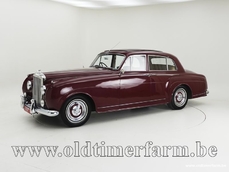
Bentley S1
99950€
Aalter
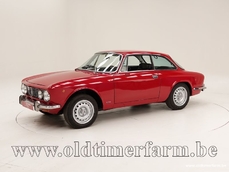
Alfa Romeo 2000 GTV
25950€
Aalter
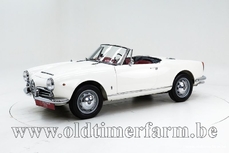
Alfa Romeo Giulia 1600 Sprint
69950€
Aalter
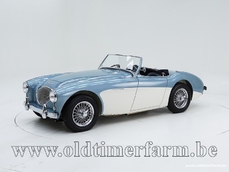
Austin-Healey 100
89950€
Aalter
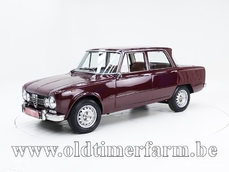
Alfa Romeo Giulia
12500€
Aalter
About Aston Martin
Aston Martin, one of Britain's best known sports car manufacturer, was founded in 1913 by Lionel Martin and Robert Bamford. During its chequered financial history the company has had numerous owners taking over the company, Sir David Brown just to mention one.
Between the wars Bertelli was both technical director and designer of all new Aston Martins, thus known as "Bertelli cars". These included the 1½-litre "T-type", "International", "Le Mans", "MKII" its racing version, the "Ulster", and the 2-litre 15/98 and its race going derivative, the "Speed Model".
During the war years the company produced aircraft components.
In 1947, Aston was purchased and thus saved by Sir David Brown. The company also acquired Lagonda the same year for its 2.6-litre W. O. Bentley-designed engine. Both companies shared resources and workshops creating the iconic "DB" series of cars. In 1950, they presented the DB2, followed by the DB2/4 in 1953, the DB2/4 MkII in 1955, the DB Mark III in 1957.
DB4 with its strong Italian flavor and construction was introduced in 1958. The lightweight superleggera (tube-frame) body was designed by Carrozzeria Touring in Milan. Although the design and construction techniques were Italian, the DB4 was the first Aston to be built at the company's Newport Pagnell works in Buckinghamshire, England. The six-cylinder engines of these cars from 1954 up to 1965 were designed by Tadek Marek. Despite initial problems with cracking engine blocks DB4 was a success that really established the make together with its later derivates DB5, of James Bond Goldfinger fame, and more civilized DB6 Grand Tourer.
With the all new model DBS in the late 60's the company went to eight cylinder configuration when it was modified to Aston Martin v8 – a sort of Gentleman's muscle car.