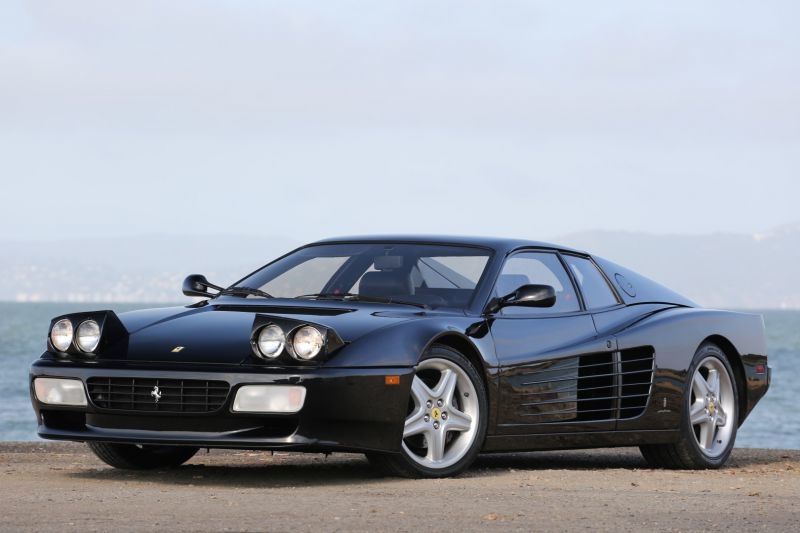

Ferrari 512 4.9 Liter Flat-12 no. 32847 1993
General description :
1993 Ferrari 512 TR
VIN ZFFLG40AXP0095283
Black with Black Leather
Introduced at the Paris Auto Show in 1984, the Pininfarina designed Ferrari Testarossa stunned the world with its unprecedented styling and technical innovations. While performance was exceptional thanks to a new four-valve engine that employed electronic fuel injection for the first time, the car was also remarkably civilized. The well-appointed interior was modern, spacious, and comfortable, while the stunning Pininfarina styling has become a defining icon of the 1980s. The Testarossa was a fast and comfortable flagship, one that made a great long distance tourer, eschewing some of the rawness of prior Ferraris in exchange for effortless speed.
For the 1992 model year, the Testarossa was comprehensively re-engineered, with the new version designated the 512 TR. Often erroneously considered simply a refined version of the Testarossa, the 512 TR was thoroughly reworked in a way that significantly changed the car’s character. The new car had a newfound urgency, responsiveness, and nimbleness that decisively quashed any Testarossa detractors’ complaints that the Testarossa had gone soft. The carefully revised chassis was much stiffer, featuring a lower-mounted engine and gearbox and a lower ride height. The steering ratio was quickened, revised shocks fitted, and enlarged cross-drilled brakes inside of new 18” wheels, which replaced the 16” wheels of the Testarossa. On the powertrain front, engine output increased 43 hp to 428 bhp at 6750 rpm thanks to a higher compression ratio, larger intake valves, Nikasil liners, and Bosch Motronic M2.7 engine management, all of which collectively resulted in a broader power curve, improved acceleration, and better drivability. The transaxle was also reworked with a shorter rear end ratio and numerous improvements to address the sometimes cantankerous shifter of the Testarossa including a single plate clutch and revised shifter mechanism with ball bearings and improved geometry. The result of these changes was significantly improved performance: top speed increased to 15 mph to 195 mph while 0-60 came in a stunning 4.8 seconds.
Cosmetically, the iconic Testarossa styling was freshened for the 512 TR with a new front fascia, twin brake ducts feeding larger brakes, new secondary light clusters, a new engine lid, color-coded rocker panels, clear turn signal lenses at the rear, and all new five-spoke wheels. The interior received a more contemporary dash and revised center console with other ergonomic improvements. Available only for the 1992-1994 model years, only 408 512 TRs were imported to the US, making it one of the more desirable and rare supercars of this period.
This particular example was completed in September 1992, supplied new to the US market, and sold new April 28, 1994 by Lake Forest Sportscars Ltd. of Lake Forest, IL. Delivered in factory black with black leather interior, and featuring a dealer installed Sony CD stereo, the original owner traded in his 1986 Testarossa (recorded on the purchase order) for this car. The 512 TR resided with the first owner in both Illinois and Florida for over 20 years, covering 30,635 miles when it was then sold to the second owner in 2015. The current owner is offering the car with copious records and receipts documenting both the mileage and diligent professional service this beautifully maintained 512 TR has received since new. Among the many service records retained for general service dating back to 1995, the car had the clutch replaced in 2002 at 19,900 miles, a 2009 $11,000 engine-out service, and refinishing for three wheels performed by Ferrari-Maserati of Fort Lauderdale. In 2014, with 30,634 miles recorded, Ferrari of Palm Beach performed a $17,438 service, which included the recommended engine out service, timing belts, all fluids, battery, sealing kit, air and oil filters, gaskets, and four new Pirelli tires. In 2015, the car was Ferrari Classiche Certified, verifying the original engine, gearbox, and differential are all in place with correctly corresponding numbers as originally assembled by Ferrari.
Today with 33,000 miles showing, this properly preserved and maintained low mile Testarossa is beautifully finished in stunning black with black leather interior. The black finish delivers an elegant presentation, particularly on this design. The dramatic sweeping fender line is accentuated as the normally dominant side intakes recede into the paint, giving the car a more unified and stealthy appearance. The black body and matching interior delivers a distinct continuity to the greenhouse. The original factory paint is very nice overall, still retaining a high gloss finish throughout, but with some normal stone chips from road use. The hood, deck lid, and doors open and shut easily with excellent factory panel gaps and consistent bumper to body fit. There are a few minor scratches around the car. The factory wheels are in very good condition with no significant damage to the surfaces or edges, but some aging to the wheel center caps and paint finish. The glass, trim, and Testarossa signature black accents are all in excellent condition, including the chrome emblems and script. The lighting and lenses throughout the car remain in excellent condition as well, showing no significant chips or marks. The glass appears to be original and is excellent other than some typical delamination at the bottom corners of the front windscreen.
The original black leather interior is in equally nice condition. The leather is clean, smooth, and supple with very minimal wear throughout, showing only minor surface wear on the left bolster of the driver’s seat. Seating cushion and support bolsters are exceptionally nice with all leather surfaces and stitching properly preserved and nicely finished. The plastic portion of the drivers seatback rake adjustment lever has broken. The dash pad is nicely maintained with the dash cap edge curling along the top edge over the passenger side. The instrument panel and black insert panels, rotating knobs, and center console all appear in very nice condition overall and function appropriately. The shift knob shows some aging in the form of surface cracks. The orange-glow gauges have excellent color and clear lenses, finished off with a beautifully maintained steering wheel. The carpeting and kick-plates all remain clean and devoid of any noticeable scuffs or stains, with some minor evidence of use in the driver’s foot box and on both floor mats. The headliner and door panels are clean, tight, and extremely well-preserved. This example is fitted with a period correct, dealer installed Sony radio with a CD changer located in the front storage area.
The engine compartment and trunk are likewise nicely maintained with no noticeable wear in either location. The trunk liners and carpet are very clean as are the various original components including the original accessories. The engine is nicely detailed with excellent finishes, properly preserved engine components, and factory labeled engine bay. Clearly when the professional service work and recent engine-out service was performed, exceptional mechanical and cosmetic workmanship resulted in the fine presentation both under the hood and under the car. The chassis appears very clean, free from any structural damage or compromise to the suspension, engine, and transaxle. The casing around the catalytic converters has deteriorated but the catalysts themselves appear intact. The condition of the undercarriage further supports the documented low mileage recorded on this car.
As one might expect of a lower mileage properly maintained and fully serviced late model Ferrari, this 512 TR performs beautifully. The car starts instantly and idles with a throaty growl, with a noticeably different exhaust note from a Testarossa, something which becomes increasingly evident when on the move. At full throttle, the 512 TR sounds fabulous and guttural in a way that the Testarossa does not. The biggest difference the driver notices immediately compared to the Testarossa is the urgency. The car feels lighter, the engine more responsive and linear, and it is clear that Bosch’s learning curve during their first decade of making electronic fuel injection systems was very steep. Not only is the car faster, but the delivery is much more transparent, as though a layer of insulation has been removed between the driver and the engine. The shifting experience is also meaningfully improved, with lower shift effort, better synchromesh, and a lighter, more progressive clutch. The ride is noticeably firmer, with a corresponding increase in body control. Brakes are also improved, with strong bite and superior heat dissipation ability. As in the Testarossa, visibility is surprisingly good given the width of the car and the low stance. Seating position and easily reached controls validate the refinement the 512 TR received during its development. At the end of a drive in the 512 TR, the driver is struck by the comprehensiveness of the improvements over the Testarossa. There is basically no aspect of the driving experience that is not decisively better and the resulting changes transform the Testarossa from a fast, civilized touring car to a gratifying driver’s car that can still fulfill the GT role of its predecessor.
The car is exceptionally complete, including its complete set of manuals in Schedoni leather pouch, tool case with complete tools and spare belt, tire inflator, car cover, emergency light and pouch, a set of folding keys and key code tags, and a custom tailored car cover. The Ferrari Classiche “Red Book” and plaque, original 512 TR brochure, as well as all records dating back to 1995 including the original purchase invoice are also included with this remarkable car.
With fastidious service, known history from new, and exceptional documentation, this very desirable, Classiche-certified, matching-numbers 512 TR is a superb example. Not only is the 512 TR a meaningfully improved driver’s car over the Testarossa, it is also rarer, and the sizeable difference in values between the cars genuinely reflects the differences between the cars.
http://fantasyjunction.com/cars/2153-Ferrari-512%20TR-4.9%20Liter%20Flat-12
1993 Ferrari 512 4.9 Liter Flat-12 no. 32847 is listed sold on ClassicDigest in Emeryville by Fantasy Junction for $187500.
Car Facts
Car type : Car Make : Ferrari Model : 512 Model Version : 4.9 Liter Flat-12 no. 32847 Engine size : 4.9 Model Year : 1993 Location : Emeryville
Sold
Seller Information
Sold
People who viewed this Ferrari 512 also viewed similar Ferrari listed at ClassicDigest
Ferrari 512
Emeryville
Ferrari 512
Emeryville
Ferrari 512
250000 €
Aalter
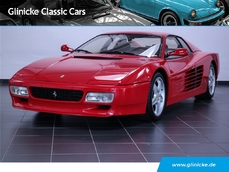
Ferrari 512
Ochshäuser Straße 37 34123 Kassel, Germany
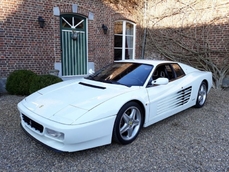
Ferrari 512
145000 €
Engelbamp 27BE-3800 Sint Truiden
Other cars listed for sale by this dealer
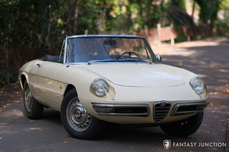
Alfa Romeo Spider Duetto
Emeryville
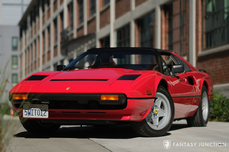
Ferrari 308 GTS
Emeryville
Honda S2000
Emeryville
Ford Pick Up
Emeryville
Ford De Luxe
Emeryville
About Ferrari
The first Ferrari road car was the 125 S introduced in 1947 and powered by a 1.5 L V12 engine, right? Well it's not quite that simple, Ferrari did in fact produce e Tipo 815, in 1940. Tipo 815 was designed by ex-Alfa Romeo engineers Alberto Massimino and Vittorio Bellentani and by Enrico Nardi under Enzo's company but legal issues with the former associate Alfa Romeo prevented Ferrari from launching the Ferrari marque at that point.
Enzo did produce a series of fine road cars in the 50's and 60's but they were merely to finance his true passion racing, wheather GT/Sports car or Grand Prix. The 50's saw the birth of Ferrari's most memorable cars, 250 GTB (tour de France) 250 Testa Rossa, 250 GT swb just to name a few.
Under the surface tension was growing though. In November 1961 long-time sales manager Girolamo Gardini made an ultimatum to Enzo: if tensions continued, he would leave the company. As a result, Gardini was ousted, as well as Scuderia Ferrari manager Romolo Tavoni, chief engineer Carlo Chiti, experimental sports car development chief Giotto Bizzarrini, and a number of others who stood by them.
Without Chiti and Bizzarrini the development of what was to become the most quintessential Ferrari and today the world's most expensive car, 250 GTO, was at a pivoting point. 250 GTO project was saved by a young engineer Mauro Forghieri and long-time racing bodyman Sergio Scaglietti who stepped in and took over the program with known results.
In addition to 250 GTO, Ferrari launced such master pieces as 250 LM, 250P, 275 GTB, 365 GTB/4 "Daytona" during the the 60's
By the late 60's Ferrari's prototypes' success came to a sudden halt by a new competitor, GT40. Ford turned to Lola to produce a Ferrari beating long distance racer after Enzo had cut the deal off with Henry Ford II making the latter absolutely boil with fury. The collaboration between Ford and Lola created the mighty Ford GT40 that gave Ferrari some heavy hits in Le Mans 24 to come.
By the end of the 60's FIAT purchased 50% of the company, starting a development that has led to a new mass-produced era of Ferraris.
Whether you are selling or looking for a classic Ferrari www.classicdigest.com is the place to check out.