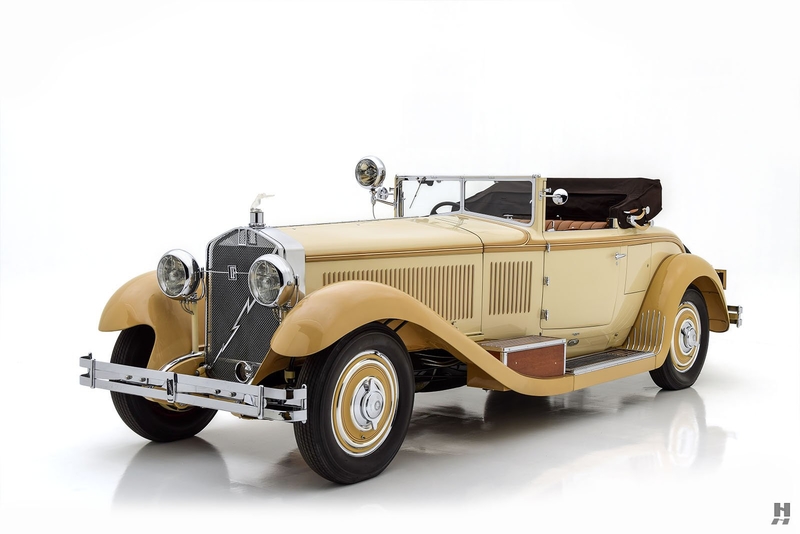


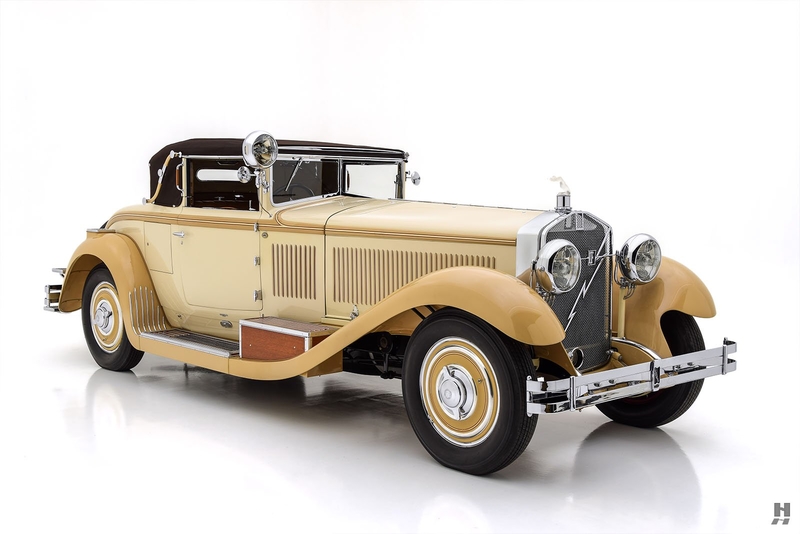
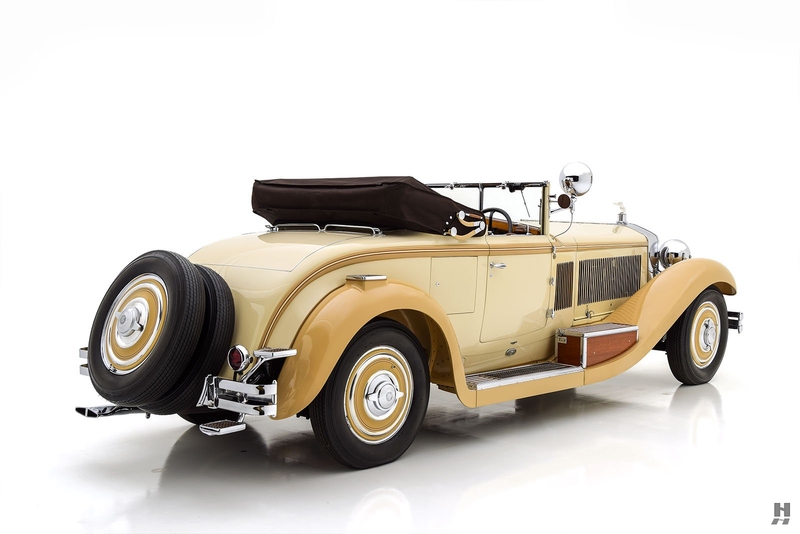
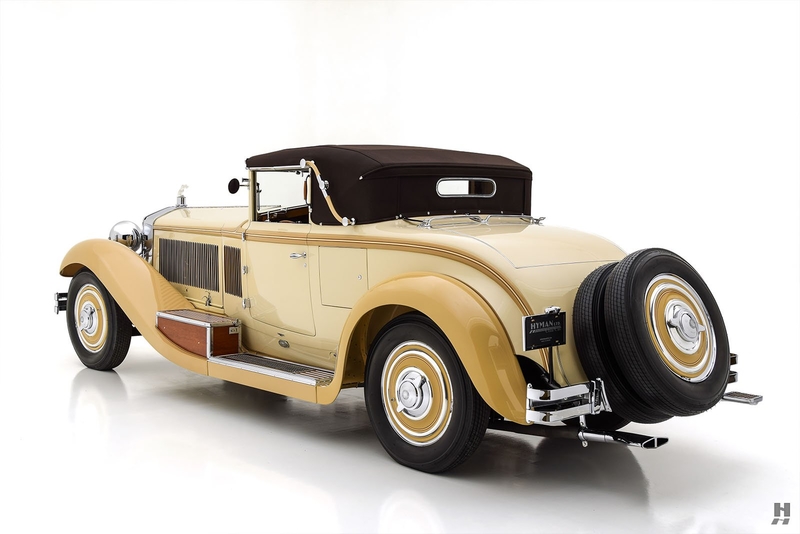
Isotta-Francini Tipo 8A 8A SS Castagna Roadster 1930
General description :
Destined to become one of Italy’s most prestigious luxury car manufacturers, Isotta-Fraschini formed in the late 1800s when lawyer Cesare Isotta partnered with brothers Vincenzo, Antonio, and Oreste Fraschini. The four men shared a passion for motorcars, and they began importing French DeDions into Milan before embarking on a more ambitious plan to build a car of their own. Finding success in the early 1910s, the company grew steadily and enjoyed an increasingly loyal following, particularly in the American market. The Tipo 8 of 1912 marked Isotta-Fraschini’s arrival in the upper echelon of car manufacturers, featuring world’s first production inline 8-cylinder engine and four-wheel brakes.
The successor Tipo 8A followed in 1924, retaining the eight-cylinder layout, but with an entirely new chassis and suspension. Testers criticized early iterations for being underpowered compared to the mighty Hispano-Suiza, but in Isotta’s defense, the 8A’s objective was silence over speed. Not to be outdone, however, subsequent evolutions of the Tipo 8A, the Spinto, and Super Spinto, made 135 hp and 160 hp respectively, putting any criticism to rest. Particularly in ultimate S.S. form, the Isotta-Fraschini Tipo 8A stands among the most desirable of all Classic Era automobiles. The combination of power, prestige and engineering excellence was matched by the work of great coachbuilders including Fleetwood, Derham, Worblaufen, and Italy’s own Castagna. In America, where nearly a third of Isottas were sold, the price of an 8A exceeded that of a Model J Duesenberg. Pricing started at $9,750 for a chassis alone, with complete cars often approaching $20,000 depending on coachwork. As such, Isottas attracted the likes of King Faisal, the Aga Khan, William Randolph Hearst, and Rudolph Valentino, to name just a few.
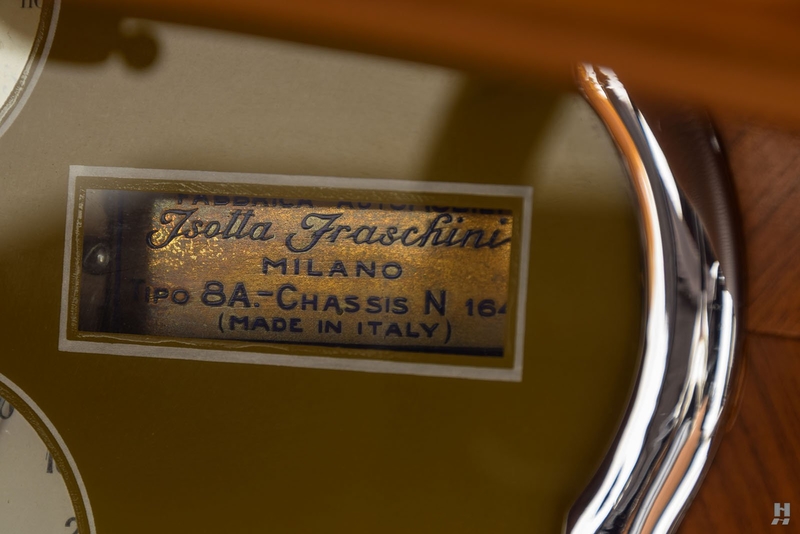
Full of charisma and imposing presence, this 1930 Isotta-Fraschini Tipo 8A SS is well known in collector circles as one of the most correct and meticulously restored examples extant. In the 1950s, chassis number 1643 belonged to Ferris Alger of New Hope, Pennsylvania, known as one of the founding members of the Classic Car Club of America. Described by some as an eccentric, Alger kept many important classics scattered about his New Hope property. Among those cars were two Isotta-Fraschinis – a town car in the barn and this Castagna-bodied convertible coupe kept out in the yard. Around 1952, a young car enthusiast named John “Jack” Nagle first spotted this spectacular Castagna-bodied Isotta parked outside the International Motor Sports Show in New York City. Nagle fell in love with the car and vowed to own one someday.
Two years later, while traveling through New Hope, he was shocked to see the complete Isotta #1643 sitting in Ferris Alger’s yard, along with a sign that read “Danger… Keep Away.” Naturally, he did what any self-respecting car enthusiast would do – ignore the warning and try to buy the car. He was met with a resounding NO, but Alger did at least show him the car. In fact, over the coming years, Nagle regularly visited with Alger about the Isotta and other vehicles, and Alger was more than happy to share his vast knowledge with his young friend. Finally, after eight years of cordial visits, Alger finally agreed to sell the Isotta to Nagle, on the premise that it would be restored.
Upon returning home to Cherry Hill, New Jersey, Jack Nagle set to work assessing the project. Period photos show the car was complete, but it was in rough condition, and everything would need attention. Amazingly, the 7.4-liter inline-eight fired up with little effort, running well enough for Nagle to take a drive around the block! That would be the last drive for some time; however, as project swelled into an exhaustive, meticulous restoration that would consume the next twenty-plus years.
With the assistance of a series of close friends and colleagues from the CCCA and around the collector car world, Nagle’s restoration of 1643 grew steadily in scope and detail – to the point of becoming an obsession. Every single component was carefully returned to as-new condition, with an unwavering mission to ensure each aspect remained faithful to the original. For instance, he returned a set of pistons while rebuilding the engine because their weight was too far from that of the ones that came out of the engine, and he feared spoiling the car’s refinement. Among his other duties, Jack Nagle served as the CCCA’s Awards Chairman for many years, and the same high standards to which he held others were applied to the restoration of his magnificent Isotta.
Finally, in July 1984, the reborn Isotta-Fraschini #1643 arrived at the Baltimore Grand Classic, scoring a perfect 100 points on debut. It was an emotional moment for the man who had first seen this spectacular car some 30 years prior and dedicated so much of his life to its resurrection. Shortly afterward, Nagle sold the Isotta to the highly respected collector Noel Thompson of New Vernon, New Jersey. In Mr. Thompson’s care, the car earned its CCCA Senior Premier award and scored a 2nd place in a special class of Isotta-Fraschini automobiles at the 1989 Pebble Beach Concours d’Elegance.
Following its time with Thompson, the car joined a private collection on the west coast, with the current owner acquiring it from that collector in 1997. For the last 22 years, the Isotta-Fraschini has been part of an extensive collection, appearing only occasionally in shows and events. As a testament to the breathtaking quality of the restoration, its last major concours appearance was in 2006 at the Amelia Island Concours d’Elegance. Over the years, this car has featured in numerous books, magazines, and publications, including an 8-page feature in the CCCA magazine, as well as in Dennis Adler’s book Speed and Luxury, Beverly Ray Kimes’ book The Classic Car, and many others.
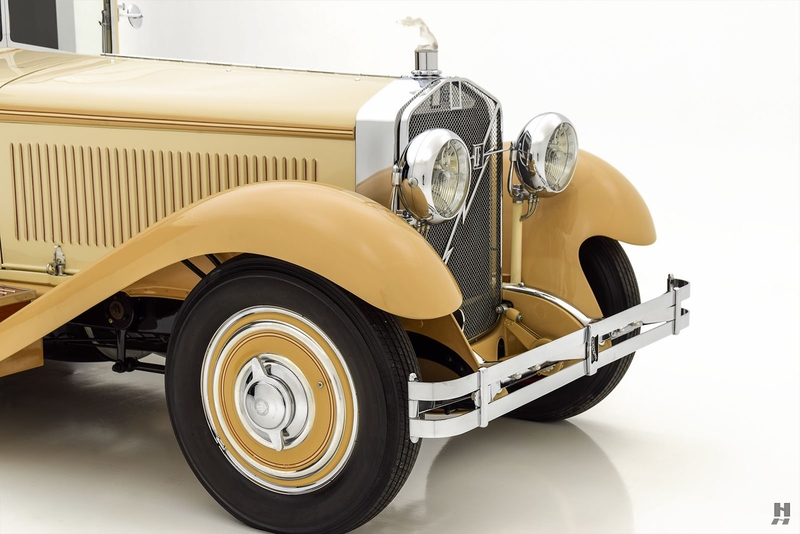
Seemingly in defiance of time, this Isotta-Fraschini remains utterly breathtaking today. The restoration has aged gracefully, with only some minor cracking in the lacquer giving up the fact that 35 years have elapsed since it first rolled out of Jack Nagle’s garage. Finished in a handsome two-tone light tan, the body is accented with subtle burgundy stripes (applied by Italian craftsmen hired by Nagle to achieve the desired effect). It has since been updated with alloy wheel discs, which accentuate the long, low, and flowing lines of the Castagna coachwork. The body is exquisitely appointed: From the magnificent Stephen Grebel headlamps and spot lamp to the intricately crafted running board plates, the detail is impressive. Currently, a Lalique Crystal goddess mascot tops the radiator; however, the sale includes an incredibly rare factory mascot, restored to the same standard as the rest of the fine car.
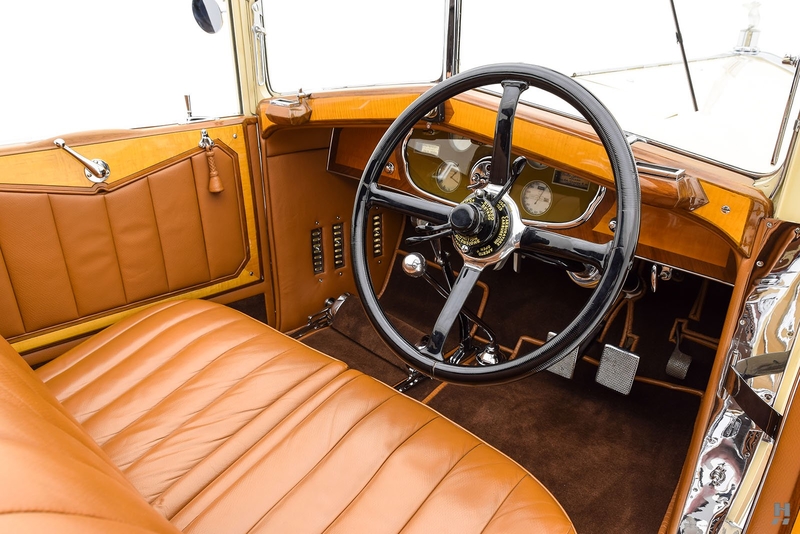
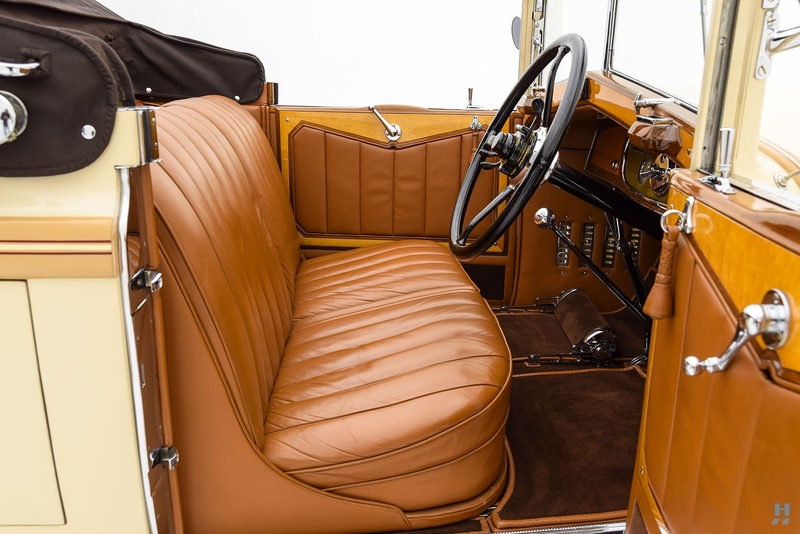
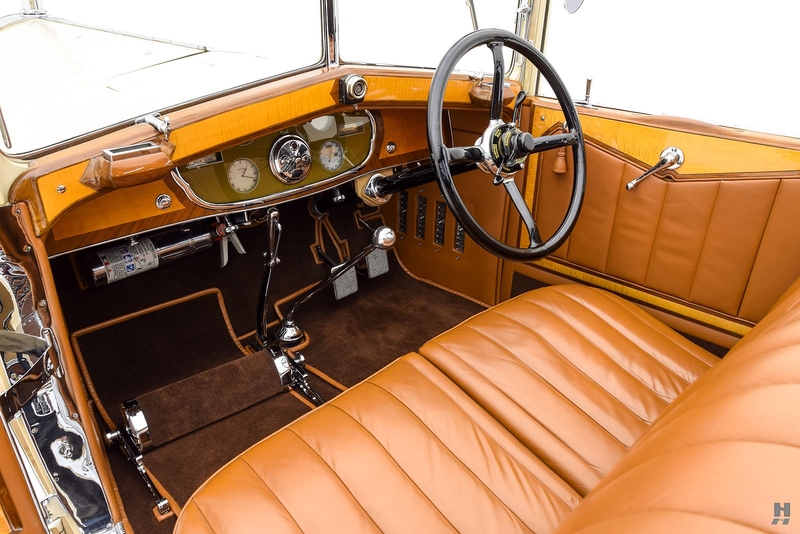
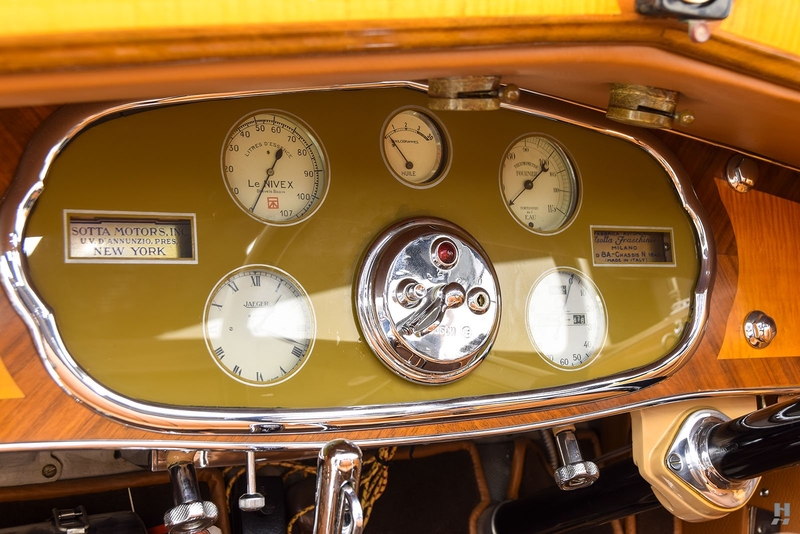
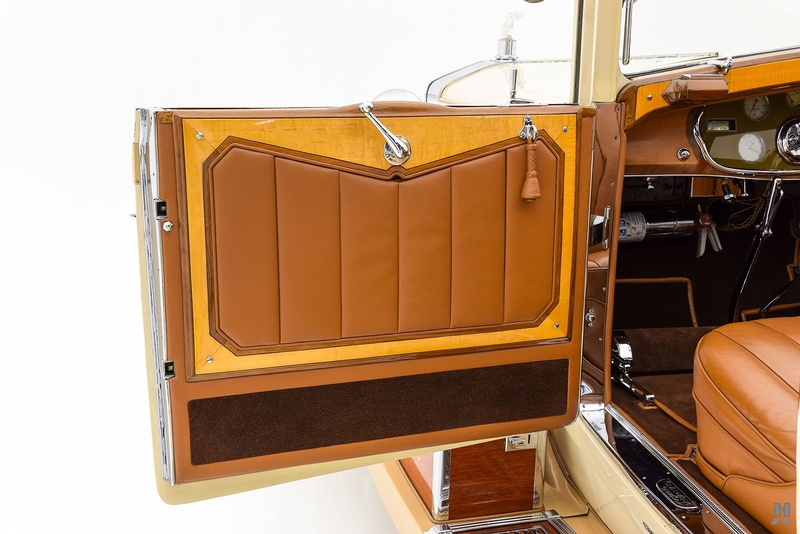
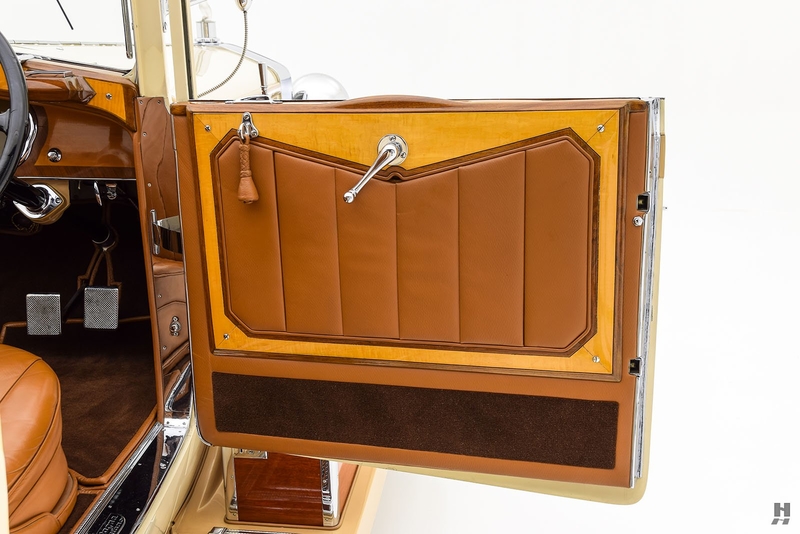
Providing a pleasing contrast to the body color scheme is a richly appointed dark tan leather interior. The upholstery is supple, taut, and finished to a very high standard, showing a fabulous character acquired through time and care. A hallmark of this Castagna coachwork is the intricate wood trim on the door panels, instrument fascia, and even in the rumble seat compartment. During the restoration, someone began fitting burl walnut, assuming it would look better than the original – however, Mr. Nagel insisted on its removal and replacement with pecky walnut and maple, as that was exactly true to original specification. The wood is gorgeous, with only a slight mellowing to the impeccable finish. A period tool kit accompanies the car, as well as reproduction owner’s manual and parts manual.
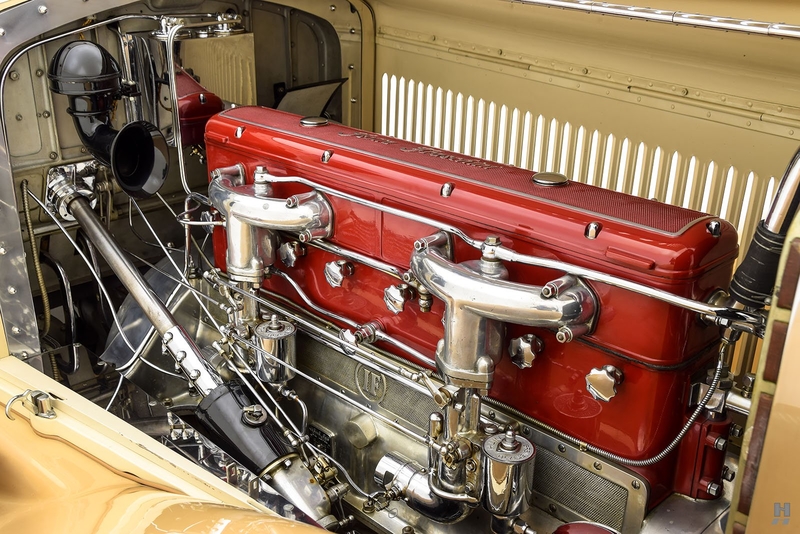
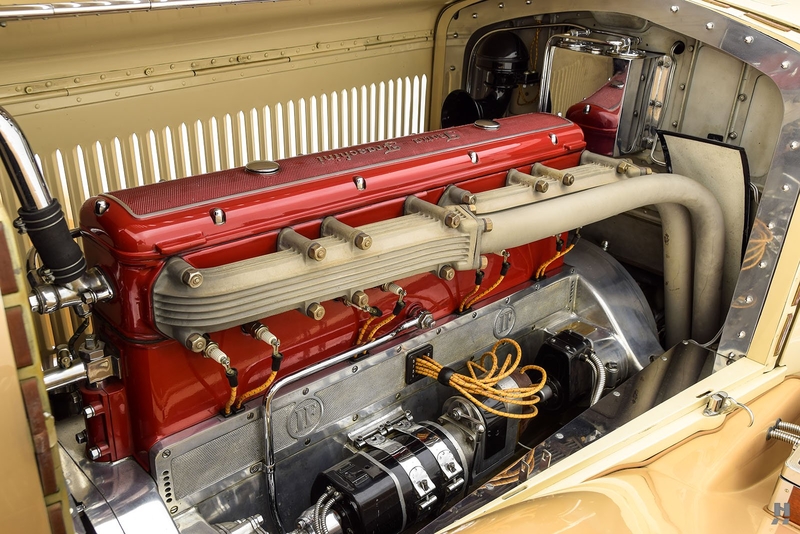
The mighty 7.3-liter, overhead valve, inline-eight is more than up to the task of propelling the big Isotta along with ease. In twin-carburetor S.S. specification as this car, the engine makes an impressive 160 horsepower and an ocean of torque. With the signature bright red cylinder block, the jewel-like presentation continues on the engine, which was completely rebuilt during the restoration.
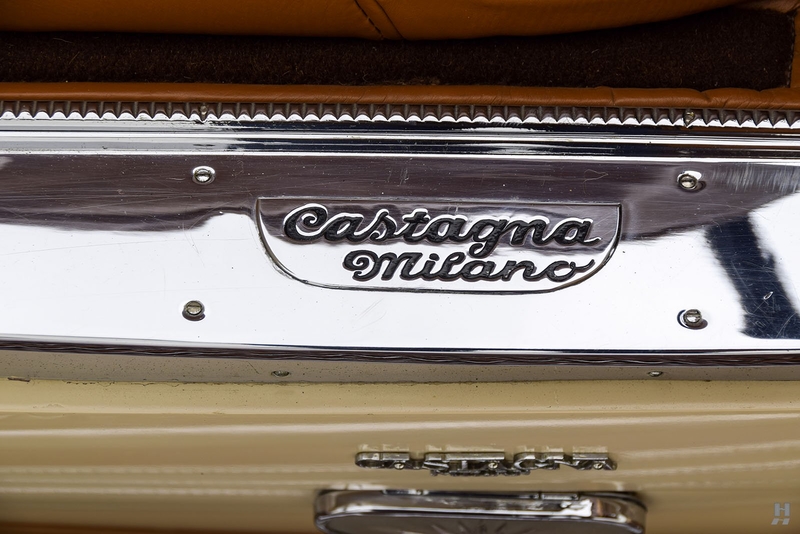
Compared with the Americans and other European neighbors, Italy’s contribution to Classic Era automobiles was somewhat smaller, yet as we see with this exceptional motorcar, no less impactful. The coming together of Isotta-Fraschini chassis and Castagna coachwork is one of the most desirable marriages in all of motoring, and this sporting, elegant convertible coupe is one of the prettiest of the breed. With its fascinating history and impeccable restoration, this example is ready for the next keeper to carry on its remarkable legacy.
Offers welcomed and trades considered
https://hymanltd.com/vehicles/6413
1930 Isotta-Francini Tipo 8A 8A SS Castagna Roadster is listed sold on ClassicDigest in St. Louis by Mark Hyman for Not priced.
Car Facts
Car type : Car Make : Isotta-Francini Model : Tipo 8A Model Version : 8A SS Castagna Roadster Engine size : 0.0 Model Year : 1930 Sub type : Convertible Location : Missouri
Sold
Seller Information
Sold
Other cars listed for sale by this dealer
AC Cobra 289
195000$
Missouri
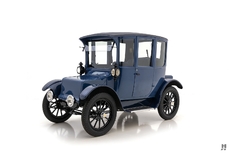
Other Other
142500$
Missouri
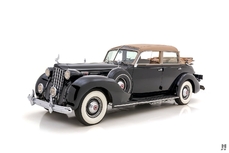
Packard Twelve
139500$
Missouri
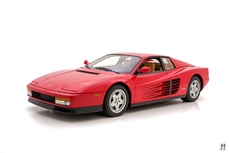
Ferrari Testarossa
159500$
Missouri
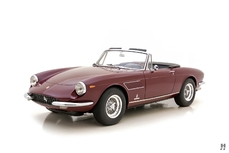
Ferrari 330 GTS
2275000$
Missouri
About Isotta-Francini
The history of Isotta-Fraschini, an Italian luxury automobile manufacturer, is a fascinating tale of opulence, innovation, and enduring style. Let's explore this illustrious journey, highlighting some of the different models produced over the years.The Early Years:
Isotta-Fraschini was founded in Milan, Italy, in 1900 by Cesare Isotta and the brothers Vincenzo, Antonio, and Oreste Fraschini. The company initially focused on manufacturing cars and luxury vehicles, becoming one of the first Italian automakers to do so. Their early models, such as the Isotta-Fraschini Tipo 8, were known for their advanced engineering and meticulous craftsmanship.
The Pre-War Glory:
Isotta-Fraschini rose to prominence in the pre-World War I era and was particularly celebrated for its high-quality, finely detailed automobiles. In 1908, they introduced the Tipo 20/30, powered by a 7.3-liter inline-four engine, and later the Tipo 8, featuring a revolutionary 7.4-liter straight-eight engine. These models became popular among the European elite, and Isotta-Fraschini cars were often chosen by royalty, celebrities, and heads of state.
The Interwar Period:
The 1920s and 1930s marked a golden era for Isotta-Fraschini. The company continued to produce luxurious and powerful cars, including the Tipo 8A, which boasted a refined chassis and a variety of coachbuilt bodies. The Tipo 8A became synonymous with elegance and sophistication, attracting an exclusive clientele. Isotta-Fraschini's V8 engines were revered for their smoothness and power, making the brand a symbol of luxury and prestige.
The Art Deco Style:
During the Art Deco era, Isotta-Fraschini collaborated with renowned coachbuilders such as Castagna, Touring, and Zagato to create custom-bodied masterpieces. These one-of-a-kind designs showcased the brand's commitment to artistry and craftsmanship. The Isotta-Fraschini Tipo 8A S LeBaron Boattail Speedster is a notable example, celebrated for its exquisite styling and performance.
The Decline and Post-War Years:
World War II disrupted production for Isotta-Fraschini, and the post-war period presented challenges for luxury automakers. The company faced financial difficulties, leading to the discontinuation of car production in the late 1940s. Isotta-Fraschini shifted its focus to producing industrial and marine engines.
While Isotta-Fraschini cars became increasingly rare, they remained highly sought after by collectors and connoisseurs due to their exceptional craftsmanship and timeless elegance.
Modern Revival:
In the 1980s, an attempt was made to revive the Isotta-Fraschini brand, and a new luxury car was introduced, the Isotta-Fraschini T8. Despite its modern features, it didn't achieve the same level of acclaim as its historic predecessors.
The legacy of Isotta-Fraschini lives on through its classic automobiles, which continue to be treasured by car enthusiasts and collectors. These cars represent a bygone era of luxury and craftsmanship, and they remain symbols of enduring style and innovation in the automotive world. Isotta-Fraschini's historical impact on the realm of luxury automobiles is a testament to the brand's enduring prestige and heritage.