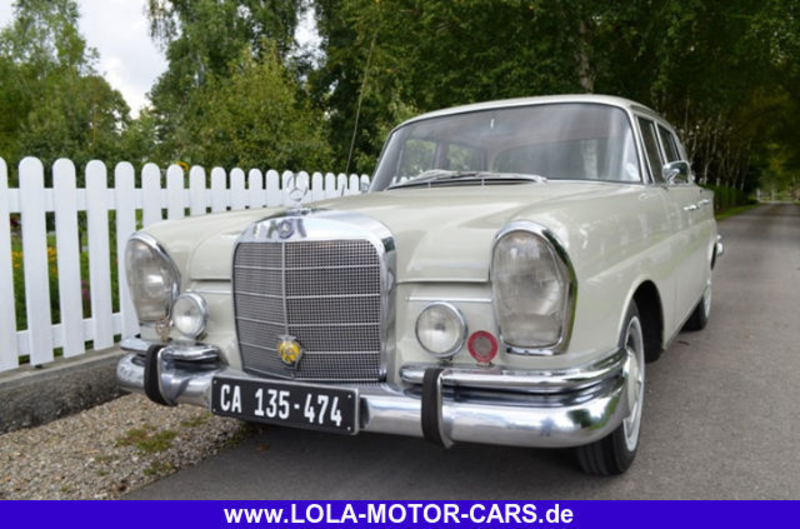

Mercedes-Benz 230S w111 Fintail S | W111 | Heckflosse | Automatik | 1967
General description :
1967 | MERCEDES 230 S | W111 | Heckflosse | Automatik |
Aufbruch in eine neue Zeit! Mit Panoramascheiben, Heckflossen und jeder Menge Platz läutete der neue 220er die Ära der Einheitskarosserie ein. Ein Trendsetter war erschienen...
Hier ein behutsam restaurierter 230er mit Lenkrad-Automatik. Ein aus Südafrika stammendes Fahrzeug mit RHD / Rechtslenkung und sehr guter Blechsubstanz - aufgrund des trockenen Klimas.
FARBEN | INTERIEUR
Lackierung beige
Interieur Kunstleder rot
Teppichboden grau
Armaturenbrett Holz mit Leder
Instrumente Chrom
TECHNIK
2.300 ccm | 120 PS | 6 Zylinder
3-Gang-Lenkrad-Automatik
Armaturen Meilen
Original-Lenkrad in Elfenbein
RHD
Außenspiegel links / rechts
Ausstellfenster links / rechts
Mittelarmlehne vorne / hinten
Nebel- bzw. Zusatzscheinwerfer
Sicherheitsgurte vorne
Stahlfelgen mit Original-Chromzierringen und Radkappen
Weißwand-Reifenringe
INFORMATIONEN
Tachostand abgelesen 59.986 mls = 95.977 km
Gesamtlaufleistung unbekannt
Interieur / Sitze neu bezogen
Dachhimmel mit Original-Kunstleder neu bezogen
Armaturenbrett Holz und Leder restauriert bzw. neu
schöne behutsame Restaurierung
Teillackierung
DOKUMENTE
(ZA) Fahrzeugpapiere Südafrika vorhanden
(D) Deutsche Fahrzeugpapiere §§ 21, 23 und 29 mit neuer HU und H-Kennzeichen / Oldtimerzulassung auf Anforderung möglich
Unsere Fahrzeug Nr. 369MB88Weitere interessante Klassiker finden Sie auf unserer Homepage, http://www.lola-motor-cars.de. Dort finden Sie bis zu 30 Bilder von den Fahrzeugen. Noch mehr Bilder, Detailaufnahmen und Bilder auf der Hebebühne, senden wir Ihnen gerne auf Anfrage, per Email zu. Angebot freibleibend. Zwischenverkauf und Irrtümer vorbehalten. Verkauf im Kundenauftrag. Differenzbesteuerung laut § 25a UStG.
Unsere Öffnungszeiten sind von Montag bis Freitag von 09.00 bis 18.00 und Samstag von 09.00 bis 14.00. Wir bitten freundlichst um Terminabsprache. Unsere Ausstellungsräume befinden Sie sich 12 km von der Autobahn A8 München – Stuttgart, und 14 km von der Autobahn Würzburg – Füssen entfernt. Mit Günzburg haben wir eine InterCity-Station und die Flughäfen München, Stuttgart oder Memmingen sind nur 100 km entfernt.
Transport: Gerne unterbreiten wir Ihnen ein Angebot für eine Anlieferung in geschlossenen oder offenen LKW.
Finanzierung / Leasing: Gerne lassen wir Ihnen ein Angebot für eine Finanzierung bzw. Leasing des Fahrzeuges unterbreiten.
Verkauf Ihres Klassikers: Sie wollen einen Klassiker oder Ihre Sammlung verkaufen? Gerne beraten wir Sie und übernehmen den Verkauf. Diskret, ohne Kosten, Arbeit und Ärger für Sie! Rufen Sie uns an +49 (0)9073 800.190.
http://home.mobile.de/LOLAMOTORCARSGMBH#des_232474951
1967 Mercedes-Benz 230S w111 Fintail S | W111 | Heckflosse | Automatik | is listed sold on ClassicDigest in Adalbert-Stifter-Straße 8DE-89423 Gundelfingen a d Donau by Auto Dealer for €17900.
Car Facts
Car type : Car Make : Mercedes-Benz Model : 230S w111 Fintail Model Version : S | W111 | Heckflosse | Automatik | Engine size : 2.3 Model Year : 1967 Sub type : Sedan Location : Adalbert-Stifter-Straße 8DE-89423 Gundelfingen a d Donau
Sold
Seller Information
Sold
People who viewed this Mercedes-Benz 230S w111 Fintail also viewed similar Mercedes-Benz listed at ClassicDigest
Mercedes-Benz 230S w111 Fintail
16900 €
Wehntalerstrasse 25 CH-8165 Oberweningen, Switzerland
Mercedes-Benz 230S w111 Fintail
23500 €
Saxtorp
Other cars listed for sale by this dealer
Mini Cooper
22900€
Adalbert-Stifter-Straße 8DE-89423 Gundelfingen a d Donau
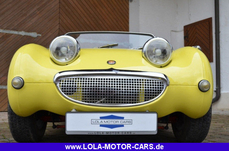
Austin-Healey Sprite
33900€
Adalbert-Stifter-Straße 8DE-89423 Gundelfingen a d Donau
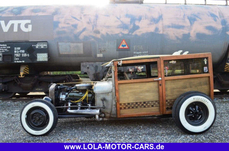
Ford Model B
38900€
Adalbert-Stifter-Straße 8DE-89423 Gundelfingen a d Donau
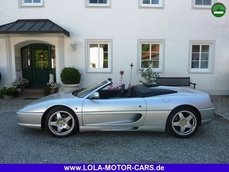
Ferrari
79900€
Adalbert-Stifter-Straße 8DE-89423 Gundelfingen a d Donau
Jaguar Mk2
21900€
Adalbert-Stifter-Straße 8DE-89423 Gundelfingen a d Donau
About Mercedes-Benz
In the annals of automotive history, the journey of Mercedes-Benz is a tale that unfolds with the ingenuity of its founding pioneers. In the year 1886, Karl Benz crafted the Benz Patent Motorwagen, a creation that would go down in history as the world's inaugural automobile. Unbeknownst to him, this moment marked the genesis of what would evolve into the most illustrious premium car manufacturer globally. The financial underpinning of this pioneering venture, interestingly, was provided by Karl Benz's wife, Bertha Benz, demonstrating a remarkable partnership that would set the tone for Mercedes-Benz's legacy.A parallel narrative emerged not far away, as Daimler-Motoren-Gesellschaft, founded by Gottlieb Daimler and Wilhelm Maybach, entered the scene. In 1901, they unveiled their automobile under the now-famous moniker "Mercedes," meaning "godsend" in Spanish. This name was bestowed upon the car at the behest of Emil Jellinek's daughter, the distributor for Daimler-Motoren-Gesellschaft. The wheels of innovation were set in motion.
Fast forward to 1926, a pivotal year that witnessed the merger of Daimler with Benz & Cie., culminating in the birth of Daimler-Benz. The amalgamation saw the adoption of "Mercedes-Benz" as the distinguished trademark for their automobiles, fusing the legacies of two visionary entities into one.
Contrary to perceptions of conservatism, the trajectory of Daimler-Benz unfolds as a chronicle of industry firsts. From the introduction of the honeycomb radiator to the float carburetor, and the pioneering implementation of four-wheel brakes in 1924, Daimler-Benz consistently pushed the boundaries of automotive innovation. The diesel-powered Mercedes-Benz 260 D in 1936 marked the inception of diesel engines in passenger cars. The iconic Mercedes-Benz 300SL Gullwing made history as the first car with direct fuel injection, albeit the Gutbrod's tiny 2-stroke engine can claim precedence.
Safety innovations became a hallmark, with Béla Barényi's patented safety cell design in the "Ponton"-models in 1951, featuring front and rear crumple zones. The W116 450SEL 6.9 saw the introduction of the Anti-Lock Brake system (ABS), another pioneering safety feature. From the first production airbags and beyond, the legacy of "firsts" continued to be etched into the fabric of Daimler-Benz.
Over its centennial journey, Mercedes-Benz has not merely produced cars but has sculpted automotive icons. The SSKL, 710 SSK Trossi Roadster, 770K Grosser, 540K Spezial Roadster, 300SL Gullwing, w100 600 Pullman, w111 280SE 3.5 Flachkühler, w113 230SL Pagoda, w109 300 SEL 6.3, and w201 2.3-16 Cosworth stand testament to the brand's commitment to engineering excellence.
The roaring Silver Arrows, or "Silberpfeile," including the W 25, W 125, W154, W165, and W196, created a legacy of dominance on the racetrack. These machines were not merely cars; they were expressions of precision, speed, and an indomitable spirit that left their competitors in the dust.
As Mercedes-Benz marches into the future, it does so not just as an automaker but as a custodian of a legacy, a torchbearer of innovation, and a beacon of automotive excellence. The road ahead is sure to witness the continued fusion of cutting-edge technology, timeless design, and an unwavering commitment to setting new standards in the world of automobiles.
One luminary figure who left an indelible mark was Béla Barényi, often heralded as the "father of passive safety" for his pioneering work in safety engineering. His patented safety cell design, featuring front and rear crumple zones, became a hallmark of Mercedes-Benz's commitment to occupant safety, setting new standards that reverberated throughout the automotive world.
Moving through the chronicles, the collaborative genius of Wilhelm Maybach, alongside Gottlieb Daimler, laid the foundation for Daimler-Motoren-Gesellschaft. Their innovations not only birthed the first Mercedes but established a culture of relentless pursuit of technological excellence that remains integral to Mercedes-Benz's DNA.
In the post-merger era of 1926, Ferdinand Porsche emerged as a prominent figure within Mercedes-Benz. His work on the Mercedes-Benz S-Type, a supercharged race car, garnered acclaim and set the stage for a legacy that extended far beyond the marque. Porsche's impact would later extend to his eponymous company, but his influence at Mercedes-Benz during those formative years was pivotal.
As the 20th century progressed, the legendary Rudolf Uhlenhaut emerged as a key figure. Uhlenhaut, an accomplished engineer and the driving force behind the iconic Silver Arrows, played a crucial role in Mercedes-Benz's dominance in motorsports. His engineering prowess and attention to detail were instrumental in creating some of the most formidable racing cars of the era.
In the latter half of the century, figures like Bruno Sacco, the head of design at Mercedes-Benz from 1975 to 1999, left an indelible imprint on the brand's aesthetic identity. Sacco's design philosophy, characterized by clean lines and timeless elegance, shaped iconic models like the W126 S-Class and the W201 190E, solidifying Mercedes-Benz's reputation for luxury and sophistication.
The narrative would be incomplete without acknowledging the contributions of engineers like Hans Scherenberg, whose leadership in the 1970s ushered in a new era of technological innovation at Mercedes-Benz. Scherenberg's tenure saw the development of groundbreaking technologies, including the Anti-Lock Brake system (ABS) and the introduction of airbags in production cars.