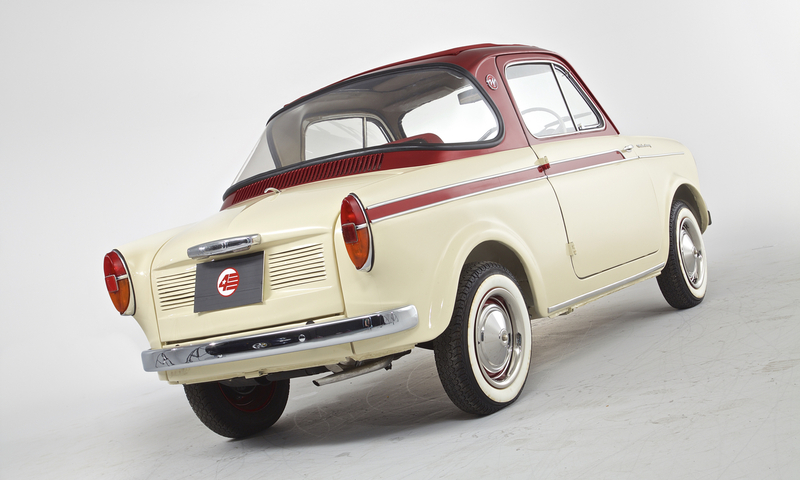

Neckar Weinsberg 500 Coupe 1963
General description :
A fully-restored Weinsberg coupe, one of only 5 RHD.
MODEL HISTORY
NSU-Fiat was a German car manufacturer that produced Fiat vehicles under license at a plant acquired from NSU in Heilbronn from 1929 to 1957. In 1957, following a complicated litigation process over the right to use the by now increasingly high profile ‘NSU' name on passenger cars, the name used for the Fiat-designed cars was changed to Neckar, and with this name the company continued to produce Fiats in Germany until 1971.
The Neckar Weinsberg 500 was produced in two versions, the Limousette and Coupé, and was based on the Fiat Nuova 500 (1957-1977), with equal driving performance and handling characteristics. Introduced in March 1959 as the NSU/Fiat, 6,228 vehicles were manufactured from 1959 to 1963, with daily production peaking at 14 cars. The price was 3,840DM in 1959 and 3,620DM in 1962.
The Coupe and the Limousette only differed in their rear window design: The coupé featured a wraparound panoramic rear screen, allowing only enough headroom above the rear seat for small children. The Limousette, however, had rear side windows and a steeper, conventional rear window like a small saloon, hence the name.
In contrast to the Autobianchi Bianchina (an Italian 500-based minicar), both Weinsberg versions were built from partially assembled car bodies with modifications to both front and rear panels. The front bonnet is higher, as is the wing profile, with finned rear wings and rear lights that are unique to the Weinsberg. The cars benefited from some equipment upgrades in character with a luxury version: a sunroof instead of a folding roof, special bumpers, standard two-tone paint and wheel covers, an ashtray in the dashboard, better upholstery fabrics, and wide pockets in the doors.
Never officially intended for the UK market, only five RHD cars are known to exist. What's more, the survival rate of these Neckars has not been good, with only approximately 50 cars currently known to the Neckar Weinsberg register.
Equipment
Sunroof, Chrome wheel covers, Suicide doors, Ashtray, Fitted carpets, Spare wheel.
EXTERIOR
The exterior of this charming little coupe is presented in ivory with a contrasting metallic burgundy roof. An extensive restoration of the Neckar has recently been completed by specialists Italclassic, and the result is this splendid example of a seldom seen automobile.
The quality of the paintwork is to a high standard throughout, with absolutely no marks or damage to note whatsoever. On close inspection much of the original trim has been retained, with replacement items fitted only where necessary.
INTERIOR
The interior has been fully re-trimmed and appears as new. Upholstered in red leatherette, the seats present impeccably and show no signs of any wear at all. The painted dash and fascia are free from any chips or scratches, and the switchgear still feels solid to operate.
The interior is sparsely equipped however this only adds to the period charm. What's great is that no modern ‘upgrades' have been fitted, which makes driving this Neckar feel like you've taken a step back in time.
ENGINE & TRANSMISSION
Opening the rear hatch you'll find the original 479cc Fiat unit. Having had the engine removed during restoration, the engine bay appears very fresh with no corrosion at all. The engine and gearbox underwent a full rebuild in 2009 but the car has seen little or no use since then.
Maintaining plenty of originality, the components retain a nice patina with everything appearing just as they should. The Neckar starts instantly and idles up to temperature without fuss.
WHEELS, TYRES & BRAKES
The Neckar sits on the correct set of 12-inch wheels, presented in metallic burgundy and finished with chrome embellishers; they are as new throughout.
The wheels are shod in a brand new set of tyres with no wear to speak of.
HISTORY FILE
Believed to be one of only five right-hand drive Neckar Weinsbergs in existence, this rare coupe was supplied in 1963 to Saint Helier, Jersey. In its early years the car changed hands between companies at the same address but was eventually sold to a lady with a Spanish surname. She owned the Neckar until it was confiscated in Alicante by Spanish customs in 1986, "in lieu of payment of fines". All of this is documented by the Jersey Archives.
As normal in these cases, the car was auctioned off to recover some revenue. Because of its age and illegality it was sold for ‘scrap', but fortunately went to a pioneer car collector and former president of the Veteran Car Club of Spain, Eugenio Martin Rubio. Eugenio had a very keen eye for the unusual and saved a lot of interesting cars from the crusher. The mileage of 31,000 miles is believed to be original.
The Neckar was parked up on jacks and remained untouched until 2008, when Eugenio began to sell off his collection. The vehicle was then purchased by the current owner who started the restoration process shortly after. The first stage was mechanical; a garage in Alicanti rebuilt the engine and gearbox in 2009. The project then remained on hold until 2013, at which point all aspects of the restoration were managed by the Spanish company Italclassic at a cost of over £11,000.
The owner's philosophy was to build a show car with a focus on originality. The factory colour scheme, however, was changed to a more pleasing aesthetic, but only Fiat/Lancia colours were chosen. All major components are original with only consumables having been replaced. Some parts unique to the Neckar, such as mouldings and the rear screen, were re-made from scratch by a bodywork specialist named Marcos Blastor. Others fixtures such as the rear lights and badges came from swap meets, etc. throughout Europe.
http://www.4starclassics.com/neckar-weinsberg-500-coupe-for-sale/
1963 Neckar Weinsberg 500 Coupe is listed sold on ClassicDigest in Kingsley by 4 Star Classics for £19995.
Car Facts
Car type : Car Make : Neckar Model : Weinsberg Model Version : 500 Coupe Engine size : 0.5 Model Year : 1963 Sub type : Coupé Location : Hampshire Vehicle Registration : Normal
Sold
Seller Information
Sold
Other cars listed for sale by this dealer
Datsun 240Z
39995£
Hampshire
Volkswagen Karmann-Ghia
36995£
Hampshire
Peugeot 205
10995£
Hampshire
Mercedes-Benz 500SL r129
19995£
Hampshire
BMW 735
29995£
Hampshire
About Neckar
Neckar, although a smaller automotive manufacturer, held significant importance for many individuals as it provided an affordable option in the automobile market. Here's an overview of Neckar's history and its various models from inception to the end:Early Years and Formation:
Origins: Neckar Automobilwerke GmbH was a German automobile manufacturer based in Heilbronn, originally founded in 1901 as a bicycle and motorcycle factory.
Transition to Cars: In the post-World War II era, Neckar transitioned to car production. Initially, they collaborated with Fiat, producing licensed versions of Fiat models.
Evolution of Neckar Models:
Neckar-Fiat 500: Produced in the 1950s, it was a rebadged version of the Fiat 500 (also known as the Topolino). This compact car gained popularity due to its affordability and efficiency.
Neckar Jagst: Launched in the late 1950s, the Neckar Jagst series included various models such as the Jagst 770, Jagst 900, and others. These were based on the Fiat 600 platform but featured unique styling cues.
Neckar Panthor: An offshoot of the Jagst series, the Panthor was a compact car featuring a distinctive design and shared mechanical components with the Fiat-based models.
Neckar Europa: In the early 1960s, Neckar introduced the Europa, a compact car based on the Fiat 1100. It was offered in sedan and coupe variants and was relatively well-received.
Later Years and Acquisition:
Merger with Daimler-Benz: In 1961, Daimler-Benz acquired a majority stake in Neckar. This marked a shift in focus for the company, eventually leading to the cessation of Neckar-branded car production.
Transition to Mercedes-Benz: Neckar's Heilbronn facilities were utilized by Daimler-Benz to produce various Mercedes-Benz models after the acquisition, including the W108 and W109 series.
Legacy:
Affordable and Accessible: Neckar cars were known for providing a budget-friendly option for many individuals, offering reliable transportation during their production years.
Transition to Daimler-Benz Production: While Neckar cars ceased to exist, their legacy lived on through the utilization of their facilities by Daimler-Benz for the production of Mercedes-Benz vehicles.
Neckar's history represents a transitional phase in the German automotive industry, where affordability and accessibility played a key role in providing transportation solutions for a broad consumer base.