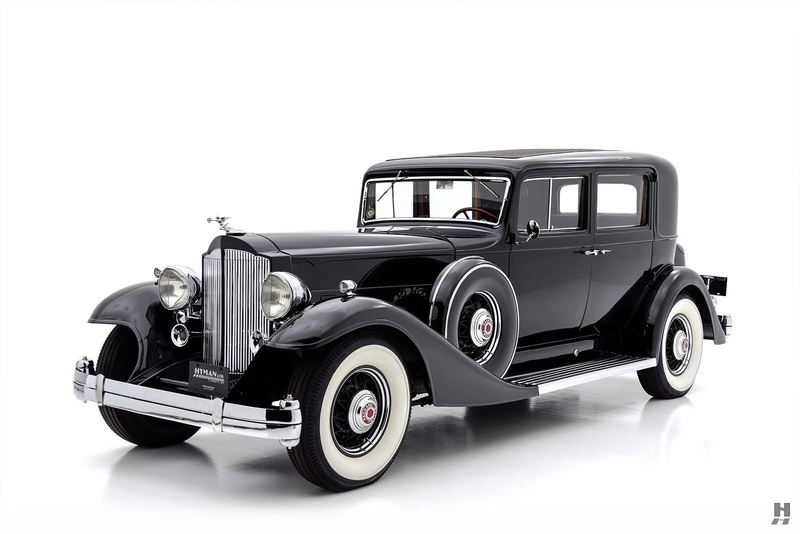

Packard Twelve Club Sedan 1933
General description :
The beautiful Packard Tenth Series was introduced in 1933 at the 33rd National Automobile Show. The entire model range had been revamped with new styling and new names. The old Standard Eight, Deluxe Eight, and Twin-Six nomenclature was dropped for the simpler Eight, Super Eight and Twelve. Packard execs felt the new names were more upscale and helped differentiate Packard from entry-level eight cylinder cars from the likes of Ford. Names aside, the new Tenth Series featured the first hints of streamline styling trends that were creeping into automobile design at the time. Front fenders were skirted for a fuller look, and the radiator grille featured a Vee-design. Beneath the body was a new X-member frame, 17-inch wheels, and refinements to the adjustable power braking and ride control systems. The flagship of the fleet was the Twelve, available as the Model 1005 on a 142-inch wheelbase, or the Model 1006 on the 147-inch wheelbase. With the 1005, buyers had eleven body styles to choose from, while the 1006 was only offered in two formal limousine styles. Interestingly, Packard produced the 10th Series for only eight months until the 11th series replaced it. As a result, just 525 Twelves were built in 1933.
This 1933 Packard Twelve 1005 wears handsome Club Sedan coachwork from the factory catalog and is one of only a handful of known survivors. This lifelong California car was first sold in August 1933 via Earle C. Anthony’s Los Angeles showroom, though little of its subsequent early history is known. In February 1979, this car surfaced in a classified ad in the LA Times. The advertisement described the car as one of 5 known examples, and while it was mostly complete, it was in need of a total restoration.
An artist, avid car collector, and restorer from nearby Altadena, California, Mr. Ron Lawless, recognized the rarity and importance of the car and soon brought the derelict Packard home. The late Mr. Lawless would restore the car himself over a ten year period, painstakingly disassembling it down to a bare chassis and rebuilding every component along the way. Period photos show the car was complete but rough, requiring considerable effort to return it to its former elegance. While indeed an ambitious project, Mr. Lawless was up to the task and the results are truly outstanding. He would go on to enjoy his finely restored Packard for nearly 40 years.
With the restoration completed by the late 1980s, Ron showed his Packard extensively on the West Coast, earning numerous awards along the way. In 1989, the Packard was entered in a CCCA Grand Classic where it received a National First Prize and Senior badge. As late as 2009, it was still being shown, winning its class at the LA Concours.
Today, the restoration has matured, and the car has taken on a very pleasing and attractive patina. The Club Sedan coachwork is understated and handsome, and the bodywork appears straight, tidy, and exhibits sound fit and finish, a testament quality of the original restoration. The black paintwork is glossy and attractive, with some minor cracking visible in the lacquer in places. This car is well equipped with dampened bumpers (standard on the Twelve and optional on the Super Eight), dual side-mount spare wheels with painted covers, trunk rack, and dual chrome trumpet horns. The chrome is very good overall, with bumpers and headlamps in excellent condition, and only some minor pitting found on smaller parts.
Packard intended the Club Sedan to be a luxury car for the owner-driver, so accommodations in the front and rear are generous and comfortable. The cabin is trimmed in lovely blue-gray fabric in both front and rear, with complementary carpet and headlining. The upholstery is remarkably well-preserved for what is nearly a 30-year-old restoration, appearing clean, tidy and generally free of excessive wear. Restored woodwork surrounds the windows, while wood-grained metal panels (Mr. Lawless’ specialty) dress instrument panel. Factory correct switches, controls, and Waltham instruments all present in fine condition.
Under the hood rests Packard’s sublime 445.5 cubic-inch L-head V12, producing 160 horsepower in standard form. Photos show the engine was rebuilt at the time of the restoration, and it remains appropriately detailed in proper Packard green with period correct plumbing and hardware. Some of the enamel on the manifolds has worn off in the course of moderate use, which is not out of the ordinary for an older restoration. Otherwise, the finishes and detailing remain in very good order. It is a delight to drive, with prodigious power and the smooth, easy-driving nature that is expected from a Packard of this era.
Rare and elegant, this Packard Twelve has been well-maintained and enjoyed by a dedicated enthusiast for the past 40 years. Its charming, care-worn patina and usable nature make it a prime candidate for AACA tours, CCCA CARavan touring or similar driving events and is sure to entertain its next keeper for many more years.
https://hymanltd.com/vehicles/6232
1933 Packard Twelve Club Sedan is listed sold on ClassicDigest in St. Louis by Mark Hyman for $102500.
Car Facts
Car type : Car Make : Packard Model : Twelve Model Version : Club Sedan Engine size : 0.0 Model Year : 1933 Sub type : Sedan Location : Missouri
Sold
Seller Information
Sold
People who viewed this Packard Twelve also viewed similar Packard listed at ClassicDigest
Packard Twelve
139500 $
Missouri
Packard Twelve
249500 $
Missouri
Packard Twelve
189500 $
Missouri
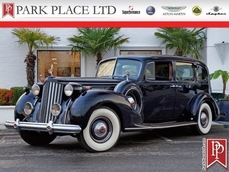
Packard Twelve
109950 $
13710 NE 20th Street Bellevue, WA 98005
Other cars listed for sale by this dealer
AC Cobra 289
195000$
Missouri
Other Other
142500$
Missouri
Packard Twelve
139500$
Missouri
Ferrari Testarossa
159500$
Missouri
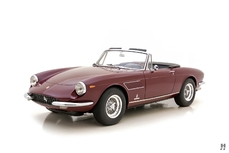
Ferrari 330 GTS
2275000$
Missouri
About Packard
Packard: A Comprehensive HistoryEarly Years and Foundation:
Founding: The Packard Motor Car Company was established in 1899 in Warren, Ohio, by James Ward Packard, William Doud Packard, and George Lewis Weiss.
Pioneering Luxury: Initially producing high-quality automobiles, Packard became synonymous with luxury, craftsmanship, and engineering excellence.
Notable Achievements and Contributions:
Packard Twin Six: Introduced in 1916, this V12-powered car established Packard as a premier luxury automobile brand.
Model Line Expansion: Packard expanded its lineup with various models, including sedans, coupes, convertibles, and limousines, catering to affluent customers seeking elegance and performance.
Engineering Innovations: The brand introduced several innovations, such as the first use of aluminum pistons, air conditioning, and the Ultramatic automatic transmission.
Ten Historically Significant Models with Technical Specifications:
Packard Twin Six (1916):
Engine: 7.3L V12 engine.
Performance: Around 85 horsepower.
Packard Eight (1930-1938):
Engine: Straight-8 engine with various displacements.
Performance: Ranged from 90 to over 130 horsepower.
Packard Super Eight (1939-1951):
Engine: Straight-8 engine.
Performance: Produced between 130 to 180 horsepower.
Packard One-Twenty (1935-1942):
Engine: Straight-8 engine.
Performance: Approximately 100 to 120 horsepower.
Packard Clipper (1941-1957):
Engine: V8 engine.
Performance: Ranging from 135 to 185 horsepower.
Packard Caribbean (1953-1956):
Engine: V8 engine.
Performance: Varying between 275 to 310 horsepower.
Packard Patrician (1951-1956):
Engine: Inline-8 and V8 engines.
Performance: Ranged from 150 to 180 horsepower.
Packard Hawk (1958):
Engine: V8 engine.
Performance: Produced around 275 horsepower.
Packard Executive (1956-1958):
Engine: V8 engine.
Performance: Varying between 240 to 290 horsepower.
Packard Predictor (1956):
Engine: Concept car showcasing design and technology.
Performance: Prototype model.
Legacy and Influence:
Quality and Elegance: Packard was revered for its exceptional build quality, refined styling, and luxury features, often considered on par with European luxury brands like Mercedes-Benz.
End of Production: The brand faced financial struggles in the 1950s, leading to its merger with Studebaker and eventual discontinuation in the late 1950s, marking the end of an era in American luxury automobiles.
Packard left an enduring legacy in the automotive industry, symbolizing elegance, engineering excellence, and a commitment to luxury that has been admired and respected by car enthusiasts worldwide.