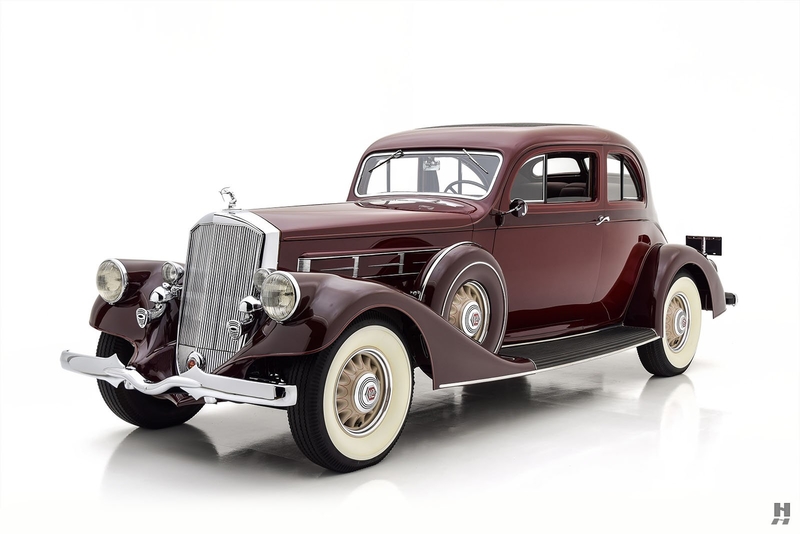

Pierce-Arrow model 6-66 Model 1245 Silver Arrow Coupe 1935
General description :
From George Pierce’s first single-cylinder Motorette in 1901 to the final twelve-cylinder car built for engineer Karl Wise in 1938, Pierce-Arrow stood proudly for quality, craftsmanship, and luxury. Along with Packard and Peerless, the Buffalo, New York firm build America’s finest luxury motorcars, earning a loyal clientele along the way. Despite the impeccable reputation, Pierce-Arrow, like many of its high-end contemporaries, struggled with limited dealer network and challenging economic conditions. Also, a takeover by bankers after World War I saw Pierce-Arrow slow to respond to buyer’s wishes, and their products soon became stale and dated. Help arrived in 1928 when Pierce Arrow’s president met with Albert Erskine of Studebaker in order to negotiate a merger. The partnership allowed Pierce-Arrow to operate independently, and it gave them the cash necessary to finally introduce their long-overdue L-Head inline eight-cylinder engine as well as vastly expand their dealer network. In 1931, chief engineer Karl Wise unveiled his entry into the hotly-contested multi-cylinder race happening in America – a pair of V12 engines of 398 or 429 cubic inches. Unfortunately, the partnership between Studebaker and Pierce-Arrow was short-lived, as Studebaker fell into receivership in 1933 and Pierce was cut loose, again left to struggle as an independent in the midst of the Great Depression.
Desperate to survive and to shake their conservative image, Pierce-Arrow management hired Phil Write as a consultant to design a new flagship that would show the world of what Pierce was capable of and the resulting twelve-cylinder Silver Arrow was a streamlined sensation. It made its grand debut at the 1933 New York Auto Show with the slogan “Suddenly it’s 1940!” The sensational machine featured fully enveloped front fenders, no running boards, and a distinct fastback roof treatment with a triangular rear window opening. The design was a marvel; however, the shocking $10,000 price tag kept even the wealthiest customers away during the austere early 1930s. Only five were built, although the highly advanced styling went on to influence Pierce-Arrow’s regular production cars later in the decade, and the Silver Arrow name appeared on a flagship coupe which drew heavily from the Phil Write-penned original.
This Pierce-Arrow 1245 Silver Arrow is one of only 875 cars produced in total by the company in 1935. It is one of only two known surviving twelve-cylinder Silver Arrow coupes out of an estimated four units originally built. This exceptional motorcar features an award-winning restoration, commissioned in the 1990s by Los Angeles based collector Harris Laskey. Finished in a striking yet understated two-tone maroon color scheme, this rare and breathtaking Silver Arrow remains in excellent condition, coming most recently from an extensive collection of significant automobiles. Finish quality on the factory coachwork is expectedly high, and the detailing is superb. The color scheme cleverly plays with the shapes and lines of the body, subtly highlighting the fastback shape. Accessories are kept to a minimum, with dual side-mount spare wheels, an Archer mascot, and twin chrome trumpet horns topped with driving lamps. The tall, canted-back radiator and unique fender-mounted headlights are distinct Pierce-Arrow characteristics. The Silver Arrow is a grand and imposing car, riding on a 144-inch wheelbase and standing over six feet tall at the roof. However, the styling does a marvelous job of masking the scale and even giving the car a sporting spirit. Beige steel artillery wheels with wide whitewall tires provide a well-judged contrast.
Inside, light brown broadcloth covers the large, softly sprung front seats, door panels, and the generous rear seats. Darker brown carpets and gorgeous woodwork provide a pleasing contrast to the seat upholstery. The quality and presentation are excellent and in keeping with the high standard set by the exterior. While it is a two-door coupe, the tall roofline and long wheelbase make for generous accommodations inside. The luxurious appointment includes opening rear windows, individual front seats, and a factory-equipped radio.
The big 462 cubic-inch V12 engine presents in good order, with slight mellowing since its meticulous restoration. The black enamel finish is in good condition, with some moderate cracking and “baking off” of the paint in places due to regular use and heat cycles. The presentation is otherwise tidy, with correct hardware, clamps, and fittings used throughout the engine bay. It runs with the smoothness and refinement expected of a multi-cylinder engine of the era. At an impressive 175 horsepower, Pierce’s V12 matched Cadillac’s complex and expensive V16 for output, giving even a large car like the model 1245 very respectable performance. The engine is paired with a three-speed manual transmission, with optional freewheeling.
Since the restoration was completed, this rare Silver Arrow appeared in numerous prestigious events. It is a CCCA National First Prize winner, it appeared at the Pebble Beach Concours d’Elegance, and it won its class at the 1999 Palo Verdes Concours, and was awarded “Most Elegant” at the Silverado Concours d’Elegance. This Pierce remains in beautiful cosmetic condition and is ready to be enjoyed on CCCA CARavan tours, or with groups such as the AACA or the Pierce-Arrow Society. This is a rare opportunity to acquire one of just two known survivors of Pierce-Arrow’s most stylish and powerful offering from 1935.
https://hymanltd.com/vehicles/6338
1935 Pierce-Arrow model 6-66 Model 1245 Silver Arrow Coupe is listed sold on ClassicDigest in St. Louis by Mark Hyman for Not priced.
Car Facts
Car type : Car Make : Pierce-Arrow Model : model 6-66 Model Version : Model 1245 Silver Arrow Coupe Engine size : 0.0 Model Year : 1935 Sub type : Coupé Location : Missouri
Sold
Seller Information
Sold
Other cars listed for sale by this dealer
AC Cobra 289
195000$
Missouri
Other Other
142500$
Missouri
Packard Twelve
139500$
Missouri
Ferrari Testarossa
159500$
Missouri
Ferrari 330 GTS
2275000$
Missouri
About Pierce-Arrow
Pierce-Arrow, once considered among America's most prestigious and luxurious automobile manufacturers, contributed significantly to automotive history with its innovation, craftsmanship, and distinctive design elements. Here's an overview of Pierce-Arrow, its history, notable models, and the renowned headlights:Pierce-Arrow: An American Icon
Early Beginnings and Foundation:
Origins: Established in 1865 as a manufacturer of household goods and later bicycles, Pierce-Arrow transitioned to automobiles in the early 20th century.
Automobile Production: Officially entered the automotive market in 1901, producing high-quality cars that targeted affluent buyers.
Milestones and Remarkable Models:
Pierce-Arrow Model 66 (1910-1918):
Powerhouse: Known for its powerful 12.7-liter six-cylinder engine, showcasing impressive performance for its time.
Luxury and Innovation: Set a standard for luxury, featuring advanced engineering and opulent amenities.
Pierce-Arrow Silver Arrow (1933):
Streamlined Design: Celebrated for its sleek, futuristic design with smooth, aerodynamic lines.
Limited Production: Only five examples were produced, making it one of the most sought-after and valuable cars in automotive history.
Iconic Headlights:
Signature Headlights: Pierce-Arrow's most distinctive feature was its trademark headlights, known as "Pierce-Arrow Headlights" or "Pierce-Arrow Headlamps."
Fender-Mounted Headlights: These headlights were mounted on the fenders rather than the traditional placement on the car's body or grille, contributing to the brand's recognizable design language.
Legacy and Influence:
Luxury and Elegance: Pierce-Arrow earned a reputation for producing some of the finest luxury cars in America, appealing to affluent buyers seeking quality and prestige.
Contributions to Automotive Design: The brand's innovative design elements, such as the fender-mounted headlights, left a lasting impact on automotive styling and aesthetics.
Decline and End:
Challenges and Transition: Economic downturns and changes in consumer preferences led to Pierce-Arrow's decline.
Final Years: The company faced financial struggles during the Great Depression and ceased automobile production in 1938.
Conclusion
Pierce-Arrow's legacy lies in its commitment to producing meticulously crafted, luxurious automobiles that exuded elegance and sophistication. Alongside its opulent vehicles, the brand's distinctive fender-mounted headlights became an enduring symbol of its unique design approach, contributing to its iconic status in automotive history despite its eventual disappearance.