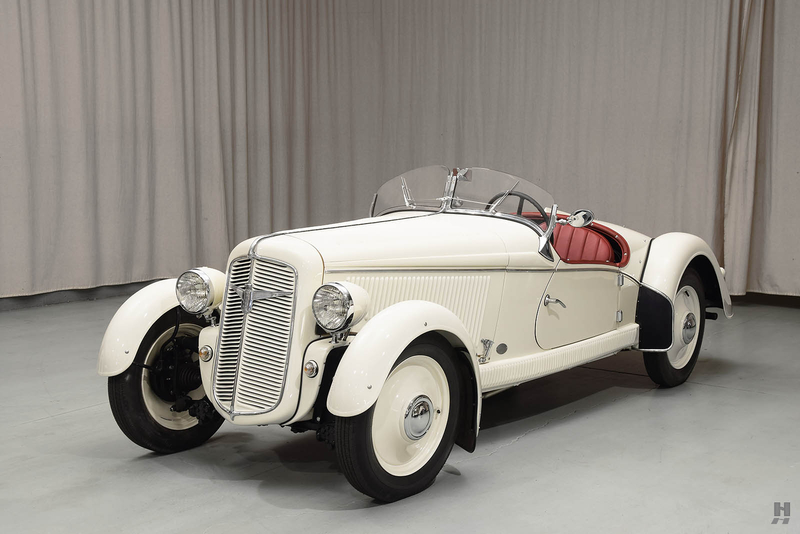

Adler Trumpf Junior Sports Roadster 1935
Allgemeine Beschreibung :
Adler may not be a name that immediately rings a bell for even the most dedicated enthusiast, but this German manufacturer traces its roots back to the very genesis of the automotive industry. Heinrich Kleyer began his career in Frankfurt, where in 1880 he founded a bicycle business, mainly importing American bicycles and selling them under the “Herold” brand. In just five short years, his business had grown enough for him to acquire a six-story building for his operation, the tallest in Frankfurt at the time. It is said that the first five floors were dedicated to manufacturing bicycles, while the top floor was reserved for riding lessons for his customers. By 1895, Kleyer adopted the name “Adler” (or Eagle) for his products and also took up typewriter manufacture. While complete automobiles did not enter his portfolio until 1900, he did supply parts such as wheels to both Gottlieb Daimler and Carl Benz – the fathers of the modern motorcar.
In 1898, Kleyer obtained the rights to produce DeDion Bouton engines; however he never did much with that capability besides use one in his first automobile in 1900. He hired a chief engineer and began to build a series of light cars, many of which drew their inspiration from Renault of the same period. By 1915, Adler offered vehicles ranging from bicycles and motorcycles, to automobiles and 3-ton trucks. By 1928, Adler had a workforce of more than 6000 and was Germany’s third largest car maker behind BMW and Opel. The bodies were made by Ambi-Budd Presswerke, a joint venture between the American Budd Company and Arthur Muller, a German industrialist. Budd owned 26% of the Adler stock and also supplied bodies for early BMWs as well as German Fords. In 1943, the company had to move production underground due to bomb attacks from the allied air forces. After the devastation of World War II, auto production was eschewed in favor of bicycles, motorbikes and typewriters, all of which were more practical for the ravaged post-war economy. Adler’s dealer network was swallowed up by Volkswagen and no more Adler automobiles were built after 1945.
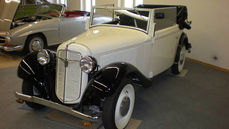
The Trumpf was conceived in 1934 as a smaller, more approachable model that was meant to move the company into a broader market and increase profits. Powered by a 995cc four-stroke side valve engine driving the front wheels, the Trumpf Junior was a direct competitor for DKW. The little Adler was available in a variety of body styles which ranged from a simple two-door “Limousine” (sedan/saloon) to a Cabrio Limousine to the wickedly stylish little Sports Roadster, as featured here.
A competition program was set up under the direction of Erwin Kleyer, who had largely taken over the reins after the death of his father Heinrich. Adler was very involved in motorsports in the mid to late 1930’s, and were at the forefront of streamlining. A streamlined Trumpf Junior set speed and endurance records at Avus in 1934, and this car and its success spawned the production Trumpf Junior Sport. Adlers also raced competitively at LeMans, the Alpine Rally, and the Spa 24 hrs, winning their class in 1935 and again in 1937. These Adlers were among the earliest scientifically streamlined racing cars and would be echoed in a few years by BMW and Alfa Romeo.
This truly wonderful 1935 Adler Trumpf Junior Sport roadster is presented in fabulous, restored condition having recently been imported from Germany to the ‘States. It is finished in classic German Racing white (used until the Auto Union and Mercedes Silver Arrows showed up in bare aluminum, starting the switch to Silver for German racing cars) over red leather and a black canvas top. The body styling is quite unlike anything else of the period, compact yet dramatic with its cycle front wings, louvered bonnet, louvered rocker panels and lovely tapered tail section. It rides on disc wheels, skinny blackwall tires and has a magnificent low-slung stance. The restoration was completed in 2015 prior to its importation.
The white paintwork is in very good order and the body, retains correct trim and badging. The fantastic cockpit is trimmed in red leather with black carpeting, red door cards and a body colored fascia. Front wheel drive keeps the chassis low slung, and allows for a surprisingly roomy cabin. Drivers over 6-feet should have no problem fitting behind the wheel. The shift lever sprouts from the dash panel, and is supported on the column, making for a shift pattern not unlike a Citroen 2CV. Fabulously styled instrumentation includes a combination speedometer, oil pressure and fuel gauge while on the passenger side is fitted a fascinating piece of technology in the form of a “Tempometer”; which is thought to be a primitive mechanical trip computer. A black canvas top and side curtains keep things cozy inside should the weather turn foul.
The sidevalve four-cylinder engine sits at an angle in the chassis to accommodate the front-drive setup, and places the transmission ahead of the motor, forcing the engine back for better weight distribution.. It is rated at 25 horsepower and runs remarkably smoothly. Close investigation reveals this is a rather advanced car for its age and size, as the chassis is fitted with full belly pans, a four-speed gearbox and independent suspension. It is a magnificent and unusual pre-war sporting car that is exceedingly rare in the United States. Restored in Germany, it was done properly without being over-restored. This rare, beautiful and fascinating automobile would surely be welcome and virtually any motoring event, tour or concours in the USA. Diminutive in size, the Adler Trumpf Junior is huge in charm. The sale includes an operating manual, a letter from the Adler Motor Club, and best of all its original log book from 1935, signed by Erwin Kleyer.
http://hymanltd.com/vehicles/5767-1935-adler-trumpf-junior-sports-roadster/
1935 Adler Trumpf Junior Sports Roadster is listed verkauft on ClassicDigest in St. Louis by Mark Hyman for $169500.
Fakten der Auto
Karosserietyp : Auto Marke : Adler Modell : Trumpf Ausführung : Junior Sports Roadster Hubraum : 0.0 Modelljahr : 1935 Karosstyp : Convertible Lage : Missouri
Verkauft
Angaben Zum Verkäufer
Verkauft
People who viewed this Adler Trumpf also viewed similar Adler listed at ClassicDigest
Adler Trumpf
24900 €
Weinsheimerstrasse 39DE-67547 Worms
Adler Trumpf
18900 €
Riemenstraße 33DE-74906 Bad Rappenau
Adler Trumpf
38700 €
Lüneburger Str. 71DE-29410 Salzwedel
Adler Trumpf
38700 €
Lüneburger Str. 71DE-29410 Salzwedel
Other cars listed for sale by this dealer
AC Cobra 289
195000$
Missouri
Other Other
142500$
Missouri
Packard Twelve
139500$
Missouri
Ferrari Testarossa
159500$
Missouri
Ferrari 330 GTS
2275000$
Missouri
über Adler
Dler war ein bedeutender deutscher Automobilhersteller mit einer reichen, jahrzehntelangen Geschichte. Hier ist ein Überblick über Adlers Geschichte:Frühe Jahre:
Gründung: Adler wurde 1900 in Frankfurt von Heinrich Kleyer gegründet. Zunächst produzierte das Unternehmen Fahrräder, bevor es auf Automobile umstieg.
Wegweisende Designs: Adler war für innovative Technik und Design bekannt. Sie führten insbesondere in den 1920er und 1930er Jahren mehrere Fortschritte in der Automobilindustrie ein.
Adler-Autos:
Adler Trumpf: In den 1930er Jahren wurde der Adler Trumpf mit Frontantrieb eingeführt, was für seine Zeit recht innovativ war. Es war ein Kompaktwagen, der aufgrund seines Designs und seiner Technik an Popularität gewann.
Adler Diplomat: Ein weiteres bemerkenswertes Modell war der Adler Diplomat, ein Luxusauto, das ein gehobenes Marktsegment bediente. Es war bekannt für seinen Komfort, seine Leistung und sein stilvolles Design.
Rennerfolg:
Erfolge im Motorsport: Adler erlangte im Motorsport Anerkennung, insbesondere bei Bergrennen und Langstreckenrennen. Ihre Rennerfolge trugen dazu bei, den Ruf der Marke zu stärken und stellten die technische Leistungsfähigkeit ihrer Fahrzeuge unter Beweis.
Zweiter Weltkrieg und Folgen:
Auswirkungen des Zweiten Weltkriegs: Während des Zweiten Weltkriegs verlagerte sich die Produktion von Adler, wie bei vielen Automobilherstellern, auf die Unterstützung der Kriegsanstrengungen und produzierte Militärfahrzeuge und -ausrüstung.
Herausforderungen der Nachkriegszeit: Nach dem Krieg stand Adler aufgrund der wirtschaftlichen und politischen Landschaft des Nachkriegsdeutschlands vor Herausforderungen. Das Unternehmen hatte Mühe, sich zu erholen, was zu finanziellen Schwierigkeiten führte.
Niedergang und Fusion:
Ende der Automobilproduktion: Adler geriet in der Nachkriegszeit in finanzielle Schwierigkeiten und stellte die Automobilproduktion Ende der 1940er Jahre endgültig ein.
Fusion mit anderen Unternehmen: Adler fusionierte mit mehreren anderen Unternehmen, darunter Triumph, zum Konzern Auto Union, der später Teil des Volkswagen-Konzerns wurde.
Vermächtnis:
Innovation und Einfluss: Adler leistete bedeutende Beiträge zur Automobiltechnik und zum Design und war Vorreiter bei Innovationen, die die Branche beeinflussten.
Historische Bedeutung: Obwohl Adler im Vergleich zu einigen anderen Herstellern die Automobilproduktion relativ früh einstellte, bleibt sein Erbe intakt und wird für seinen Innovationsgeist und seine technischen Leistungen gewürdigt.
Die Geschichte von Adler in der Automobilwelt unterstreicht seinen Beitrag zum technologischen Fortschritt und zum Erfolg im Rennsport und festigt seinen Platz in der Automobilgeschichte trotz des späteren Niedergangs des Unternehmens und der Einstellung der Automobilproduktion.