
Willys Coupe 572 cubic inch supercharged V8 1940
Allgemeine Beschreibung :
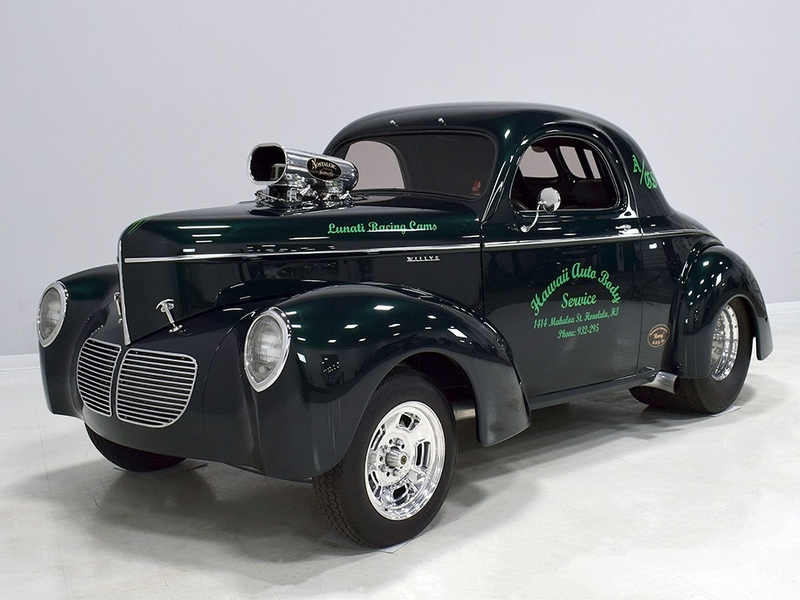
How fast is YOUR show car? A lot of guys build cars that look fast but are either all bark and no bite or have never been used as intended. That’s all fine, and if you want to buy an unknown quantity or a poser, nobody will fault you for it. But if you want a car that talks the talk AND walks the walk, you need to take a good, hard look at this spectacular 1940 Willys. It was a show car built with the best of everything, including an all-aluminum 572-inch Donovan big block cranking out nearly 1000 horsepower on pump gas. It currently runs 9s, and there’s probably more in it for the guy who wants to push it. This isn’t some theoretical estimate or best guess, this Willys has actually hammered down the quarter-mile in under 10 seconds. And shortly thereafter, it took home a trophy on the show field. Then they drove it home. You want a car that does it all? This is it, no asterisks needed.
Like most hot rod projects, this Willys didn’t start out to be a giant slayer but things kind of got out of hand. A really nice guy wanted a traditional old car that he could enjoy with his wife. He talked to some friends and once everyone had their say, it seemed that a modern fiberglass Willys body with an old-school dragster look would fit the bill just fine. So he ordered up an Outlaw Willys coupe body and sat it on a matching Outlaw fabricated chassis with boxed rails and plenty of reinforcements. They chose the 1940 front end with its split grilles just because it was a more unique look than the more familiar ’41, whose grille looked to them like an electric shaver. Outlaw fiberglass is pretty darned nice stuff, but by the time this lovely green coupe was done in the body shop, it had racked up a $37,000 invoice for the show-quality PPG Prismatic Green finish. The gaps are as good as it gets with a ‘glass car, the hood and trunk fit properly, and, well, we can’t really find any nits to pick with the way it’s put together. The lettering on the hood, doors, and B-pillar is all vinyl decals, so if you don’t like the look or would like something else, it all just peels off. We left it in place because we like the vintage racer look and because it isn’t advertising anything current—that’s a tribute to the builder’s hometown speed shop from the ‘50s. It certainly looks right and as I said, if you don’t like it, it’ll take you about 15 minutes to remove all the decals without any ill effects.
You’ll note a few other details like the correct Willys teardrop headlights, which now have LED marker lights inside. There are 1950 Pontiac taillights in back, along with a “PULL OFF” safety switch that is mandatory at the track on a car with this much firepower. There are provisions for a parachute if your track demands that particular safety feature, and a high-mounted center stop light is fitted flush with the bodywork above the split rear window. The pinstripes on the trunk and the “Panic Attack!” namesake are hand-painted but aren’t over-done. Add in some correct Willys stainless side trim, name badges on the hood, and gooseneck mirrors, and the car takes on a very vintage look.
Skipping the 8-point roll cage for a moment, you wouldn’t really realize that this is a full-tilt race car. The experts at Portage Trim stitched up the two-tone gray leather seats, which are Glide buckets with a lot of adjustability. You’ll find that this Willys coupe is a lot more spacious and comfortable than most of its kind because the guy who built it was well over six feet tall. That’s good news, because anyone should be able to get comfortable behind the wheel. There’s a warm feeling that comes from the combination of real Eucalyptus wood accent panels and plenty of ambient lighting to offset the gray upholstery. It’s incredibly inviting. Note the polished tilt column that hangs on an aluminum connecting rod, the custom-engraved horn button with the Willys logo on it, and the gently curving dash full of Auto Meter Pro-Comp liquid-filled gauges. It also offers a hand-built center console with the secondary controls and a ratcheting B&M shifter with line-lock. Look closely and you’ll see a functional Halon fire system, power windows, and even a Kenwood AM/FM/CD stereo system that sounds pretty good—as long as the thundering Donovan isn’t awake. Special Willys-logo floor panels were created and are protected by matching carpeted mats, and there’s a shift light integrated into the cage above the windshield. The trunk is finished using matching materials, and while it’s not set up for carrying cargo, it looks great with a custom cover over the fuel cell and battery. It’s worth noting that everything works just like it should, and even though this is not a complex car, someone was sweating all the details; nothing feels loose, sloppy, or half-finished.
Now about the hardware. Where to start? We have receipts adding up to tens of thousands of dollars from Fowler Engines in Columbus, Ohio, who built the 572 cubic inch monster motor you see poking through the hood. We started adding things up and it ran over $40,000 pretty quickly, which is downright scary if you're the guy paying the bills. The foundation is an all-aluminum Donovan block, which combines with a Cola steel crank and custom Lunati rods to create a bulletproof bottom end. If you’re familiar with Fowler, you know they are the supercharger specialists, so they whipped up one of their custom Littlefield 8-71 superchargers and parked it on top with a pair of 750 CFM Holley blower carbs. Lunati also supplied a full roller valvetrain, including a fairly stout camshaft that still has decent street manners and a 900 RPM idle, as well as a Mallory Hyfire ignition system. Oh, there’s also a set of Dart Super Mod aluminum heads to keep it all contained. With the giant blower, a ton of compression isn’t really needed and it was tuned to run on pump gas, although it might prefer the good stuff if you're running it at the track.
Once it was together, everything was polished—and I mean EVERYTHING. It glitters from top to bottom and since everything under the hood is aluminum, it’ll look this good for years to come if you keep it tidy. The big belt drive and scoop hanging out of the hood are intimidating as hell, but it’s also built for the street, so there’s a massive aluminum radiator, near-silent electric water pump, and a giant fan to keep it cool. The plumbing is all race-grade and you’ll note that there was probably a good chunk of change spent putting those matching green flames UNDER the hood. A subtle trick that really works well.
This engine was also expertly tuned and runs superbly; hit the fuel pumps, water pump, and ignition, then press the starter button. The big Donovan barks to life almost instantly and idles pretty happily at 1100 RPM. A few moments later, it’ll drop down to about 900 and it’ll stay there indefinitely. This is NOT a high-strung race engine that needs a lot of fretting—it was built for the street and acts appropriately. It is EXTREMELY impressive.
Underneath, you’ll find a fabricated Outlaw Performance Pro chassis with boxed frame rails and built-in safety loops. The transmission is a custom-built TH400 3-speed automatic with a mild B&M 3000 RPM stall torque converter and reverse manual valve body, so it’s snappy and fun to drive on the street. The front suspension is a traditional chrome straight axle with coil-overs and a Vega steering box, as well as a set of big Wilwood vented disc brakes. In back, a custom-built Strange aluminum center section carries a nodular Ford 9-inch housing with surprisingly mild 3.89 gears (this is a street car, remember) on a Detroit Locker spinning Strange axles. There’s a polished stainless 4-link setup with coil-over shocks and a neat race-style sway bar to keep it lined up just right, and, of course, another set of Wilwood discs. Ceramic-coated long tube headers with 2.25-inch primaries feed a 3.5-inch stainless exhaust system with side exits and baffles, so while it’s ferocious, you won’t go deaf riding in it. Again, this car was built to be totally streetable. Traditional big-n-little Halibrand style wheels add to the old-school look and carry staggered 26x7.50-15 front and massive 33x21.50-15 Mickey Thompson rubber.
Documentation is extensive, with every receipt, invoice, manual, and note included in a giant binder of information. If it went into the car, it went into the binder. The builder didn’t add up the receipts and we’re not going to do it either, but there’s easily $150,000 worth of work documented here, maybe more. Every nut and bolt is cataloged should you need replacement parts in the future, and seeing the names on the build, you should have no problem investing in the quality that went into the build. This is not a cheap car, but it is a screaming bargain compared to duplicating it yourself.
We are extremely impressed by this Willys simply because it appears to mix race and show so effortlessly that it’s hard to believe. Yes, it’s a big hairy-chested brute, but it idles nicely, rides well, tracks like a cruise missile, and is comfortable for cruising. That’s always the goal, but most rods fall short of the finish line. Not so this Willys, and that’s what endears it to us. If this is your kind of car, you will not regret owning it because I guarantee you couldn’t have done it better yourself. Wow!
http://www.harwoodmotors.com/vehicles/inventory_details.php?id=871
1940 Willys Coupe 572 cubic inch supercharged V8 is listed verkauft on ClassicDigest in Macedonia by for $69900.
Fakten der Auto
Karosserietyp : Auto Marke : Willys Modell : Coupe Ausführung : 572 cubic inch supercharged V8 Hubraum : 0.0 Modelljahr : 1940 Karosstyp : Coupé Lage : Ohio
Verkauft
Angaben Zum Verkäufer
Verkauft
People who viewed this Willys Coupe also viewed similar Willys listed at ClassicDigest
Willys Coupe
149900 $
Plymouth
Willys Coupe
90000 $
Chicago
Willys Coupe
66000 $
Louisville
Willys Coupe
119995 $
Dallas/Fort Worth
Willys Coupe
54000 $
Indianapolis
Other cars listed for sale by this dealer
Ford Fairlane
29900$
Ohio
Chevrolet Corvette
89900$
Ohio
Other Other
7900$
Ohio
Ford Galaxie
59900$
Ohio
Chevrolet Corvette
84900$
Ohio
über Willys
Die Willys-Overland Company, später einfach Willys genannt, war ein amerikanischer Automobilhersteller, der eine bedeutende Rolle in der Automobilgeschichte spielte. Hier ist ein Überblick über die Geschichte von Willys:Frühe Jahre:
Gründung: Das Unternehmen wurde 1908 von John North Willys in Toledo, Ohio, zunächst als Willys-Overland Motor Company gegründet. John Willys erwarb die Overland Automotive Division der Standard Wheel Company, die das Overland-Automobil herstellte.
Früher Erfolg: Willys-Overland war in den frühen 1910er Jahren erfolgreich und produzierte Fahrzeuge wie das Overland Model 79, das aufgrund seiner Erschwinglichkeit und Zuverlässigkeit ein beliebtes Auto war.
Erster Weltkrieg:
Militärverträge: Während des Ersten Weltkriegs sicherte sich Willys-Overland bedeutende Verträge zur Lieferung von Fahrzeugen für die Kriegsanstrengungen. Die Produktionskapazitäten des Unternehmens waren für das Militär von entscheidender Bedeutung, da es Lastkraftwagen und Automobile für verschiedene Zwecke herstellte.
Einführung des Jeep:
Beitrag zum Zweiten Weltkrieg: Im Vorfeld des Zweiten Weltkriegs reagierte Willys-Overland zusammen mit anderen Automobilherstellern auf die Anfrage der US-Armee nach einem leichten, geländegängigen Aufklärungsfahrzeug. Das Unternehmen entwickelte den Willys MB, der zum legendären Jeep wurde.
Jeep Legacy: Der Jeep spielte mit seiner Robustheit, Vielseitigkeit und Zuverlässigkeit eine entscheidende Rolle im Zweiten Weltkrieg. Sein Erfolg führte zur Gründung der Marke Jeep, die für die Herstellung von Geländefahrzeugen bekannt ist, die sowohl im militärischen als auch im zivilen Bereich an Popularität gewannen.
Die Nachkriegszeit:
Zivile Jeep-Modelle: Nach dem Krieg führte Willys zivile Versionen des Jeeps ein, wie die CJ-Serie (Civilian Jeep), die eine Adaption des Willys MB aus Kriegszeiten darstellte. Diese Fahrzeuge wurden für den Offroad- und Freizeitgebrauch beliebt.
Willys' Entwicklung und spätere Jahre:
Eigentümerwechsel: Willys-Overland geriet in finanziellen Schwierigkeiten und wechselte in den Nachkriegsjahren mehrmals den Eigentümer, bis es schließlich zur Kaiser-Jeep Corporation wurde, nachdem es in den 1950er Jahren von Kaiser Motors übernommen wurde.
Ende von Willys: 1970 erwarb die American Motors Corporation (AMC) Kaiser-Jeep. Das Willys-Namensschild verschwand allmählich, als sich AMC auf die Marke Jeep konzentrierte. Später erwarb Chrysler in den 1980er Jahren AMC und führte die Produktion und Entwicklung von Jeep-Fahrzeugen fort.
Vermächtnis:
Willys‘ Vermächtnis ist in erster Linie mit seinem Beitrag zur Automobilindustrie durch die Schaffung des Jeeps verbunden, eines Fahrzeugs, das die Mobilität während des Zweiten Weltkriegs veränderte und zu einer eigenständigen Kultmarke wurde. Der Ruf des Jeeps für Langlebigkeit, Vielseitigkeit und Geländetauglichkeit entstand durch die Innovationen und den Erfolg von Willys-Overland während des Krieges.