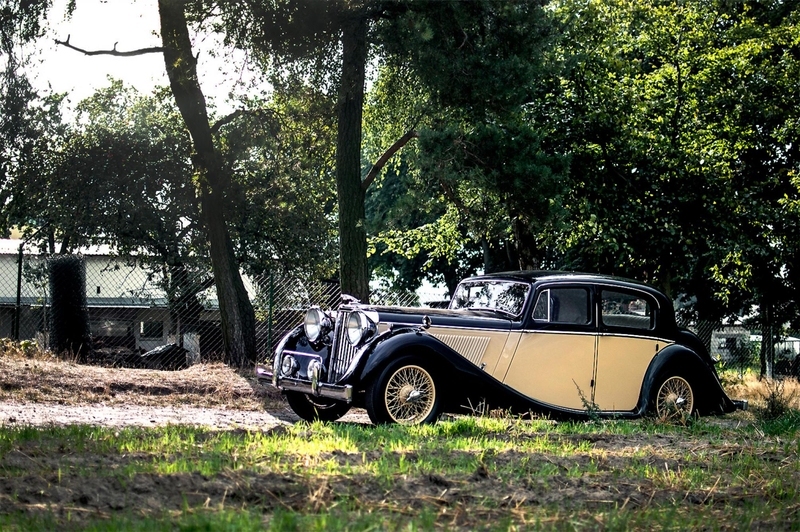

Jaguar MkV V 1948
General description :
Vintage and Prestige are proud to offer this JAGUAR Mark IV 3 1⁄2 litre, 1948 for Sale.
For many the Jaguar Mark IV is the epitome of British motor industry of thirties and forties. Imposing chromed headlamps, running boards, leather upholstery, French polished wood dashboard and suicide doors - all these features make this car highly sought-after by wedding couples.
Jaguar Mark IV 3 1⁄2 litre was a flagship model produced by Jaguar Cars Ltd. in years 1945- 1949. This one had the strongest engine with largest capacity within the model lineup with the largest body.
Jaguar sales brochures said then, that the top speed was 95 mph, which was quite spectacular achievement.
Every Jaguar Mark IV consigned for US export, was equipped with Clayton air conditioning unit, footrests, rear blind curtain for the passengers operated by the driver via a pull chord.
Only 254 left-hand drive models were made, of these 162 were made entirely by the factory, another 90 were made from complete knock-down kits sent to Jaguar Cars distributors in Brussels. The Belgian Van den Plas factory then made them into cars.
This particular example, built on 22th July 1948 in Jaguar factory, was exported to United States of America and sold new to Los Angeles client, by Charles Hornburg – the biggest Jaguar distributor in California that time. It must have been some prominent buyer, cause then Jaguars were mostly driven by movie stars, including Clarke Gable and Greta Garbo who had a similar Jaguar Mark IV. At extra cost you could have a luxurious car radio – Radiomobile 100, weighting 10 kg, with special aerial mounted on the roof of the car.
This particular car was restored to concours condition few years ago. It has black-beige two- tone paint and leather upholstery in beige, original Lucas headlamps and fog lamps.
It is said that the number of survived left hand drive Jaguars Mark IV with this engine, is around ten examples.
http://www.vintagerollsroycecars.com/sales/1148/1948-jaguar-mk-iv-3-1-2-litre/
1948 Jaguar MkV V is listed sold on ClassicDigest in Grays by Vintage Prestige for £88000.
Car Facts
Car type : Car Make : Jaguar Model : MkV Model Version : V Engine size : 0.0 Model Year : 1948 Sub type : Coupé Location : Essex
Sold
Seller Information
Sold
People who viewed this Jaguar MkV also viewed similar Jaguar listed at ClassicDigest
Jaguar MkV
112500 €
Aalter
Jaguar MkV
29000 €
Norway
Jaguar MkV
34750 $
4576 1/2 Worth St. Los Angeles, CA 90063
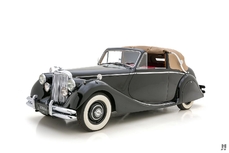
Jaguar MkV
69500 $
Missouri
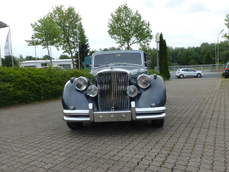
Jaguar MkV
Prinzenstrasse 20ADE-37073 Göttingen
Other cars listed for sale by this dealer
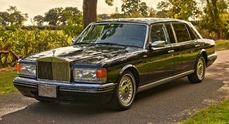
Rolls-Royce Silver Spur
Essex
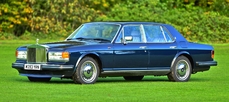
Rolls-Royce Silver Spirit
Essex
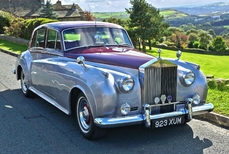
Rolls-Royce Silver Cloud SI
Essex
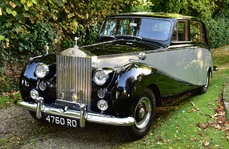
Rolls-Royce Silver Wraith
Essex
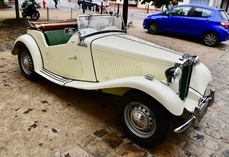
MG TD
Essex
About Jaguar
Ah, the story of Jaguar, from its early days as the SS Cars Ltd. to its pinnacle with the D-type, and the street-going evolution in the form of the iconic E-type. There's something quintessentially British about this tale, and I'll narrate it as a British journalist might.In the Beginnings:
Our journey into the world of Jaguar begins in the 1930s, when a company known as SS Cars Ltd. emerged. Despite the unfortunate coincidence of their initials with the rising political tensions in Europe, they started producing stylish and performance-oriented cars. The SS 100, introduced in 1936, was a symbol of elegance and speed, setting the stage for what would become Jaguar.
The Birth of Jaguar:
As the shadows of World War II loomed, SS Cars Ltd. wisely decided to disassociate themselves from the SS initials. Thus, in 1945, they officially became Jaguar Cars Ltd., a name that would soon be synonymous with British luxury and performance.
The XK Series:
Jaguar's post-war era brought us the XK 120, a true sensation in 1948. With its sleek design and a powerful 3.4-liter inline-six engine, it became the world's fastest production car. The XK 120 was the blueprint for what lay ahead – Jaguars that blended style with speed in a uniquely British fashion.
The D-type Dominance:
Then came the D-type, a true racing legend. Introduced in 1954, it won Le Mans three times in the 1950s, showcasing Jaguar's engineering prowess. With its innovative monocoque construction and the iconic fin at the back, the D-type was the apex of Jaguar's motorsport success.
The E-type Emergence:
But the true turning point arrived in 1961 with the introduction of the E-type, often described by Enzo Ferrari as "the most beautiful car ever made." Its long bonnet, curvaceous body, and a 3.8-liter engine delivering exhilarating performance made it an instant classic. The E-type was not just a car; it was a work of art on wheels, and it could hit 150 mph on the road.
Street and Racing Success:
The E-type's beauty was matched by its capability on the track. The lightweight E-types were particularly successful in various racing events, cementing Jaguar's reputation as a force to be reckoned with in motorsport.
The Age of Refinement:
As we delve deeper into the Jaguar story, we find that the 1950s and 1960s were an age of refinement and expansion. Alongside the magnificent D-type and the E-type's iconic emergence, Jaguar introduced models that further solidified its reputation for luxury and performance.
The MK2:
In the late 1950s, Jaguar unveiled the MK2, a sports sedan that combined elegance with power. This sleek four-door saloon was a favorite of bank robbers and law enforcement alike, thanks to its exceptional speed and handling. The MK2 was a symbol of Jaguar's ability to blend sophistication with performance and had a successful racing career as well.
The XJ6:
Fast forward to 1968, and Jaguar launched a car that would define luxury saloons for decades to come – the XJ6. It was a masterpiece of engineering and design, featuring a smooth inline-six engine, independent rear suspension, and a spacious, beautifully appointed interior. The XJ6 was a symbol of British elegance and provided a ride so smooth that it seemed to glide over the road. It became the flagship model for Jaguar and set the standard for luxury saloons, showcasing a level of refinement that left competitors in awe.
The Blend of Classic and Modern:
While the MK2 and XJ6 represented the evolution of Jaguar's saloon cars, they maintained the brand's commitment to performance and luxury. These cars didn't just belong on the racetrack; they were equally at home cruising down the grand boulevards or gliding through the English countryside.
The Challenges of Change:
However, as the 1970s arrived, Jaguar, like many British automakers, faced financial challenges and changes in ownership. The British Leyland era brought both opportunities and struggles, as the brand navigated through various mergers and transitions.
Nevertheless, the legacy of the MK2 and XJ6, along with the D-type and E-type, continues to define Jaguar as a manufacturer that combines timeless elegance with a spirit of performance. These classic models, whether driven on winding roads or parked as collectors' treasures, serve as a testament to Jaguar's enduring presence in the world of automotive excellence.
The Jaguar story, from its early days as SS Cars Ltd. to the creation of automotive icons like the E-type, MK2, and XJ6, is a journey that reflects the very essence of British motoring – a blend of luxury, power, and style that continues to captivate enthusiasts and connoisseurs alike.