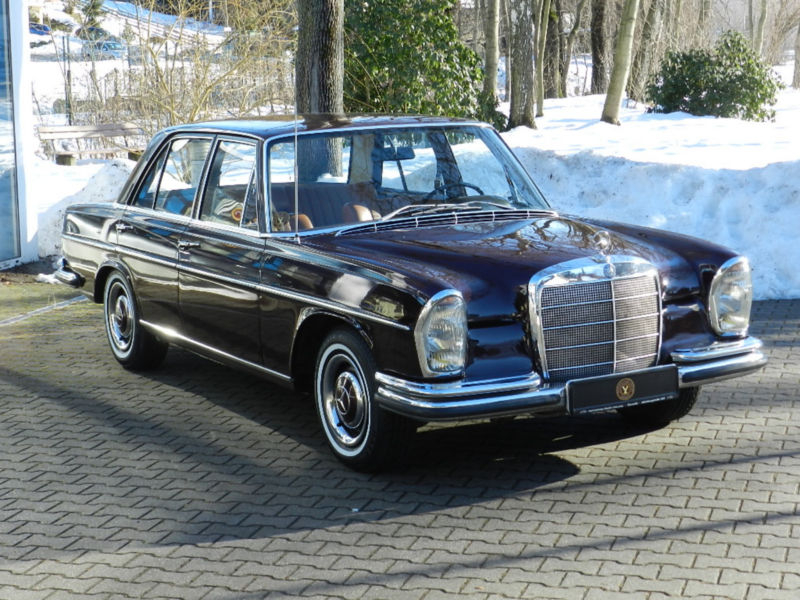

Mercedes-Benz 250S/SE w108 ,ungeschweißt,unrestauriert,schöner Zustand 1967
General description :
60 XXL Bilder unter http://www.young-classic-cars.com
MB 250SE aus der frühen Serie 1967, einer von nur 55181 gebauten Stück
- schöner, alltagstauglicher Zustand
- kerngesunde Karosse ohne erkennbare Schweißungen, Rost nur in Form kleiner weniger "Lackspinnen" erkennbar
-Unterboden ohne dicken Unterbodenschutz, alles erkennbar- perfekte zum eisstrahlen und versiegeln
- unrestauriertes Original, im org. Blech (außer Koflügel vorn re. wurde mal gewechselt)
- soeben erneuert:
Reifen,
Bremssättel überholt,
Flüssigkeiten,
Kerzen,
Verteilerkappe u. -finger,
Zündkabel,
Kupplungszylinder,
Hinterachssausgleichsfeder,
beide Domlager
-seltene und super charmante Farbkombi dunkelrot 542 (bordeaux)/ MB Tex beige
Bei diesem Wagen handelt es sich nicht, wie auch in der Preisklasse nicht anders zu erwarten ( gute Wagen der Note 2 beginnen preisl. schon bei 22000€), um eine Trailerqueen. Vielmehr handelt es sich um einen Surviver, der auf Grund seiner leichten Patina, zum Dallydriver avanciert. Dennoch ist der Wagen von optisch sehr schönem Erscheinungsbild, und technisch derzeit in tadellosem Zustand mit einwandfreiem Schalt- und Fahrverhalten ohne Nebengeräusche aus Differential, Getriebe, Fahrwerk o.ä.. Chrom und Leisten sind sehr gut erhalten, Verglasung Beleuchtung ist einwandfrei, Innenausstattung ist original und minimal patiniert, Holz wurde noch nie überarbeitet, sogar die org. Fussmatten und der org. Mittelteppich (Serie beim 250SE) sind noch tadellos. Tür- und Fenstergummis sind original und im wirklich guten Zustand. Scheibenpassungen sind perfekt. Die kritischen Stellen wie Radläufe, Schweller, Türunterkanten etc. sind rostfrei. Alles, einschließlich Radio und Scheibenwaschanlage funktioniert, nur die Uhr ist defekt- wird aber auch nicht benötigt, da einen die Fahrt im W108, die Zeit vergessen lässt und das soll auch so sein.
Fazit: Dieser wirklich gute, unrestaurierte Wagen eignet sich, auf Grund der gesunden Substanz, für Liebhaber und Kenner der Baureihe W108, welche diesen Zustand zu schätzen wissen und sich diesem mit Fachverstand hingeben um ihn so zu erhalten oder ggf. nach ihren Wünschen zu optimieren. Käufer mit Hang zur Perfektion, bitten wir, sich in Preisklassen oberhalb der 22000€ nach einem Wagen umzusehen. Aus der Erfahrung herhaus wissen wir, das dies aber auch nicht leicht wird. Denn perfekte Originale sind kaum zu bekommen, und eine gute Restauration verschlingt schnell 30000€ aufwärts. Wir selbst verkauften vor einem Jahr der gleichen Wagen- im perfekten Zustand mit 23000 Originalkilometern für 43000€ und die Interessenten standen Schlange.
Da es sich um einen Import aus Frankreich handelt, übergeben wir den Wagen mit TÜV u. H-Abnahme. Die Bordmappe mit Scheckheft ist komplett vorhanden. Die Laufleistung von 103000km ist abgelesen, nach unserer Beurteilung des Fahrzeuges, durchaus realistisch.
Die Fahrzeugbeschreibung dient lediglich der allgemeinen Identifizierung des Fahrzeuges und stellt keine Gewährleistung im kaufrechtlichen Sinne dar . Die Angaben erheben nicht den Anspruch auf Vollständigkeit und sind ohne Gewähr. Zwischenverkauf, Irrtum und Änderungen vorbehalten!
Keine tel. Preisverhandlungen! Bis 36 Mon. Garantie mögl.
https://home.mobile.de/YOUNGCLASSICCARSCHEMNITZ#des_239037255
1967 Mercedes-Benz 250S/SE w108 ,ungeschweißt,unrestauriert,schöner Zustand is listed sold on ClassicDigest in Adelsbergstraße 263DE-09127 Chemnitz by Auto Dealer for €15800.
Car Facts
Car type : Car Make : Mercedes-Benz Model : 250S/SE w108 Model Version : ,ungeschweißt,unrestauriert,schöner Zustand Engine size : 2.5 Model Year : 1967 Sub type : Sedan Location : Adelsbergstraße 263DE-09127 Chemnitz
Sold
Seller Information
Sold
People who viewed this Mercedes-Benz 250S/SE w108 also viewed similar Mercedes-Benz listed at ClassicDigest
Mercedes-Benz 250S/SE w108
Waalwijk
Mercedes-Benz 250S/SE w108
17500 €
Schulze-Delitzsch-Str. 19-21DE-33100 Paderborn
Mercedes-Benz 250S/SE w108
12790 €
Waldstr. 151DE-51147 Köln Porz
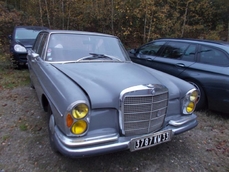
Mercedes-Benz 250S/SE w108
4890 €
Hermannstraße 11DE-40233 Düsseldorf
About Mercedes-Benz
In the annals of automotive history, the journey of Mercedes-Benz is a tale that unfolds with the ingenuity of its founding pioneers. In the year 1886, Karl Benz crafted the Benz Patent Motorwagen, a creation that would go down in history as the world's inaugural automobile. Unbeknownst to him, this moment marked the genesis of what would evolve into the most illustrious premium car manufacturer globally. The financial underpinning of this pioneering venture, interestingly, was provided by Karl Benz's wife, Bertha Benz, demonstrating a remarkable partnership that would set the tone for Mercedes-Benz's legacy.A parallel narrative emerged not far away, as Daimler-Motoren-Gesellschaft, founded by Gottlieb Daimler and Wilhelm Maybach, entered the scene. In 1901, they unveiled their automobile under the now-famous moniker "Mercedes," meaning "godsend" in Spanish. This name was bestowed upon the car at the behest of Emil Jellinek's daughter, the distributor for Daimler-Motoren-Gesellschaft. The wheels of innovation were set in motion.
Fast forward to 1926, a pivotal year that witnessed the merger of Daimler with Benz & Cie., culminating in the birth of Daimler-Benz. The amalgamation saw the adoption of "Mercedes-Benz" as the distinguished trademark for their automobiles, fusing the legacies of two visionary entities into one.
Contrary to perceptions of conservatism, the trajectory of Daimler-Benz unfolds as a chronicle of industry firsts. From the introduction of the honeycomb radiator to the float carburetor, and the pioneering implementation of four-wheel brakes in 1924, Daimler-Benz consistently pushed the boundaries of automotive innovation. The diesel-powered Mercedes-Benz 260 D in 1936 marked the inception of diesel engines in passenger cars. The iconic Mercedes-Benz 300SL Gullwing made history as the first car with direct fuel injection, albeit the Gutbrod's tiny 2-stroke engine can claim precedence.
Safety innovations became a hallmark, with Béla Barényi's patented safety cell design in the "Ponton"-models in 1951, featuring front and rear crumple zones. The W116 450SEL 6.9 saw the introduction of the Anti-Lock Brake system (ABS), another pioneering safety feature. From the first production airbags and beyond, the legacy of "firsts" continued to be etched into the fabric of Daimler-Benz.
Over its centennial journey, Mercedes-Benz has not merely produced cars but has sculpted automotive icons. The SSKL, 710 SSK Trossi Roadster, 770K Grosser, 540K Spezial Roadster, 300SL Gullwing, w100 600 Pullman, w111 280SE 3.5 Flachkühler, w113 230SL Pagoda, w109 300 SEL 6.3, and w201 2.3-16 Cosworth stand testament to the brand's commitment to engineering excellence.
The roaring Silver Arrows, or "Silberpfeile," including the W 25, W 125, W154, W165, and W196, created a legacy of dominance on the racetrack. These machines were not merely cars; they were expressions of precision, speed, and an indomitable spirit that left their competitors in the dust.
As Mercedes-Benz marches into the future, it does so not just as an automaker but as a custodian of a legacy, a torchbearer of innovation, and a beacon of automotive excellence. The road ahead is sure to witness the continued fusion of cutting-edge technology, timeless design, and an unwavering commitment to setting new standards in the world of automobiles.
One luminary figure who left an indelible mark was Béla Barényi, often heralded as the "father of passive safety" for his pioneering work in safety engineering. His patented safety cell design, featuring front and rear crumple zones, became a hallmark of Mercedes-Benz's commitment to occupant safety, setting new standards that reverberated throughout the automotive world.
Moving through the chronicles, the collaborative genius of Wilhelm Maybach, alongside Gottlieb Daimler, laid the foundation for Daimler-Motoren-Gesellschaft. Their innovations not only birthed the first Mercedes but established a culture of relentless pursuit of technological excellence that remains integral to Mercedes-Benz's DNA.
In the post-merger era of 1926, Ferdinand Porsche emerged as a prominent figure within Mercedes-Benz. His work on the Mercedes-Benz S-Type, a supercharged race car, garnered acclaim and set the stage for a legacy that extended far beyond the marque. Porsche's impact would later extend to his eponymous company, but his influence at Mercedes-Benz during those formative years was pivotal.
As the 20th century progressed, the legendary Rudolf Uhlenhaut emerged as a key figure. Uhlenhaut, an accomplished engineer and the driving force behind the iconic Silver Arrows, played a crucial role in Mercedes-Benz's dominance in motorsports. His engineering prowess and attention to detail were instrumental in creating some of the most formidable racing cars of the era.
In the latter half of the century, figures like Bruno Sacco, the head of design at Mercedes-Benz from 1975 to 1999, left an indelible imprint on the brand's aesthetic identity. Sacco's design philosophy, characterized by clean lines and timeless elegance, shaped iconic models like the W126 S-Class and the W201 190E, solidifying Mercedes-Benz's reputation for luxury and sophistication.
The narrative would be incomplete without acknowledging the contributions of engineers like Hans Scherenberg, whose leadership in the 1970s ushered in a new era of technological innovation at Mercedes-Benz. Scherenberg's tenure saw the development of groundbreaking technologies, including the Anti-Lock Brake system (ABS) and the introduction of airbags in production cars.