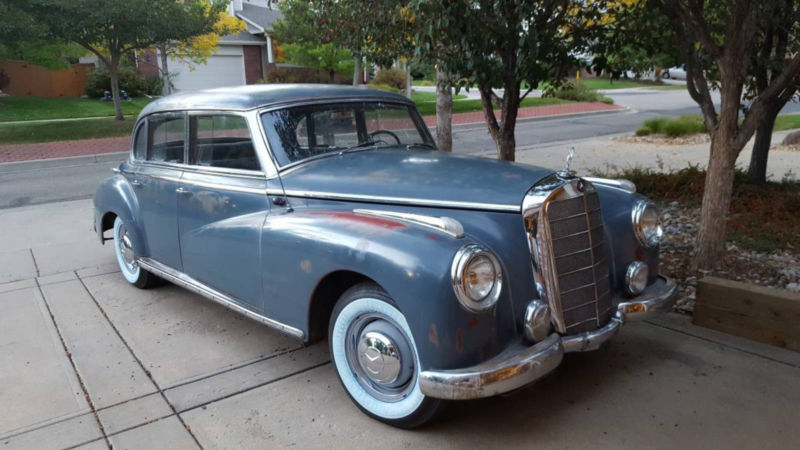

Mercedes-Benz 300 W186 Adenauer Adenauer 1 owner 1953
General description :
Original Barnfind. Pulled from farm/barn storage since 1964. One US Owner. Soldier in Germany imported the car to dry Colorado. Body, frame and underside exceptionally solid.
NEW: Seat upholstery, Battery, Carb rebuild, Coker Tires, Dash/Wood trim refinished, Brake Master Cylinder and Slave cylinders professionally rebuilt, Fuel/Cooling/Brake lines, radiator refresh.
NY Times from May 1964 found in car. "US Armed Forces In Germany 1961" license plate as well as Colorado 1961 plate.
Numbers matching. Details per data card - Exterior Color: Bluegrau Interior: Gray cloth
Original wool headliner in great shape as are the visors and window glass all around.
Becker Nurnberg radio (rare, worth $2k alone).
Car runs and drives. Brake Master Cylinder and six-wheel slave cylinders have been professionally rebuilt by WhitePost Restorations. New fuel, cooling and brake lines installed.
Starter being professionally rebuilt and installed by Passarelli Restorations (current original is failing, slow to turn).
Car has been hand cleaned up from the farm dirt, dust and grease (still more to do). Remains in Original condition. Only the items which were totally worn/faded or in need of immediate mechanical repair have been touched. Body is very, very solid. No paintwork or sandblasting done. Carb's rebuilt. Radiator and heat exchangers have been professionally cleaned/tested. All new fuel lines and heater/cooling hoses. New white-whitewall period correct tires. Interior seats re-upholstered in gray Bedford thin-line "corduroy" cloth. Solid wood dash and door trim re-finished. Floors are 100% original with no rust anywhere. Original horsehair padding intact and in excellent condition. (You won't find a car with floors this perfectly original anywhere). Underside frame has no rust (essentially protected by the central oiling system and farm/barn dirt!). Trunk is solid without rust. Chrome is shiny with some minor pitting. Bumpers are in need of re-chrome.
Exterior and underside, floors remain original with its original paint and 50 years of storage patina.
The price includes delivery from the USA to port in Holland. Ocean insurance for your car is available at an extra cost. We can assist with the VAT (6%) and customs (euro 450) as well as provide door to door delivery. With over 30 years of professional experience in the classic car business, we make the process of buying your car very straightforward and worry free.
https://home.mobile.de/CMIINTERNATIONAL#des_238997733
1953 Mercedes-Benz 300 W186 Adenauer Adenauer 1 owner is listed sold on ClassicDigest in 2683 Orchard Lake RoadUS-48320 Sylvan Lake by Auto Dealer for €42500.
Car Facts
Car type : Car Make : Mercedes-Benz Model : 300 W186 Adenauer Model Version : Adenauer 1 owner Engine size : 0.0 Model Year : 1953 Sub type : Sedan Location : 2683 Orchard Lake RoadUS-48320 Sylvan Lake
Sold
Seller Information
Sold
People who viewed this Mercedes-Benz 300 W186 Adenauer also viewed similar Mercedes-Benz listed at ClassicDigest
Mercedes-Benz 300 W186 Adenauer
149500 $
Astoria
Mercedes-Benz 300 W186 Adenauer
149500 $
Astoria
Mercedes-Benz 300 W186 Adenauer
18750 $
4576 1/2 Worth St. Los Angeles, CA 90063
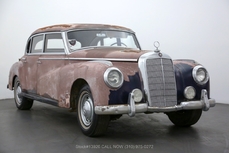
Mercedes-Benz 300 W186 Adenauer
19950 $
4576 1/2 Worth St. Los Angeles, CA 90063
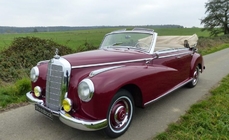
Mercedes-Benz 300 W186 Adenauer
Hainholzweg 1 Germany 21376 Gödenstorf-Lübberstedt
About Mercedes-Benz
In the annals of automotive history, the journey of Mercedes-Benz is a tale that unfolds with the ingenuity of its founding pioneers. In the year 1886, Karl Benz crafted the Benz Patent Motorwagen, a creation that would go down in history as the world's inaugural automobile. Unbeknownst to him, this moment marked the genesis of what would evolve into the most illustrious premium car manufacturer globally. The financial underpinning of this pioneering venture, interestingly, was provided by Karl Benz's wife, Bertha Benz, demonstrating a remarkable partnership that would set the tone for Mercedes-Benz's legacy.A parallel narrative emerged not far away, as Daimler-Motoren-Gesellschaft, founded by Gottlieb Daimler and Wilhelm Maybach, entered the scene. In 1901, they unveiled their automobile under the now-famous moniker "Mercedes," meaning "godsend" in Spanish. This name was bestowed upon the car at the behest of Emil Jellinek's daughter, the distributor for Daimler-Motoren-Gesellschaft. The wheels of innovation were set in motion.
Fast forward to 1926, a pivotal year that witnessed the merger of Daimler with Benz & Cie., culminating in the birth of Daimler-Benz. The amalgamation saw the adoption of "Mercedes-Benz" as the distinguished trademark for their automobiles, fusing the legacies of two visionary entities into one.
Contrary to perceptions of conservatism, the trajectory of Daimler-Benz unfolds as a chronicle of industry firsts. From the introduction of the honeycomb radiator to the float carburetor, and the pioneering implementation of four-wheel brakes in 1924, Daimler-Benz consistently pushed the boundaries of automotive innovation. The diesel-powered Mercedes-Benz 260 D in 1936 marked the inception of diesel engines in passenger cars. The iconic Mercedes-Benz 300SL Gullwing made history as the first car with direct fuel injection, albeit the Gutbrod's tiny 2-stroke engine can claim precedence.
Safety innovations became a hallmark, with Béla Barényi's patented safety cell design in the "Ponton"-models in 1951, featuring front and rear crumple zones. The W116 450SEL 6.9 saw the introduction of the Anti-Lock Brake system (ABS), another pioneering safety feature. From the first production airbags and beyond, the legacy of "firsts" continued to be etched into the fabric of Daimler-Benz.
Over its centennial journey, Mercedes-Benz has not merely produced cars but has sculpted automotive icons. The SSKL, 710 SSK Trossi Roadster, 770K Grosser, 540K Spezial Roadster, 300SL Gullwing, w100 600 Pullman, w111 280SE 3.5 Flachkühler, w113 230SL Pagoda, w109 300 SEL 6.3, and w201 2.3-16 Cosworth stand testament to the brand's commitment to engineering excellence.
The roaring Silver Arrows, or "Silberpfeile," including the W 25, W 125, W154, W165, and W196, created a legacy of dominance on the racetrack. These machines were not merely cars; they were expressions of precision, speed, and an indomitable spirit that left their competitors in the dust.
As Mercedes-Benz marches into the future, it does so not just as an automaker but as a custodian of a legacy, a torchbearer of innovation, and a beacon of automotive excellence. The road ahead is sure to witness the continued fusion of cutting-edge technology, timeless design, and an unwavering commitment to setting new standards in the world of automobiles.
One luminary figure who left an indelible mark was Béla Barényi, often heralded as the "father of passive safety" for his pioneering work in safety engineering. His patented safety cell design, featuring front and rear crumple zones, became a hallmark of Mercedes-Benz's commitment to occupant safety, setting new standards that reverberated throughout the automotive world.
Moving through the chronicles, the collaborative genius of Wilhelm Maybach, alongside Gottlieb Daimler, laid the foundation for Daimler-Motoren-Gesellschaft. Their innovations not only birthed the first Mercedes but established a culture of relentless pursuit of technological excellence that remains integral to Mercedes-Benz's DNA.
In the post-merger era of 1926, Ferdinand Porsche emerged as a prominent figure within Mercedes-Benz. His work on the Mercedes-Benz S-Type, a supercharged race car, garnered acclaim and set the stage for a legacy that extended far beyond the marque. Porsche's impact would later extend to his eponymous company, but his influence at Mercedes-Benz during those formative years was pivotal.
As the 20th century progressed, the legendary Rudolf Uhlenhaut emerged as a key figure. Uhlenhaut, an accomplished engineer and the driving force behind the iconic Silver Arrows, played a crucial role in Mercedes-Benz's dominance in motorsports. His engineering prowess and attention to detail were instrumental in creating some of the most formidable racing cars of the era.
In the latter half of the century, figures like Bruno Sacco, the head of design at Mercedes-Benz from 1975 to 1999, left an indelible imprint on the brand's aesthetic identity. Sacco's design philosophy, characterized by clean lines and timeless elegance, shaped iconic models like the W126 S-Class and the W201 190E, solidifying Mercedes-Benz's reputation for luxury and sophistication.
The narrative would be incomplete without acknowledging the contributions of engineers like Hans Scherenberg, whose leadership in the 1970s ushered in a new era of technological innovation at Mercedes-Benz. Scherenberg's tenure saw the development of groundbreaking technologies, including the Anti-Lock Brake system (ABS) and the introduction of airbags in production cars.