
Mercedes-Benz 560SL w107 1989
General description :
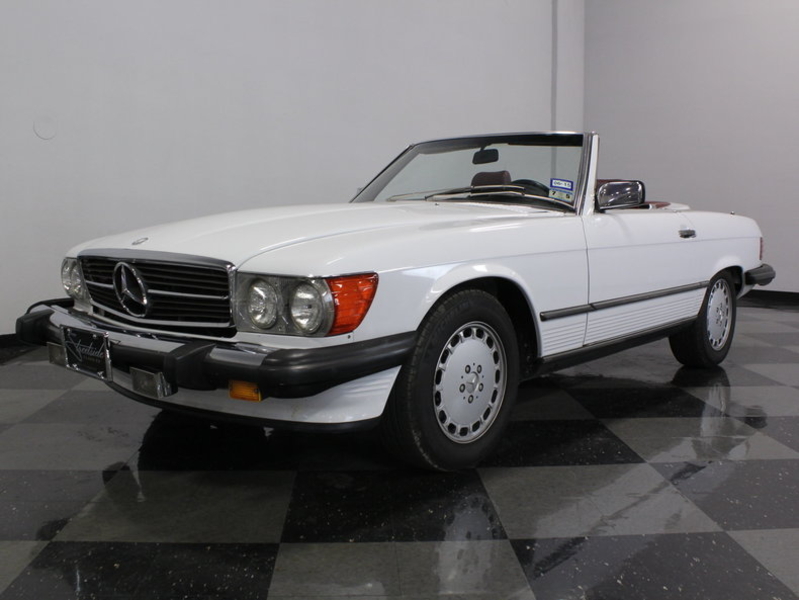
VERY CLEAN 560SL, ORIGINAL WINDOW STICKER, ONLY 60K MILES, BOTH TOPS!
There are many who feel that the W127 SLs were the last of the engineered Mercedes-Benz automobiles. After that, the cars were mainstream, and the engineers were joined by the marketing department, and the slogan "Engineered like no other car" fell by the wayside. This 1989 560SL represents the last of the best, a low-mileage survivor that proves why these cars are still wonderful machines that truly deserve their honored reputations.
If you could afford one of these when it was new, it meant you had well and truly arrived, and that you cared about smart investing as much as making a good first impression. Bright white paint is the perfect color on a grand tourer such as this, and it is remarkably well preserved on this 60,311-mile example. It has clearly led an easy life in a warm climate, and at 26 years old, it is only just now getting broken-in. Panel gaps are exemplary and the trim fits with a precision that was typical of Mercedes-Benz quality of the era, and the "built like a bank vault" term was coined just for these cars. The heavy chrome and rubber bumpers were an unfortunate by-product of federal regulations, but they, too, add to the car's appeal with their purposeful look, as if Mercedes didn't care about appearance as much as function, which was 100% true. Sadly 1989 was the last year of the W127 model, but at least it received a slender third brake light at the trailing edge of the deck lid, a big improvement over the clunky unit found on earlier models.
The luscious burgundy leather interior is incredibly inviting and looks upscale even in today's world. The leather used in these cars is not only lovely to look at, but wears like iron, and the bucket seats have a comfortable look while still being supportive and firm. Matching burgundy carpets look unaffected by the sun's rays or dirty shoes, and burled walnut trim warms up the interior without detracting from the all-business controls. A modern Alpine AM/FM/CD stereo has been retrofitted in the dash, and I don't think you'll miss the original Becker unit, which undoubtedly had a cassette player. The 560s also got an unusual little VDO temperature gauge in the center vent in the dash, an addition that left a lot of folks scratching their heads even though it's cool to watch. In back, the trunk is upholstered in plush carpet that's nicer than the stuff found in the passenger compartments of lesser automobiles and this SL offers two tops, a nice black canvas folding roof and a color-matched hardtop.
The final evolution of the 5.6 liter SOHC V8 was designed to run for hundreds of thousands of miles with only routine maintenance, and with only 60,000 or so original miles, this one is still quite fresh. With a bubbly, bouncy idle and seemingly limitless reserves of torque, it moves the two-seat roadster effortlessly without the high-strung theatrics of lesser machines, more like a German muscle car than an effete sports car. The engine bay shows signs of proper care over the years while the chassis is clean and obviously rust-free thanks to a life down south. A 4-speed automatic overdrive transmission swaps gears unobtrusively, and the supple, all-independent suspension is willing to dance, but is equally comfortable on long stretches of highway where it consumes pavement with ease. Traditional MB alloy wheels wearing 205/65/15 Michelin radials neatly straddle the ride/performance equation.
Renowned for their engineering, cars like this SL are a reminder of when the gap between the ordinary and the extraordinary was wide indeed. Call today!
http://www.streetsideclassics.com/vehicles/1328-dfw/1989-mercedes-benz-560sl
1989 Mercedes-Benz 560SL w107 is listed sold on ClassicDigest in Fort Worth by Streetside Classics for $21995.
Car Facts
Car type : Car Make : Mercedes-Benz Model : 560SL w107 Engine size : 0.0 Model Year : 1989 Sub type : Convertible Location : Dallas/Fort Worth Vehicle Registration : Normal
Sold
Seller Information
Sold
People who viewed this Mercedes-Benz 560SL w107 also viewed similar Mercedes-Benz listed at ClassicDigest

Mercedes-Benz 560SL w107
29000 $
Dallas
Mercedes-Benz 560SL w107
25000 $
Dallas
Mercedes-Benz 560SL w107
39000 $
Houston
Mercedes-Benz 560SL w107
Prés Seigneurs
Mercedes-Benz 560SL w107
27000 $
Orlando
Other cars listed for sale by this dealer
Chevrolet Camaro
23995$
Dallas/Fort Worth
Chevrolet C/K
29995$
Dallas/Fort Worth
Ford Maverick
21995$
Dallas/Fort Worth
Chevrolet C10
58995$
Dallas/Fort Worth
Chevrolet Chevelle
49995$
Dallas/Fort Worth
About Mercedes-Benz
In the annals of automotive history, the journey of Mercedes-Benz is a tale that unfolds with the ingenuity of its founding pioneers. In the year 1886, Karl Benz crafted the Benz Patent Motorwagen, a creation that would go down in history as the world's inaugural automobile. Unbeknownst to him, this moment marked the genesis of what would evolve into the most illustrious premium car manufacturer globally. The financial underpinning of this pioneering venture, interestingly, was provided by Karl Benz's wife, Bertha Benz, demonstrating a remarkable partnership that would set the tone for Mercedes-Benz's legacy.A parallel narrative emerged not far away, as Daimler-Motoren-Gesellschaft, founded by Gottlieb Daimler and Wilhelm Maybach, entered the scene. In 1901, they unveiled their automobile under the now-famous moniker "Mercedes," meaning "godsend" in Spanish. This name was bestowed upon the car at the behest of Emil Jellinek's daughter, the distributor for Daimler-Motoren-Gesellschaft. The wheels of innovation were set in motion.
Fast forward to 1926, a pivotal year that witnessed the merger of Daimler with Benz & Cie., culminating in the birth of Daimler-Benz. The amalgamation saw the adoption of "Mercedes-Benz" as the distinguished trademark for their automobiles, fusing the legacies of two visionary entities into one.
Contrary to perceptions of conservatism, the trajectory of Daimler-Benz unfolds as a chronicle of industry firsts. From the introduction of the honeycomb radiator to the float carburetor, and the pioneering implementation of four-wheel brakes in 1924, Daimler-Benz consistently pushed the boundaries of automotive innovation. The diesel-powered Mercedes-Benz 260 D in 1936 marked the inception of diesel engines in passenger cars. The iconic Mercedes-Benz 300SL Gullwing made history as the first car with direct fuel injection, albeit the Gutbrod's tiny 2-stroke engine can claim precedence.
Safety innovations became a hallmark, with Béla Barényi's patented safety cell design in the "Ponton"-models in 1951, featuring front and rear crumple zones. The W116 450SEL 6.9 saw the introduction of the Anti-Lock Brake system (ABS), another pioneering safety feature. From the first production airbags and beyond, the legacy of "firsts" continued to be etched into the fabric of Daimler-Benz.
Over its centennial journey, Mercedes-Benz has not merely produced cars but has sculpted automotive icons. The SSKL, 710 SSK Trossi Roadster, 770K Grosser, 540K Spezial Roadster, 300SL Gullwing, w100 600 Pullman, w111 280SE 3.5 Flachkühler, w113 230SL Pagoda, w109 300 SEL 6.3, and w201 2.3-16 Cosworth stand testament to the brand's commitment to engineering excellence.
The roaring Silver Arrows, or "Silberpfeile," including the W 25, W 125, W154, W165, and W196, created a legacy of dominance on the racetrack. These machines were not merely cars; they were expressions of precision, speed, and an indomitable spirit that left their competitors in the dust.
As Mercedes-Benz marches into the future, it does so not just as an automaker but as a custodian of a legacy, a torchbearer of innovation, and a beacon of automotive excellence. The road ahead is sure to witness the continued fusion of cutting-edge technology, timeless design, and an unwavering commitment to setting new standards in the world of automobiles.
One luminary figure who left an indelible mark was Béla Barényi, often heralded as the "father of passive safety" for his pioneering work in safety engineering. His patented safety cell design, featuring front and rear crumple zones, became a hallmark of Mercedes-Benz's commitment to occupant safety, setting new standards that reverberated throughout the automotive world.
Moving through the chronicles, the collaborative genius of Wilhelm Maybach, alongside Gottlieb Daimler, laid the foundation for Daimler-Motoren-Gesellschaft. Their innovations not only birthed the first Mercedes but established a culture of relentless pursuit of technological excellence that remains integral to Mercedes-Benz's DNA.
In the post-merger era of 1926, Ferdinand Porsche emerged as a prominent figure within Mercedes-Benz. His work on the Mercedes-Benz S-Type, a supercharged race car, garnered acclaim and set the stage for a legacy that extended far beyond the marque. Porsche's impact would later extend to his eponymous company, but his influence at Mercedes-Benz during those formative years was pivotal.
As the 20th century progressed, the legendary Rudolf Uhlenhaut emerged as a key figure. Uhlenhaut, an accomplished engineer and the driving force behind the iconic Silver Arrows, played a crucial role in Mercedes-Benz's dominance in motorsports. His engineering prowess and attention to detail were instrumental in creating some of the most formidable racing cars of the era.
In the latter half of the century, figures like Bruno Sacco, the head of design at Mercedes-Benz from 1975 to 1999, left an indelible imprint on the brand's aesthetic identity. Sacco's design philosophy, characterized by clean lines and timeless elegance, shaped iconic models like the W126 S-Class and the W201 190E, solidifying Mercedes-Benz's reputation for luxury and sophistication.
The narrative would be incomplete without acknowledging the contributions of engineers like Hans Scherenberg, whose leadership in the 1970s ushered in a new era of technological innovation at Mercedes-Benz. Scherenberg's tenure saw the development of groundbreaking technologies, including the Anti-Lock Brake system (ABS) and the introduction of airbags in production cars.