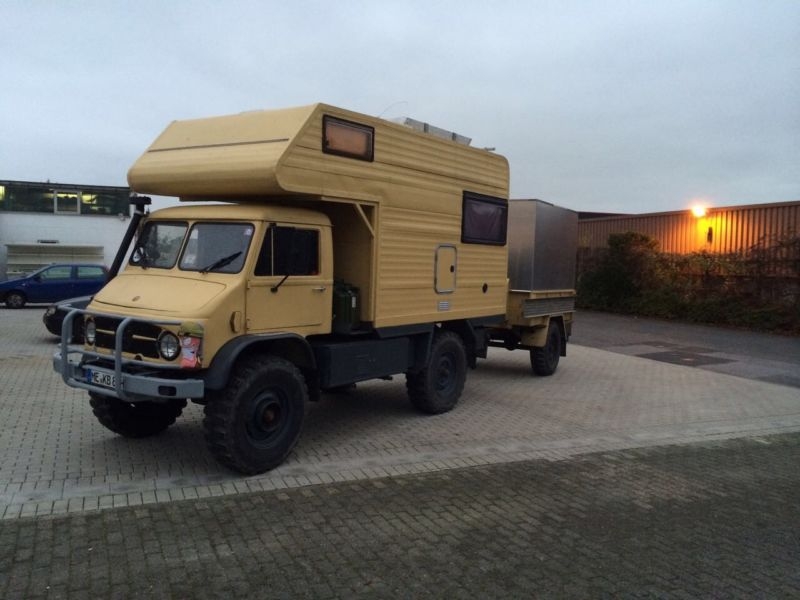

Mercedes-Benz Unimog 404S Expeditionsmobil 1967
General description :
Zum Verkauf steht unser geliebter und treuer Unimog. Er war uns stets ein treuer Reisebegleiter!
Das Fahrzeu ist seit 2011 in unserem Besitz. Wir haben ihn als fertig ausgebautes und Startbereites Expeditionsmobil gekauft. Kleine Modifikationen wurden von uns noch durchgeführt. Beispielsweise der Umbau der Sitzgruppe. Diese ist nun auch als Bett umklappbar.
Von 2013 auf 2014 haben wir ihn dann einmal gestrippt um ihn neu zu lackieren und Durchrostungen an der Karosse im Übergang zu den Radläufen zu beseitigen. Im diesem Zuge haben wir auch die Fenster vom Aufbau usw. ausgebaut und ihm eine neue Farbe verpasst.
Außerdem haben wir parallel einen BW-1-Achs Hänger aufgebaut. Diesen haben wir mit einem Aluaufbau, Laderampen und Radmulden in der Vorderen Bracke versehen um unsere Motorräder auf Reisen mitnehmen zu können. Der Hänger gehört auf Wunsch selbstverständlich dazu!
Nun zum eigentlichen Fahrzeug und dessen Aufbau.
Das Fahrgestell ist ein Unimog 404S ehemals von der Bundeswehr. Der Vorbesitzer hat diesen direkt vom Bund gekauft und restauriert. In diesem zuge hat er einen Motorumbau durchgeführt. Verbaut ist ein 3 Liter 5 Zylider Turbomotor OM617 aus dem G-Modell von Mercedes. Mit seinen 125PS wird er zum Wolf im Schafspelz. Natürlich ist es keine Rakete aber eine gemütliche Reisegeschwindigkeit von 90km/h ist dennoch entspannt möglich.
Der Alkovenaufbau ist ein kompletter Eigenbau. Der Vorbesitzer war Schreiner und hat ihn demnach mit besten Wissen und Gewissen hergerichtet. Eine Küche mit Herd und Waschbecken sind vorhanden. Außerdem eine kleine Nasszelle mit Waschbecken, Portapoti und Duschwanne. Letzteres wurde von uns jedoch nie gestestet.
Ein kleiner Warmwasserboiler und eine Truma-Standheizung, sowie die Solaranlage runden das ganze Paket ab.
Der Frischwassertank fasst 100Liter und ist Frostsicher im Innenraum verbaut. Der ABwassertank ist in einer der Unterbaukästen.
Der Aufbau hat zwei vom Fahrzeug getrennte Batterien. Diese werden sowohl bei Anschluss ans 230V Netz, als auch über die Solaranlage geladen.
Nun aber zum negativen Part:
- bei unserer letzten Tour vor ca einem Jahr ist uns die Kurbelwellenriemenscheibe "fliegen" gegangen. Seitdem fehlt uns die Zeit den Schaden in Ruhe zu beheben. Am besten wäre es diese aus einem leichten Material passend auf das Maß der Kurbelwelle nachzudrehen.
Daher ist der Wagen nicht fahrbereit. Bei ernsthaftem Kaufinteresse können wir den Schaden evtl. beheben.
Weitere Bilder folgen in Kürze!
Für Fragen oder eine Terminabsprache zur Besichtigung stehen wir Ihnen gerne jederzeit zur Verfügung!
https://home.mobile.de/CLASSICCARSMETTMANNBOEDEKER#des_254498946
1967 Mercedes-Benz Unimog 404S Expeditionsmobil is listed sold on ClassicDigest in Industriestrasse 13DE-40822 Mettmann by Auto Dealer for €15900.
Car Facts
Car type : Car Make : Mercedes-Benz Model : Unimog Model Version : 404S Expeditionsmobil Engine size : 0.0 Model Year : 1967 Sub type : Pick up Location : Industriestrasse 13DE-40822 Mettmann
Sold
Seller Information
Sold
People who viewed this Mercedes-Benz Unimog also viewed similar Mercedes-Benz listed at ClassicDigest
Mercedes-Benz Unimog
54950 €
Waalwijk
Mercedes-Benz Unimog
9900 €
Weinsheimerstrasse 39DE-67547 Worms
Mercedes-Benz Unimog
16500 €
Å dalen 23DK-6600 Vejen
Mercedes-Benz Unimog
Hauptstr. 3DE-67294 Rittersheim
Mercedes-Benz Unimog
19900 €
Gewerbering 27DE-08056 Zwickau
Other cars listed for sale by this dealer

Bentley T1
19900€
Industriestrasse 13DE-40822 Mettmann
About Mercedes-Benz
In the annals of automotive history, the journey of Mercedes-Benz is a tale that unfolds with the ingenuity of its founding pioneers. In the year 1886, Karl Benz crafted the Benz Patent Motorwagen, a creation that would go down in history as the world's inaugural automobile. Unbeknownst to him, this moment marked the genesis of what would evolve into the most illustrious premium car manufacturer globally. The financial underpinning of this pioneering venture, interestingly, was provided by Karl Benz's wife, Bertha Benz, demonstrating a remarkable partnership that would set the tone for Mercedes-Benz's legacy.A parallel narrative emerged not far away, as Daimler-Motoren-Gesellschaft, founded by Gottlieb Daimler and Wilhelm Maybach, entered the scene. In 1901, they unveiled their automobile under the now-famous moniker "Mercedes," meaning "godsend" in Spanish. This name was bestowed upon the car at the behest of Emil Jellinek's daughter, the distributor for Daimler-Motoren-Gesellschaft. The wheels of innovation were set in motion.
Fast forward to 1926, a pivotal year that witnessed the merger of Daimler with Benz & Cie., culminating in the birth of Daimler-Benz. The amalgamation saw the adoption of "Mercedes-Benz" as the distinguished trademark for their automobiles, fusing the legacies of two visionary entities into one.
Contrary to perceptions of conservatism, the trajectory of Daimler-Benz unfolds as a chronicle of industry firsts. From the introduction of the honeycomb radiator to the float carburetor, and the pioneering implementation of four-wheel brakes in 1924, Daimler-Benz consistently pushed the boundaries of automotive innovation. The diesel-powered Mercedes-Benz 260 D in 1936 marked the inception of diesel engines in passenger cars. The iconic Mercedes-Benz 300SL Gullwing made history as the first car with direct fuel injection, albeit the Gutbrod's tiny 2-stroke engine can claim precedence.
Safety innovations became a hallmark, with Béla Barényi's patented safety cell design in the "Ponton"-models in 1951, featuring front and rear crumple zones. The W116 450SEL 6.9 saw the introduction of the Anti-Lock Brake system (ABS), another pioneering safety feature. From the first production airbags and beyond, the legacy of "firsts" continued to be etched into the fabric of Daimler-Benz.
Over its centennial journey, Mercedes-Benz has not merely produced cars but has sculpted automotive icons. The SSKL, 710 SSK Trossi Roadster, 770K Grosser, 540K Spezial Roadster, 300SL Gullwing, w100 600 Pullman, w111 280SE 3.5 Flachkühler, w113 230SL Pagoda, w109 300 SEL 6.3, and w201 2.3-16 Cosworth stand testament to the brand's commitment to engineering excellence.
The roaring Silver Arrows, or "Silberpfeile," including the W 25, W 125, W154, W165, and W196, created a legacy of dominance on the racetrack. These machines were not merely cars; they were expressions of precision, speed, and an indomitable spirit that left their competitors in the dust.
As Mercedes-Benz marches into the future, it does so not just as an automaker but as a custodian of a legacy, a torchbearer of innovation, and a beacon of automotive excellence. The road ahead is sure to witness the continued fusion of cutting-edge technology, timeless design, and an unwavering commitment to setting new standards in the world of automobiles.
One luminary figure who left an indelible mark was Béla Barényi, often heralded as the "father of passive safety" for his pioneering work in safety engineering. His patented safety cell design, featuring front and rear crumple zones, became a hallmark of Mercedes-Benz's commitment to occupant safety, setting new standards that reverberated throughout the automotive world.
Moving through the chronicles, the collaborative genius of Wilhelm Maybach, alongside Gottlieb Daimler, laid the foundation for Daimler-Motoren-Gesellschaft. Their innovations not only birthed the first Mercedes but established a culture of relentless pursuit of technological excellence that remains integral to Mercedes-Benz's DNA.
In the post-merger era of 1926, Ferdinand Porsche emerged as a prominent figure within Mercedes-Benz. His work on the Mercedes-Benz S-Type, a supercharged race car, garnered acclaim and set the stage for a legacy that extended far beyond the marque. Porsche's impact would later extend to his eponymous company, but his influence at Mercedes-Benz during those formative years was pivotal.
As the 20th century progressed, the legendary Rudolf Uhlenhaut emerged as a key figure. Uhlenhaut, an accomplished engineer and the driving force behind the iconic Silver Arrows, played a crucial role in Mercedes-Benz's dominance in motorsports. His engineering prowess and attention to detail were instrumental in creating some of the most formidable racing cars of the era.
In the latter half of the century, figures like Bruno Sacco, the head of design at Mercedes-Benz from 1975 to 1999, left an indelible imprint on the brand's aesthetic identity. Sacco's design philosophy, characterized by clean lines and timeless elegance, shaped iconic models like the W126 S-Class and the W201 190E, solidifying Mercedes-Benz's reputation for luxury and sophistication.
The narrative would be incomplete without acknowledging the contributions of engineers like Hans Scherenberg, whose leadership in the 1970s ushered in a new era of technological innovation at Mercedes-Benz. Scherenberg's tenure saw the development of groundbreaking technologies, including the Anti-Lock Brake system (ABS) and the introduction of airbags in production cars.