

Mercedes-Benz 500K Replica 350 V8 1934
General description :
Description
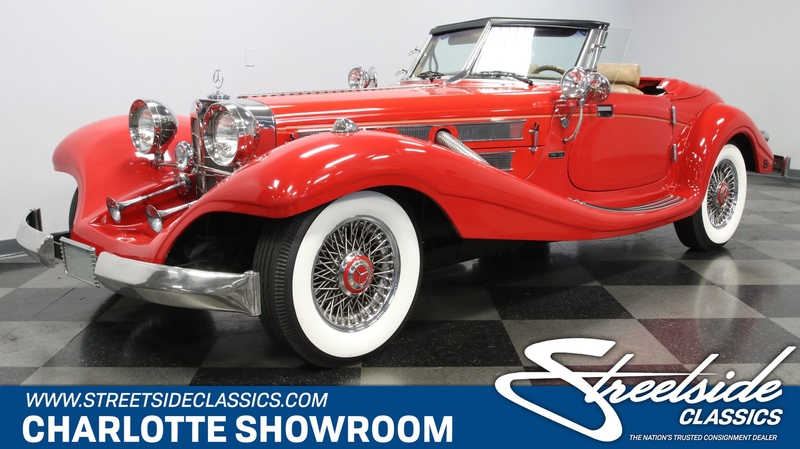
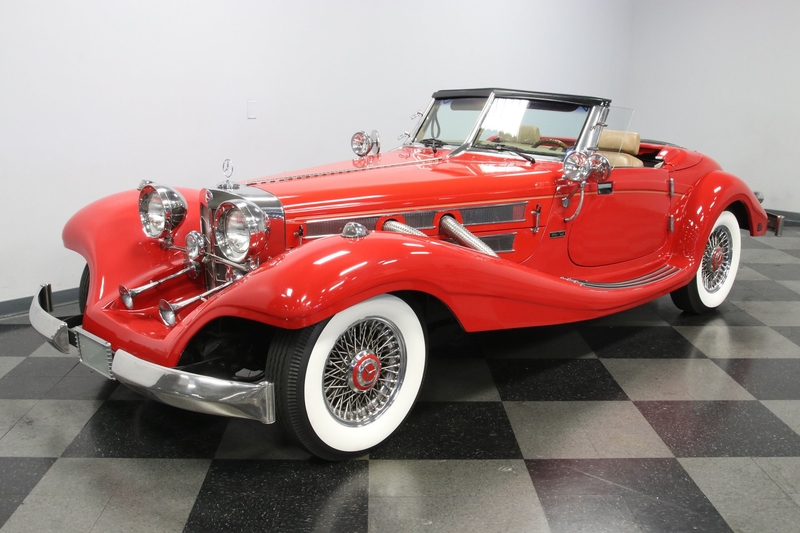
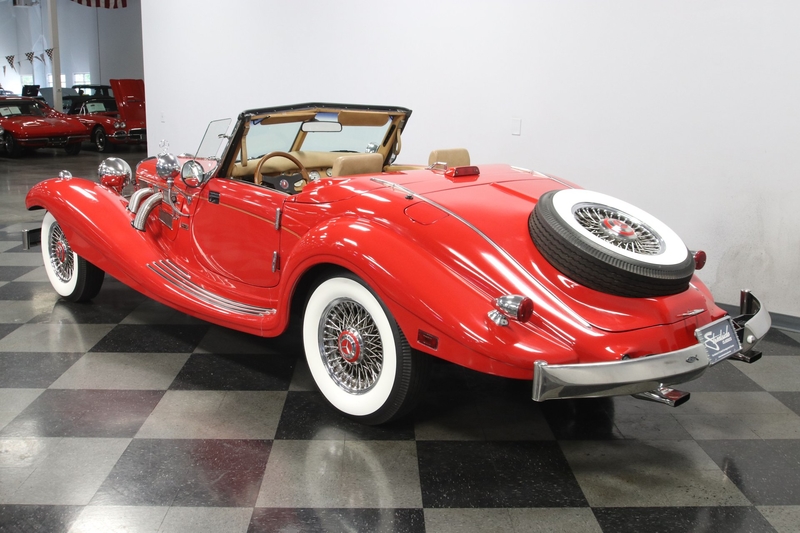
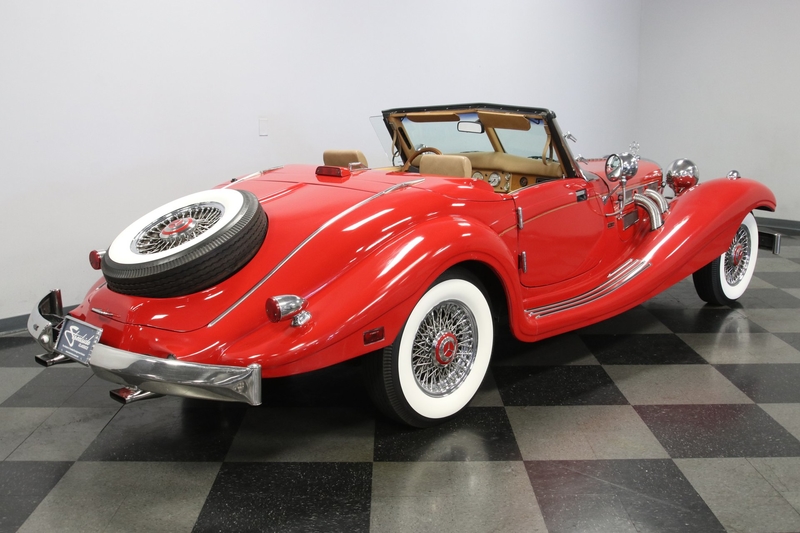
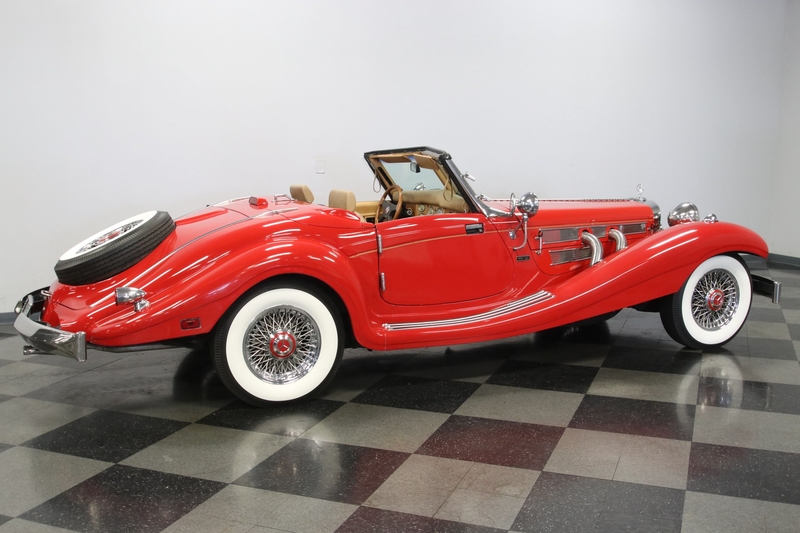
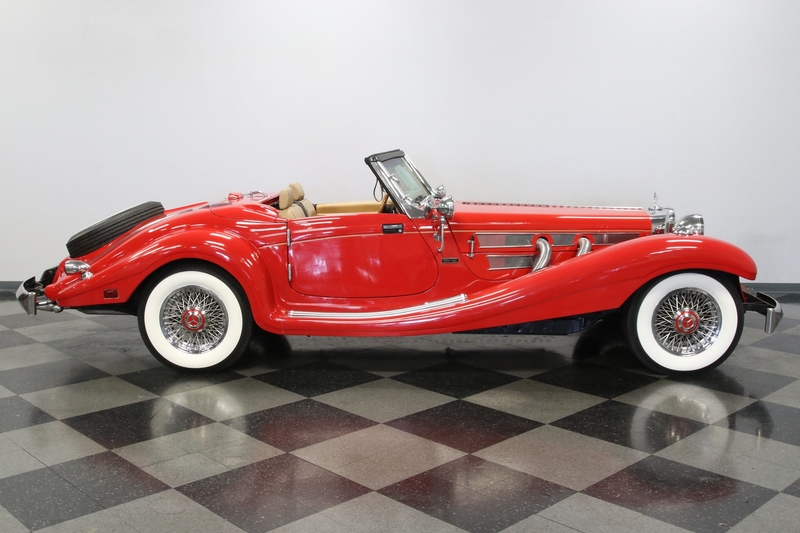
The 1934 Mercedes-Benz 500K is part of the highest echelon of classic cars, but for those who don't want to spend an estate's worth of money, or get nervous driving a multi million-dollar classic, this great-looking factory built replica by Heritage is the way to go. With fuel-injected V8 power, four-wheel disc brakes, major, costly, upgrades, totaling over $24,000. This particular car has been vastly improved, and is head and shoulders above the average Heritage vehicle.
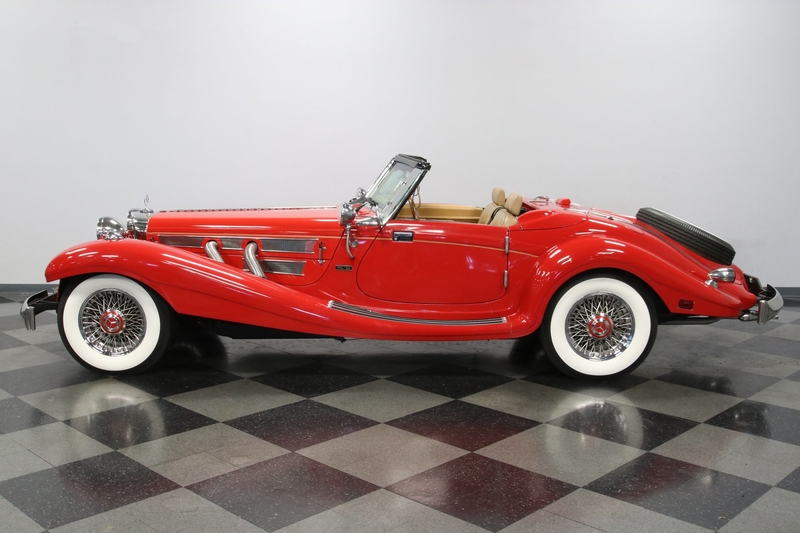
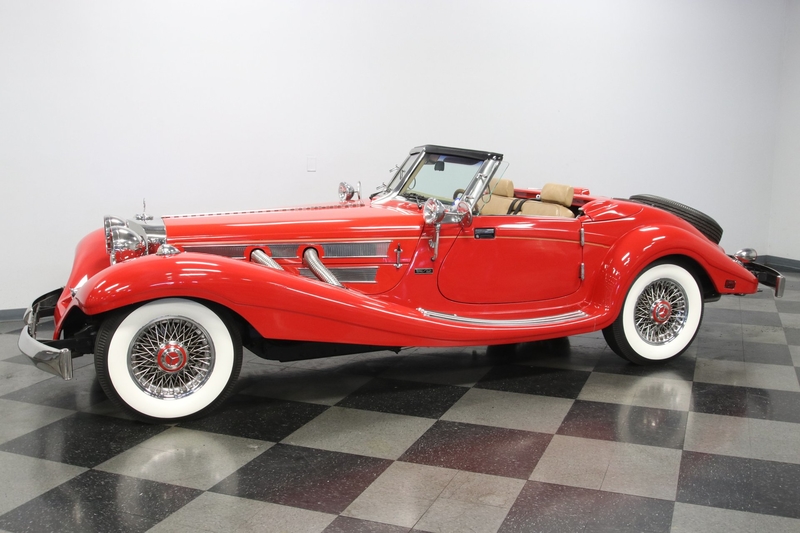
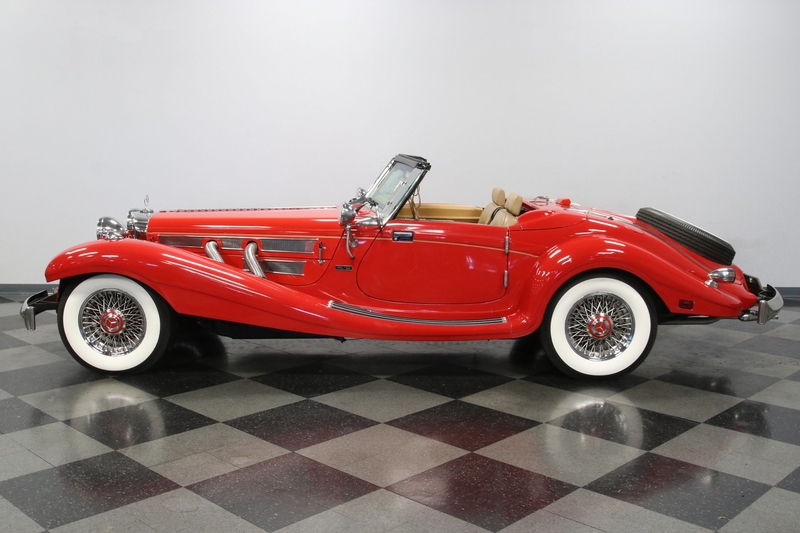
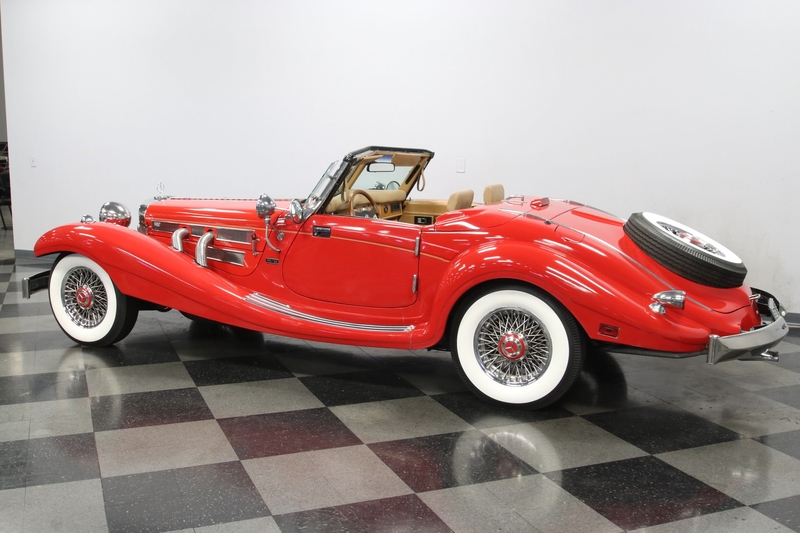
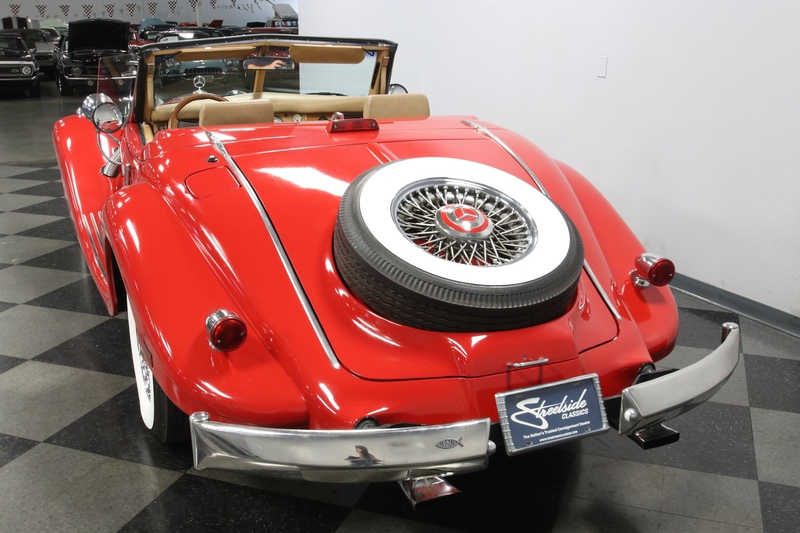
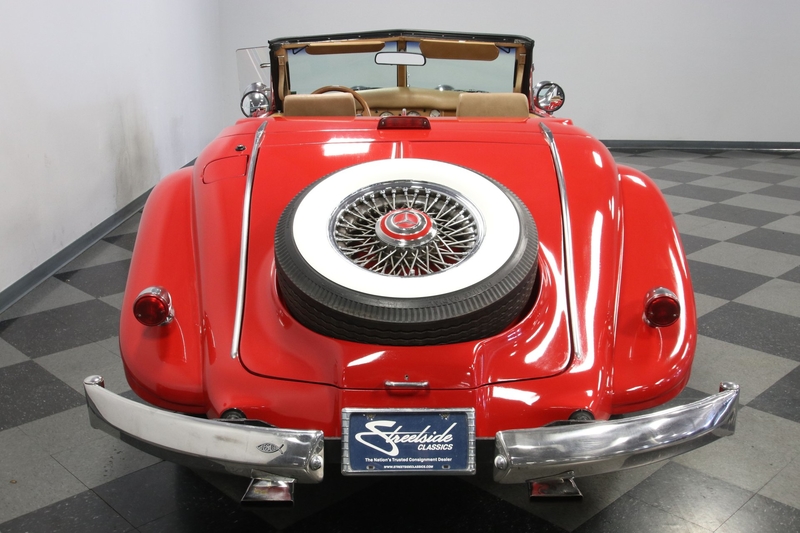
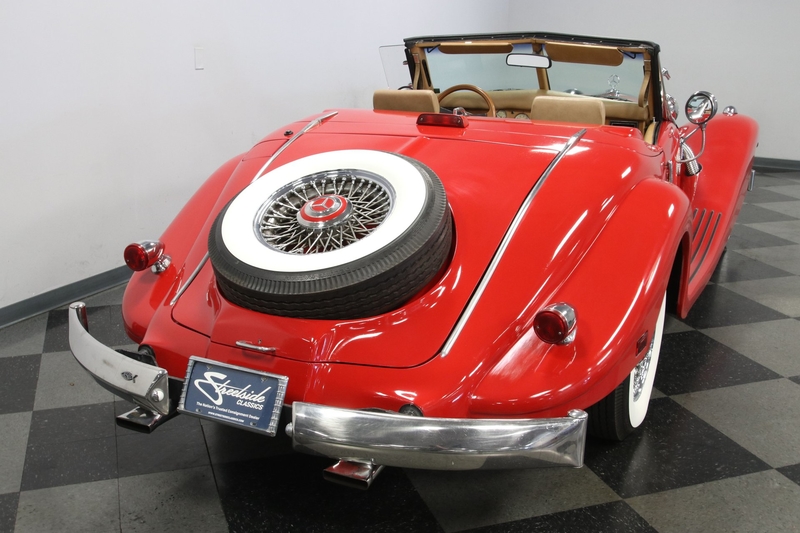
The reason why the Mercedes 500K is such a coveted classic is because it's one of the most beautiful designs to ever hit the road. And so it's great to see a fiberglass replica that takes the time to get the look right. The proportions are quite correct, so you get that extra-long hood that allows the flowing fenders to fully develop those million-dollar lines. Red is always a desirable color because it can attract extra attention from blocks away, and it makes for a nice backdrop for all the beautiful brightwork details. The hallmark (faux) side exhaust pipes, dual horns, dual spotlights, correct wide dual exhaust tips, and a full-size spare tire on the rear give this distinction from every angle. Occasionally you will find other 500K replicas out there, so it's important to notice how this one provides a clear difference in quality. For example, this has genuine Dayton wire wheels, because after all, nothing quite breaks the spell of an authentic-style vehicle than adding cheap wheel covers. That's why these are even nicely detailed with color-matched tri-star center caps and wide bright whitewall tires. While cars like this were meant for top-down motoring, this one makes sure it's a total package that also is impressive with the roof in place. The folding top utilizes Mercedes fabric for a special design that follows the original 500K silhouette closely. The frame is even chromed. Plus, the bright white coordinates with the wide whitewalls to give this a hint of two-tone appeal when the roof is in place. And if desirable to the new owner, the consingor is offering a hardtop for the car. With slight modification can offer another option for days that you do not want the wind-in-your hair feeling.
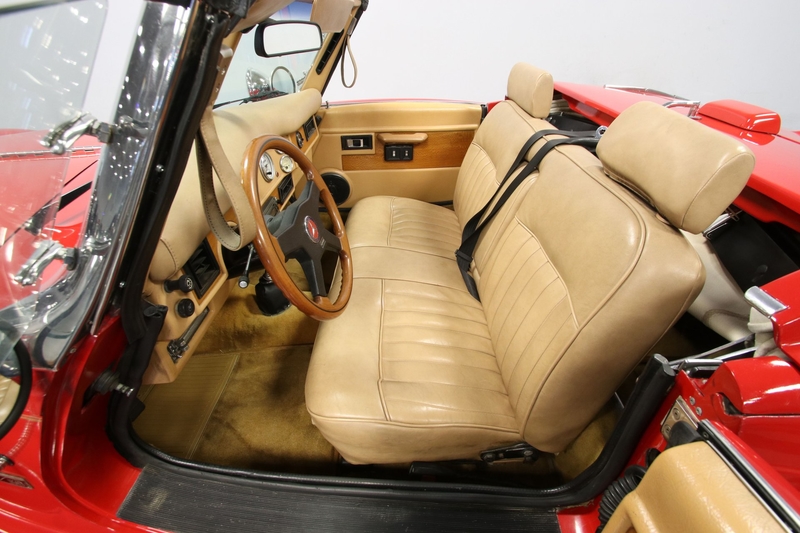
The tan interior looks timelessly elegant against the red exterior. This has a very vintage and well-coordinated appearance with suicide doors, tasteful wood paneling, and classic-style VDO gauges mounted prominently in the center of the dash. But that's not this car's whole story. While it has the look of a pre-war classic, this was built with far more modern comfort in mind. The vinyl seating has a fold-down armrest and wide headrests for an individual level of comfort. It's built with the driver in mind with upgrades like the wood-rimmed sports steering wheel, power steering, and Hurst floor shifter for the three-speed automatic. There are modern conveniences you could have never dreamed of in a pre-war machine, like power windows, power locks, and an AM/FM/CD stereo. This has even been fitted with R134a air conditioning (will need a recharge) in case you want to stay cool even when going for a Sunday afternoon drive.
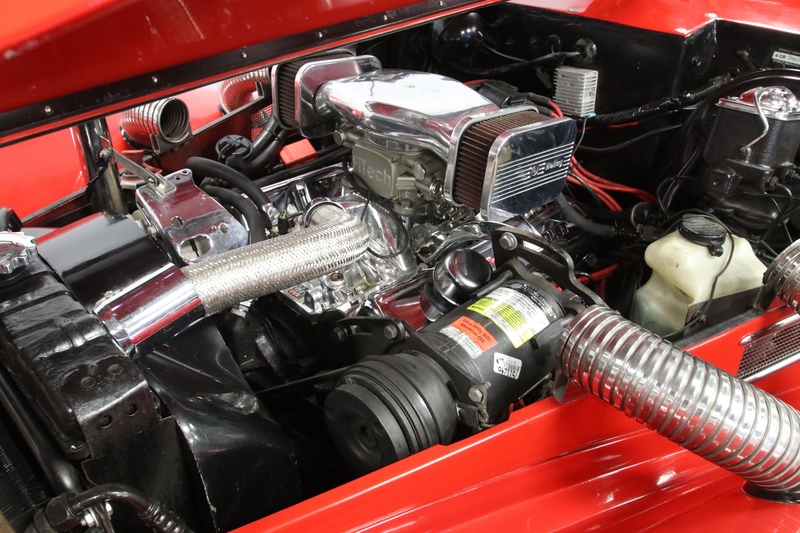
The polished package on the motor ensures you're going to open both sides of this butterfly hood every time you park at the car show. And just like the rest of this car, it has an impressive appearance that also has a practical side. You've got a hardy Chevy 350 cubic-inch crate V8 powering this Mercedes-style vehicle. This was further upgraded with the expensive FI Tech fuel injection system, which is great for both power and consistent delivery as well as a dual exhaust system which not only adds symmetry when looking at the car from the rear but helps with performance and an exquisite exhaust note. It's all part of a car that was made to be a great driver. That's why the front suspension was positioned and adjusted for a more comfortable ride; there are upgraded sway bars front & rear; and you have the superior stopping power of four-wheel power disc brakes.
While this is already an impressive package, the sale also comes with some extraordinary additions. It includes a 23-book Mercedes library plus, you get restoration photos, buildsheets, service manuals, maintenance records, and receipts documenting over $24,000 invested in this upgraded convertible. This is a head-turning tribute to arguably the most beautiful car ever. Thank goodness the owner has an anti-theft device setup on the car, everyone is going to be envious when they see this car out-and-about. So when you can look like a million bucks for a fraction of the price, you know you need to grab this deal. Call now!
Features : Vinyl Interior , Seatbelts , Power Windows , Power Steering , Power Locks , Power Brakes , Fuel Injection , Four Wheel Disc Brakes , Heat , Air Conditioning , Manual Convertible Top , Defrost , CD Player , AM/FM Radio ,
https://www.streetsideclassics.com/vehicles/5898-cha/1934-mercedes-benz-500k-replica
1934 Mercedes-Benz 500K Replica 350 V8 is listed sold on ClassicDigest in Charlotte by Streetside Classics for $44995.
Car Facts
Car type : Car Make : Mercedes-Benz Model : 500K Model Version : Replica 350 V8 Engine size : 0.0 Model Year : 1934 Location : Charlotte
Sold
Seller Information
Sold
People who viewed this Mercedes-Benz 500K also viewed similar Mercedes-Benz listed at ClassicDigest
Mercedes-Benz 500K
2450000 $
Astoria
Mercedes-Benz 500K
Essex
Mercedes-Benz 500K
Essex
Mercedes-Benz 500K
22900 €
Nußbergerstraße 1DE-94234 Viechtach
Other cars listed for sale by this dealer
GMC Sierra
26995$
Charlotte
Dodge Challenger
Charlotte
Chevrolet Camaro
54995$
Charlotte
Chevrolet Camaro
94995$
Charlotte
Chevrolet Corvette
61995$
Charlotte
About Mercedes-Benz
In the annals of automotive history, the journey of Mercedes-Benz is a tale that unfolds with the ingenuity of its founding pioneers. In the year 1886, Karl Benz crafted the Benz Patent Motorwagen, a creation that would go down in history as the world's inaugural automobile. Unbeknownst to him, this moment marked the genesis of what would evolve into the most illustrious premium car manufacturer globally. The financial underpinning of this pioneering venture, interestingly, was provided by Karl Benz's wife, Bertha Benz, demonstrating a remarkable partnership that would set the tone for Mercedes-Benz's legacy.A parallel narrative emerged not far away, as Daimler-Motoren-Gesellschaft, founded by Gottlieb Daimler and Wilhelm Maybach, entered the scene. In 1901, they unveiled their automobile under the now-famous moniker "Mercedes," meaning "godsend" in Spanish. This name was bestowed upon the car at the behest of Emil Jellinek's daughter, the distributor for Daimler-Motoren-Gesellschaft. The wheels of innovation were set in motion.
Fast forward to 1926, a pivotal year that witnessed the merger of Daimler with Benz & Cie., culminating in the birth of Daimler-Benz. The amalgamation saw the adoption of "Mercedes-Benz" as the distinguished trademark for their automobiles, fusing the legacies of two visionary entities into one.
Contrary to perceptions of conservatism, the trajectory of Daimler-Benz unfolds as a chronicle of industry firsts. From the introduction of the honeycomb radiator to the float carburetor, and the pioneering implementation of four-wheel brakes in 1924, Daimler-Benz consistently pushed the boundaries of automotive innovation. The diesel-powered Mercedes-Benz 260 D in 1936 marked the inception of diesel engines in passenger cars. The iconic Mercedes-Benz 300SL Gullwing made history as the first car with direct fuel injection, albeit the Gutbrod's tiny 2-stroke engine can claim precedence.
Safety innovations became a hallmark, with Béla Barényi's patented safety cell design in the "Ponton"-models in 1951, featuring front and rear crumple zones. The W116 450SEL 6.9 saw the introduction of the Anti-Lock Brake system (ABS), another pioneering safety feature. From the first production airbags and beyond, the legacy of "firsts" continued to be etched into the fabric of Daimler-Benz.
Over its centennial journey, Mercedes-Benz has not merely produced cars but has sculpted automotive icons. The SSKL, 710 SSK Trossi Roadster, 770K Grosser, 540K Spezial Roadster, 300SL Gullwing, w100 600 Pullman, w111 280SE 3.5 Flachkühler, w113 230SL Pagoda, w109 300 SEL 6.3, and w201 2.3-16 Cosworth stand testament to the brand's commitment to engineering excellence.
The roaring Silver Arrows, or "Silberpfeile," including the W 25, W 125, W154, W165, and W196, created a legacy of dominance on the racetrack. These machines were not merely cars; they were expressions of precision, speed, and an indomitable spirit that left their competitors in the dust.
As Mercedes-Benz marches into the future, it does so not just as an automaker but as a custodian of a legacy, a torchbearer of innovation, and a beacon of automotive excellence. The road ahead is sure to witness the continued fusion of cutting-edge technology, timeless design, and an unwavering commitment to setting new standards in the world of automobiles.
One luminary figure who left an indelible mark was Béla Barényi, often heralded as the "father of passive safety" for his pioneering work in safety engineering. His patented safety cell design, featuring front and rear crumple zones, became a hallmark of Mercedes-Benz's commitment to occupant safety, setting new standards that reverberated throughout the automotive world.
Moving through the chronicles, the collaborative genius of Wilhelm Maybach, alongside Gottlieb Daimler, laid the foundation for Daimler-Motoren-Gesellschaft. Their innovations not only birthed the first Mercedes but established a culture of relentless pursuit of technological excellence that remains integral to Mercedes-Benz's DNA.
In the post-merger era of 1926, Ferdinand Porsche emerged as a prominent figure within Mercedes-Benz. His work on the Mercedes-Benz S-Type, a supercharged race car, garnered acclaim and set the stage for a legacy that extended far beyond the marque. Porsche's impact would later extend to his eponymous company, but his influence at Mercedes-Benz during those formative years was pivotal.
As the 20th century progressed, the legendary Rudolf Uhlenhaut emerged as a key figure. Uhlenhaut, an accomplished engineer and the driving force behind the iconic Silver Arrows, played a crucial role in Mercedes-Benz's dominance in motorsports. His engineering prowess and attention to detail were instrumental in creating some of the most formidable racing cars of the era.
In the latter half of the century, figures like Bruno Sacco, the head of design at Mercedes-Benz from 1975 to 1999, left an indelible imprint on the brand's aesthetic identity. Sacco's design philosophy, characterized by clean lines and timeless elegance, shaped iconic models like the W126 S-Class and the W201 190E, solidifying Mercedes-Benz's reputation for luxury and sophistication.
The narrative would be incomplete without acknowledging the contributions of engineers like Hans Scherenberg, whose leadership in the 1970s ushered in a new era of technological innovation at Mercedes-Benz. Scherenberg's tenure saw the development of groundbreaking technologies, including the Anti-Lock Brake system (ABS) and the introduction of airbags in production cars.