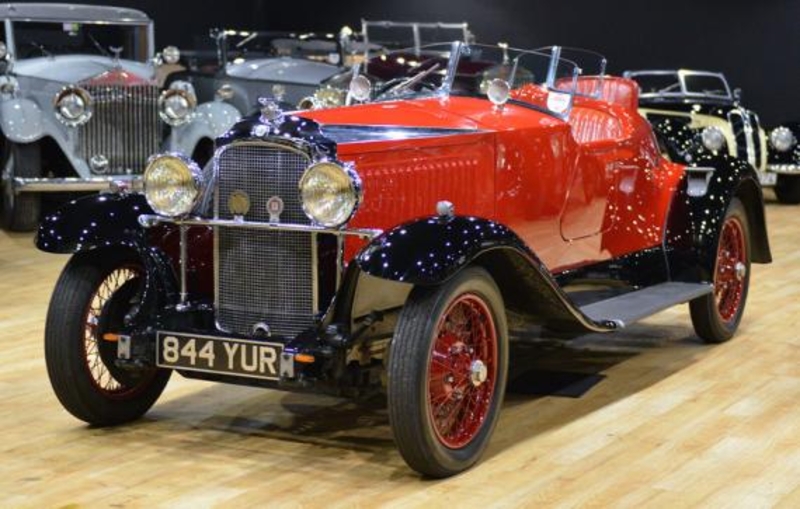

Vauxhall 20/60 1929
General description :
1929 Vauxhall Hurlingham.
Chassis Number: T658
Body Number RA507
Registration Number: 844YUR
Rare & Beautiful; it is believed that just 48 Hurlinghams were produced. This example is a four owner car that was exported to South Africa in 1936 & has recently returned to these shores. The car has undergone a meticulous restoration at the hands of the last owner; a noted & fastidious collector in Cape Town.
Vauxhall advertised the Hurlingham in the Motor on December 3rd 1929, referring to it as the Hurlingham 2-seater, although in fact the single dickey to the rear provides a third seat. The advert also featured the latest of Phillips patriotic inventions, a Britannia figure with the legend “Pride of British”.
Priced at £650 with its voluptuous boat type aluminium body resplendent with motorboat style scuttle vents, standard bolt-on wire wheels and twin V-screens, the Hurlingham represented good value by the standards of the day. The art deco detailing was superb, with a chrome strake on the scuttle that swooped up to form the central windscreen pillar. This line was then picked up in the cockpit by the shape of the seat back divider which merged into a central fin down to the tail of the car. Pleasingly the period details on our car are all present from the owls eye rear stop lamps at the back to the V motif escutcheon plates covering the front dumb irons.
The 3.0 Litre T series 20/60 engine has been taken apart during restoration & completely rebuilt. Thus it starts instantly & runs in comparative silence. The four speed box boasts three straight cut gears giving way to a silent fourth. The original carburetor is pleasingly extant. The engine bay is detailed & in show condition with the access plate covers & rocker cover highly polished. The one shot lubrication system is all present & correct.
The 20-60 chassis was factory modified to create a Hurlingham. The catalogue mentions the car having “a higher back-axle ratio and is otherwise specially equipped to secure a higher speed performance.” In advertisements a higher compression ratio is mentioned and experience indicates that the valve springs may also have been stronger whilst the road springs had fewer leaves to both reduce the height of the car a little and adjust the ride for the lighter bodywork.
This car is resplendent in its red coachwork offset by black wings with the paint being in beautiful order. The bonnet scallops are of chrome leading back from the radiator & giving an impression of speed even whilst stationary. The rear hatch flips up easily to reveal the dickey protected by its separate wind screen. Interior is red leather of some considerable age in near perfect condition & patinated to just the right degree.
The car comes to us with a comprehensive history file dating back to its early days in South Africa. Considerable correspondence exists in the file between noted aficionado the late Stanley Irving, who was a leading light for many years on the subject of Hurlinghams, a torch which his son Nigel now carries. I was able to photograph & forward to Nigel copies of his fathers letters from the '60's & 70's making for a poignant dialogue. The car just come back from Mr Irvings establishment where it has had a thorough service, tune up & correct set up applied to the brakes.
Surely the weapon of choice for cads & bounders in the late '20's, these cars rarely come to market & are very sought after. The car is with us now in our showroom & ready for viewing. I collected it in London, drove over tower bridge & then out down the A13 where, once clear of traffic it cruised at an easy relaxed 60mph, running cool & with excellent oil pressure.
http://www.vintagerollsroycecars.com/car-details/1929-vauxhall-hurlingham_843.html
1929 Vauxhall 20/60 is listed sold on ClassicDigest in Grays by Vintage Prestige for £110000.
Car Facts
Car type : Car Make : Vauxhall Model : 20/60 Engine size : 0.0 Model Year : 1929 Location : Essex Vehicle Registration : Normal
Sold
Seller Information
Sold
Other cars listed for sale by this dealer
Rolls-Royce Silver Spur
Essex
Rolls-Royce Silver Spirit
Essex
Rolls-Royce Silver Cloud SI
Essex
Rolls-Royce Silver Wraith
Essex
MG TD
Essex
About Vauxhall
The history of Vauxhall Motors, a British automobile manufacturer, is a rich tapestry spanning more than a century, involving innovation, collaborations, and transitions.Early Years: Vauxhall was established in 1857 in Vauxhall, London, initially producing pumps and marine engines. In 1903, they ventured into automobile manufacturing, creating their first car, the Vauxhall 6HP. The brand gained a reputation for producing reliable vehicles.
Acquisition by General Motors (GM): In 1925, Vauxhall was acquired by General Motors (GM), which influenced its trajectory for several decades. This partnership brought technological advancements and expanded Vauxhall's market.
Genuine Vauxhall Models: In the earlier years of Vauxhall's history, especially before the collaboration with Opel, Vauxhall produced cars that were uniquely developed by the company. These vehicles, such as the Vauxhall Victor, Viva, and Cresta, were designed and engineered by Vauxhall independently of Opel.
Badge-Engineered Opels: As Vauxhall came under the ownership of General Motors (GM) in the mid-20th century, it became part of a network of GM-owned brands that included Opel in Germany. This led to the practice of badge engineering, where certain Opel models were rebranded and sold as Vauxhalls in the UK and vice versa.
For instance, models like the Vauxhall Carlton and Cavalier had their counterparts in the Opel range, such as the Opel Omega and Ascona. These cars were essentially the same vehicles with minor cosmetic differences and were marketed under different badges for specific markets.
This strategy allowed GM to streamline production and development costs by sharing platforms and technologies across markets, thereby creating cars that were economically feasible for different regions while retaining a semblance of distinct branding.
Perceived Differences: While many of these badge-engineered models shared much of their engineering, components, and technology, there were perceptions among some consumers and critics that Opel-badged cars might have been slightly more refined or better equipped compared to their Vauxhall counterparts. However, this perception wasn't universal and might not have been true for all models.