
Volkswagen Käfer Typ1 1.1L Flat 4 1952
Allgemeine Beschreibung :
1952 Volkswagen Beetle
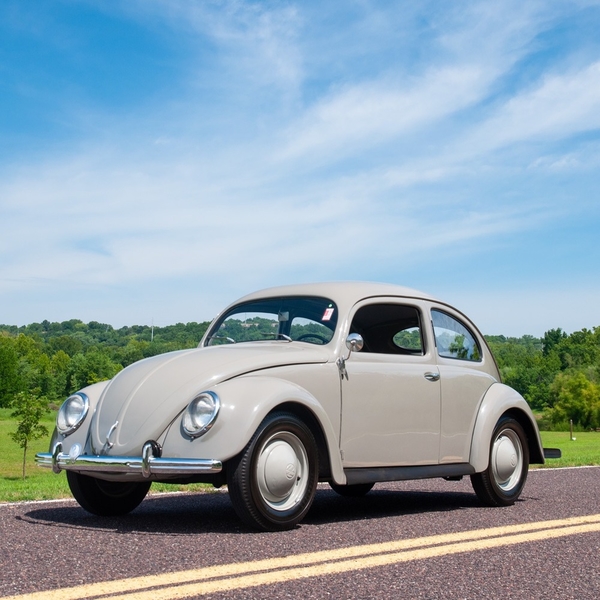
Very rare and highly desirable split window Volkswagen; final year for split rear window
Has certificate of authenticity from Stiftung AutoMuseum Volkswagen
A true time capsule experience
Owned and lovingly cared for by Norbert Scholz from 1960 to 2007 or 47 years!
Base model Standard as original in Pearl Grey (code L21)
Original style German interior by West Coast Classics
46,xxx original miles and only 165 miles added since restoration, on an actual mile Arizona title
Original 25 hp, air-cooled 1.1L flat four-cylinder engine with T air cleaner, D regulator, etc.
Lever shocks, cable brakes and three-speed manual transmission as original
Verified with GPS; speedometer accuracy up to 71 mph
NOS three-spoke standard steering wheel and horn button
Hella headlights and VDO gauges
Dual filament tail/brake lights installed for safety
Ribbed semaphores
New Firestone blackwall tires
California Black Plates included
Documentation includes original owners manual and VW birth certificate, various maintenance paperwork, a photo album of the restoration and a tool roll
Classic Volkswagen fans, MotoeXotica Classic Cars has a rare treat for you a 1952 VW Beetle split window model. Nineteen fifty-two was the final year for the now rare and highly desirable split window model. If youre looking for a true time capsule experience, you dont want to miss this car! The previous owner had the car meticulously restored back to original standards with a rebuilt engine, brakes, and suspension!
Built on July 9, 1951 in Germany; it left the factory on July 18. It left with the following options chrome-plated bumpers, hubcaps, outlet pipes, front indicator lights, tank cap and door handles, trim strips, passenger sun visor, larger reflector in brake light and a speedometer marked in miles per hour.
Norbert Scholz owned and lovingly took care of this car from 1960 to 2007 47 years! This is a Standard model as original in Pearl Grey (code L21) with an original style German interior from West Coast Classics.
This cars paint and trim are nearly flawless; this car looks simple and elegant; even the wheel covers are Pearl Grey. The windows on this Bug are in overall very good condition, however the drivers side rear side glass has a blemish, but original to the car. The cars lights are clear and haze-free, including the fantastic Hella headlights and dual filament tail/brake lights installed for safety. Straight and solid describes this cars bodywork including the ribbed semaphores, the engine bay is quite tidy and the cargo area up front looks great. The cars chrome bumpers look as good as the rest of the exterior.
This Bug rolls on new Firestone Deluxe Champion Gum-Dipped tires, size 5.60-15 at all four corners and as mentioned, each tire is wrapped around a steel wheel topped by Pearl Gray full moon wheel covers.
Out back is the rebuilt original 1.1L flat four-cylinder engine breathing via a single tailpipe. The engine has the T air cleaner and the D regulator. Buttoned to the motor is a three-speed manual transmission, along with lever shocks and cable brakes.
Inside, the aforementioned original German style interior from West Coast Classics is overall excellent condition. The grey front buckets and rear bench seat are in excellent shape, as is the carpet, headliner and new old stock (NOS) three-spoke steering wheel and horn button. The instrument panel, with its VDO gauges and inner door panels are all in fantastic conditions. This is an audio delete model. Using global-positioning sensors as verification, this cars top speed has been measured at 71 miles per hour.
Changes for 1952 included – crankshaft end play adjusted by 3 shims;tire size changes from 5.00×16 to 5.6×15; six leaved torsion bars increase suspension travel; new instrument panel from October; 26PCI (or 28PCI?) carburetor in late 52;transmission has three synchro gears (second, third, fourth) replacing old crash box;window crank reduced from 10 ½ to 1 ¼ turns;vent windows; vent flaps in quarter panels discontinued; rotary heater knob introduced; T-type engine lid handle introduced; two brake/taillights replace single unit; interior light moved to left side door pillar;bigger, stronger bumpers; self-parking wipers; crank starter hole discontinued on all models;widened body side trim; oval horn grill to front;and redesigned Pope’s nose number plate light.
During this period, many changes were made throughout the vehicle beginning with the availability of hydraulic brakes and a folding fabric sunroof in 1950. The rear window of the VW Beetle evolved from a divided or split oval, to a singular oval. The change occurred between October 1952 and March 1953. Beetles built during this time were known as a Zwitter, or hybrid, as they used the split-window bodyshell with oval-model chrome trim, vent windows and dashboard.
Documentation includes original owners manual and VW birth certificate, various maintenance paperwork, a photo album of the restoration and a tool roll plus California black plates. Competition to this VW in 1952 included the Allstate, the Crosley and the Henry J.
So, if youre in the market for an early 1950s Volkswagen, if youre a German car collector or you just like to buy classic cars that are a little off the beaten path, visit MotoeXotica Classic Cars soon. We predict this one wont linger long.
VIN: 10266025 EIN: 02114133
Please Click Here to View Our YouTube Video!!!
https://www.motoexotica.com/inventory/listing/1952-volkswagen-beetle-split-window/
1952 Volkswagen Käfer Typ1 1.1L Flat 4 is listed verkauft on ClassicDigest in Fenton (St. Louis) by for $59900.
Fakten der Auto
Karosserietyp : Auto Marke : Volkswagen Modell : Käfer Typ1 Ausführung : 1.1L Flat 4 Hubraum : 1.1 Modelljahr : 1952 Karosstyp : Sedan Lage : Fenton (St. Louis)
Verkauft
Angaben Zum Verkäufer
Verkauft
People who viewed this Volkswagen Käfer Typ1 also viewed similar Volkswagen listed at ClassicDigest
Volkswagen Beetle Typ1
30000 $
Tampa
Volkswagen Beetle Typ1
22500 $
Dallas
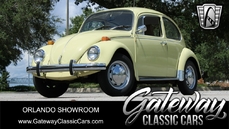
Volkswagen Beetle Typ1
13000 $
Orlando
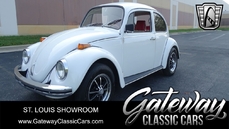
Volkswagen Beetle Typ1
26000 $
St. Louis
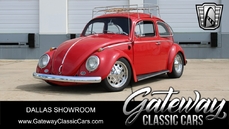
Volkswagen Beetle Typ1
21000 $
Dallas
Other cars listed for sale by this dealer
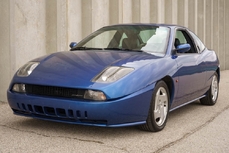
Fiat Coupe
15500$
Fenton (St. Louis)
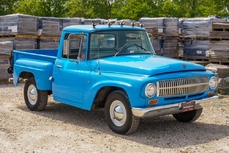
International C-1100
Fenton (St. Louis)
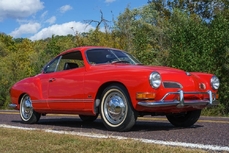
Volkswagen Karmann-Ghia
Fenton (St. Louis)
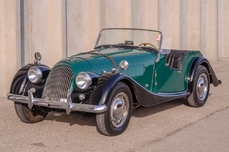
Morgan Plus 4
Fenton (St. Louis)
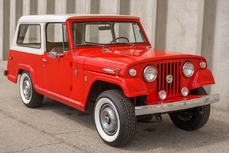
Willys Jeepster
Fenton (St. Louis)
über Volkswagen
Die Volkswagen-Geschichte ist in der Tat eine faszinierende Geschichte von Innovation, Belastbarkeit und Wiederbelebung nach dem Krieg, die von verschiedenen Modellen gekennzeichnet ist, die in der Automobilgeschichte zu Ikone geworden sind.Das Volksauto (Volkswagen): Zunächst von Adolf Hitler in den 1930er Jahren als "Volksauto" oder "Volkswagen" auf Deutsch vorgestellt, war die Idee, ein erschwingliches und praktisches Fahrzeug für das deutsche Volk zu schaffen. Dieses Konzept führte zur Entwicklung des von Ferdinand Porsche entworfenen Volkswagenkäfers (oder des Typ 1).
Nachkriegsherausforderungen: Nach dem Zweiten Weltkrieg stand Volkswagen erhebliche Herausforderungen. Die Fabrik war stark beschädigt, und die Verbindung der Marke mit dem NS -Regime führte in einigen Regionen zu einem mangelnden Interesse an dem Auto.
Britische Intervention - Die britische Armee & Ivan Hirst: Die britische Armee übernahm die Kontrolle über die Fabrik in der unmittelbaren Nachkriegszeit. Major Ivan Hirst, ein Offizier der britischen Armee, spielte eine entscheidende Rolle bei der Wiederbelebung von Volkswagen. Er erkannte das Potenzial des Käfers und setzte sich für seine Produktion ein. Er überzeugte das britische Militär, mehrere tausend Autos zu bestellen. Diese Entscheidung hat dazu beigetragen, die Wiederbelebung der Marke zu starten.
Exporterfolg und der globale Anziehungskraft des Käfers: Der Käfer gewann nicht nur in Deutschland, sondern auch weltweit an Popularität und wurde zu einer Ikone des erschwinglichen Fahrwerks. Das einfache, zuverlässige Design und das einzigartige Erscheinungsbild machten es zu einem Favoriten unter den Verbrauchern weltweit.
Modellentwicklung: Im Laufe der Jahre führte Volkswagen verschiedene Modelle neben dem Käfer ein, wobei jeder zum Wachstum der Marke beitrug:
Typ 2 (VW -Bus oder Transporter): In den 1950er Jahren wurde er in den 1960er Jahren zu einem ikonischen Symbol der Hippie -Bewegung eingeführt und wurde wegen seiner Geräumigkeit und Vielseitigkeit geliebt.
Golf (Kaninchen in den USA): Der Golf (oder Kaninchen in den USA) wurde Mitte der 1970er Jahre ins Leben gerufen und markierte eine Verlagerung in Richtung Frontantrieb, modernes Design und Schrägheckpraktikabilität und wurde zu einem Eckpfeiler des Erfolgs der Marke.
Passat, Jetta und andere Modelle: Volkswagen erweiterte seine Aufstellung mit Modellen wie dem Passat und Jetta, die sich für verschiedene Marktsegmente befassen.
Herausforderungen und Innovationen: Trotz des Erfolgs stand Volkswagen vor Herausforderungen, einschließlich Qualitätsproblemen in den 1970er Jahren. Die Marke hat jedoch weiterhin neue Modelle und Technologien entwickelt und entwickelt.
Aufstieg des GTI und globaler Expansion: In den 1980er Jahren stieg der legendäre Golf GTI auf, eine Hochleistungsversion, die den Trend der heißen Luke auslöste. Volkswagen erweiterte auch seine globale Präsenz in diesem Zeitraum.
Die britische Intervention bei der Wiederbelebung von Volkswagen nach dem Zweiten Weltkrieg spielte eine entscheidende Rolle bei der Wiederbelebung der Marke. Während es in den 1950er und 1960er Jahren aufgrund des Erfolgs von Volkswagen in den 1950er und 1960er Jahren möglicherweise einige Spannungen oder einen Wettbewerb zwischen Automobilunternehmen gegeben hat, hat die Fähigkeit der Marke, innovative und beliebte Modelle zu produzieren, ihren Platz in der Automobilgeschichte festigend.