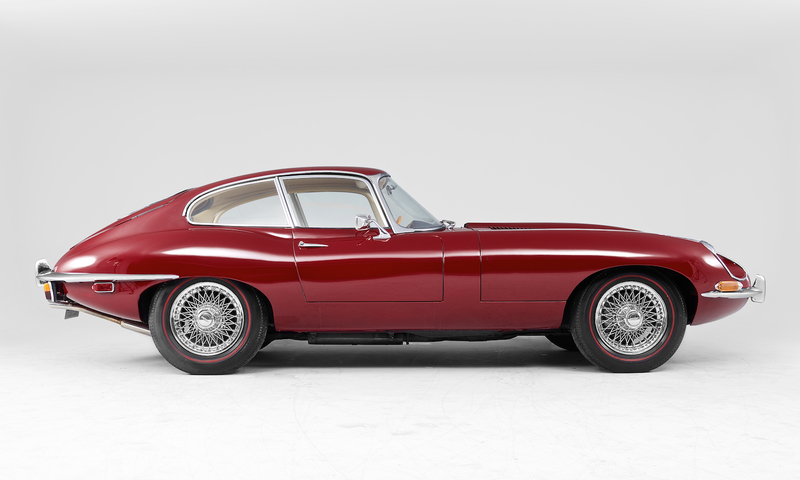

Jaguar E-type Series II 1968
General description :
An early Series II fixed head coupe, Regency Red with 84k miles.
MODEL HISTORY
The Jaguar E-Type was a British sports car manufactured between 1961 and 1975. Its combination of beauty, high performance, and competitive pricing established the marque as an icon of 1960s motoring. At a time when most cars had drum brakes, live rear axles, and mediocre performance, the E-Type sprang on the scene with a 150mph top speed, a 0-60 time of less than 7 seconds, monocoque construction, disc brakes, rack and pinion steering, and unrivaled looks. On its release Enzo Ferrari called it "The most beautiful car ever made".
The car was based on Jaguar's own famed racer, the Type D, which had won the world's most prestigious sports-car race three consecutive years (1955-1957) and, as such, it was the first production vehicle not to use a separate body bolted onto a chassis. Instead it employed the racing design of a body tub attached to a tubular framework, with the engine bolted directly to the framework.
Later model updates of the E-Type were officially designated "Series II" and "Series III", and over time the earlier cars have come to be referred to as "Series I." As with other largely hand made cars of the time, changes were incremental and ongoing, which has led to confusion over exactly what is a Series I car.
In 1968 the Series II was introduced featuring a number of design changes, largely due to U.S. design legislation. The most distinctive feature is the absence of the aerodynamic glass headlight covers, which impacted several other imported cars, like the Citroën DS, as well. Unlike other cars though, this retrograde step was applied worldwide for the E-Type, not just to Americans living under the authority of the National Highway Traffic and Safety Administration. Other hallmarks of Series II cars are a wrap-around rear bumper, re-positioned and larger front indicators and tail lights below the bumpers, better cooling aided by an enlarged ‘mouth' and twin electric fans, as well as uprated brakes. Series II cars have been known to be the best drivers and most reliable of the E-Type lines.
Equipment
Disc brakes, Wooden steering wheel, Seat belts, Dash clock, Glove compartment, Cigarette lighter, Ash tray, Spare wheel.
EXTERIOR
This very early series II is number 14 of the LHD fixed head coupes built. As such it is fitted with the more attractive Series I bonnet, as confirmed by the chassis number. Since coming out of storage the car has been treated to a bare metal re-spray. Having previously resided in a dry USA state, the Jaguar had minimal corrosion and so only minor metalwork repairs were required; this is documented by photographs in the history file.
Since the E-Type has never required major restoration all the panels are believed to be original, and the shut lines are correct. When the car was rebuilt all of the rubber seals where replaced and the original bumpers re-chromed. The Regency Red paintwork now has a beautiful deep shine and looks sublime with the sparkling chrome and parchment leather interior. It is not a flawless concours car but presents to an excellent standard and makes for a great investment to drive and enjoy.
INTERIOR
Prior to the car's refurbishment the interior was in perfectly good order, but the decision was made to have it fully re-trimmed in supple parchment leather. The seats and centre console now present in perfect, unmarked condition with new piped upholstery. The door cards and all other panels have been correctly trimmed in matching vinyl.
The car has also been treated to a fresh set of fitted carpets. Furthermore the dash remains in its original condition and is free from any damage, with all switchgear presenting in good order too. The wooden steering wheel retains an excellent finish, as does the gear knob, handbrake, and the rear luggage area.
ENGINE & TRANSMISSION
Once unlatched, the vast front end lifts with ease to reveal the 4.2-litre straight-six engine. Being a Californian E-Type this example is fitted with twin Zenith-Stromberg carburettors producing 245hp.
The engine bay is in very presentable condition but could benefit from further detailing to make perfect. Having been very recently overhauled the car remains in great mechanical fettle, starting first turn of the key with a little choke, and drives extremely well.
WHEELS, TYRES & BRAKES
Sitting on the correct set of 15-inch ‘knock-off' wire wheels, the E-Type maintains a truly vintage aesthetic. They are in good order with only minor age-related wear to note.
The wheels are shod in a matching set of period Michelin tyres with ample tread remaining. Behind the spokes the disc brakes present in good order, stopping the car quickly and with ease.
HISTORY FILE
This E-type was manufactured in 1968, and was the fourteenth left-hand drive Series II fixed head coupe off the production line. As a result the car was fitted with the more attractive Series I bonnet, rather than the subsequent larger ‘mouth' variation. The chassis number confirms this although the car was not then registered until 1969. The Jaguar remained in California until 1991 and was in regular use up until that point, details of which are documented in a hand written service log present in the history. It was then imported to the UK and driven up until 1999, when it then remained in dry storage until 2012.
The car has had a recent re-commissioning to include both a cosmetic and mechanical overhaul, and the mileage of 84,079 is believed genuine. Present in the history file is a huge stack of invoices for parts and works carried out over recent years. There are also several UK MOT certificates, photographs taken during the restorative work, as well as the US Title Certificate.
http://www.4starclassics.com/jaguar-e-type-series-ii-for-sale/
1968 Jaguar E-type Series II is listed sold on ClassicDigest in Kingsley by 4 Star Classics for £49995.
Car Facts
Car type : Car Make : Jaguar Model : E-type Model Version : Series II Engine size : 4.2 Model Year : 1968 Sub type : Race/Rally Car Location : Hampshire
Sold
Seller Information
Sold
People who viewed this Jaguar E-type also viewed similar Jaguar listed at ClassicDigest
Jaguar E-type
119950 €
Waalwijk
Jaguar E-type
Emeryville
Jaguar E-type
84500 €
Wehntalerstrasse 25 CH-8165 Oberweningen, Switzerland
Jaguar E-type
69995 €
United Kingdom
Jaguar E-type
92000 $
Houston
Other cars listed for sale by this dealer
Datsun 240Z
39995£
Hampshire
Volkswagen Karmann-Ghia
36995£
Hampshire
Peugeot 205
10995£
Hampshire
Mercedes-Benz 500SL r129
19995£
Hampshire
BMW 735
29995£
Hampshire
About Jaguar E-type
The Jaguar E-Type FHC (Fixed Head Coupe) is a classic sports car that was produced by the British automaker Jaguar Cars from 1961 to 1974. It is often regarded as one of the most beautiful cars ever produced, with its long, sleek hood, flowing curves, and aggressive stance.The E-Type FHC was derived from the D-Type race car that won the 24 Hours of Le Mans in 1955, 1956, and 1957. It was powered by a 3.8-liter inline-six engine that produced up to 265 horsepower and featured advanced suspension and braking systems, with independent suspension and disc brakes on all four wheels.
The E-Type FHC was known for its exceptional handling and performance, with a top speed of up to 150 mph and acceleration from 0 to 60 mph in as little as 6.7 seconds. Its design was also innovative for its time, featuring an independent rear suspension and a monocoque construction.
The Jaguar E-Type FHC became an iconic car of the 1960s and was favored by celebrities and enthusiasts alike. OTS i.e The Jaguar E-Type Roadster became an iconic car of the 1960s and was favored by celebrities wanting to be seen in their car.